

180
J.-F. Cornet et al.
illuminated length Lz enables one to determine and use a fixed value of Kj for
any value of Fo.
In addition to this analysis, considering a macroscopic energy balance of
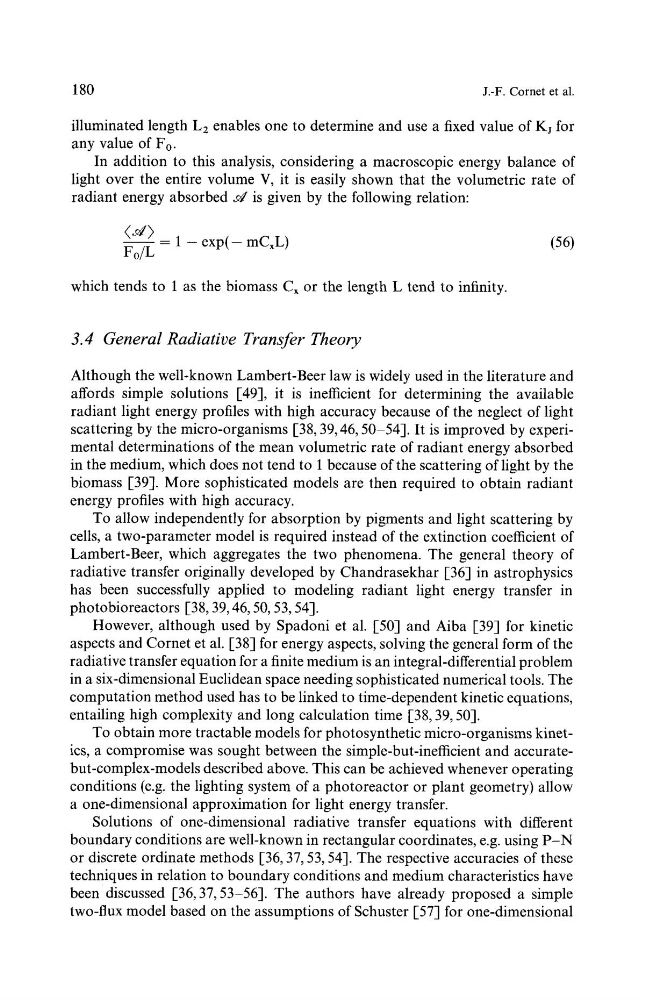
light over the entire volume V, it is easily shown that the volumetric rate of
radiant energy absorbed d is given by the following relation:
(d)
Fo/L
- 1 - exp(- mCxL)
(56)
which tends to 1 as the biomass Cx or the length L tend to infinity.
3.4 General Radiative Transfer Theory
Although the well-known Lambert-Beer law is widely used in the literature and
affords simple solutions [49], it is inefficient for determining the available
radiant light energy profiles with high accuracy because of the neglect of light
scattering by the micro-organisms [38, 39, 46, 50 54]. It is improved by experimental determinations of the mean volumetric rate of radiant energy absorbed
in the medium, which does not tend to 1 because of the scattering of light by the
biomass [39]. More sophisticated models are then required to obtain radiant
energy profiles with high accuracy.
To allow independently for absorption by pigments and light scattering by
cells, a two-parameter model is required instead of the extinction coefficient of
Lambert-Beer, which aggregates the two phenomena. The general theory of
radiative transfer originally developed by Chandrasekhar [36] in astrophysics
has been successfully applied to modeling radiant light energy transfer in
photobioreactors [38, 39, 46, 50, 53, 54].
However, although used by Spadoni et al. [50] and Aiba [-39] for kinetic
aspects and Cornet et al. [38] for energy aspects, solving the general form of the
radiative transfer equation for a finite medium is an integral-differential problem
in a six-dimensional Euclidean space needing sophisticated numerical tools. The
computation method used has to be linked to time-dependent kinetic equations,
entailing high complexity and long calculation time [38, 39, 50].
To obtain more tractable models for photosynthetic micro-organisms kinetics, a compromise was sought between the simple-but-inefficient and accuratebut-complex-models described above. This can be achieved whenever operating
conditions (e.g. the lighting system of a photoreactor or plant geometry) allow
a one-dimensional approximation for light energy transfer.
Solutions of one-dimensional radiative transfer equations with different
boundary conditions are well-known in rectangular coordinates, e.g. using P-N
or discrete ordinate methods [36, 37, 53, 54]. The respective accuracies of these
techniques in relation to boundary conditions and medium characteristics have
been discussed [36,37, 53-56]. The authors have already proposed a simple
two-flux model based on the assumptions of Schuster [57] for one-dimensional
J.-F. Cornet et al.
illuminated length Lz enables one to determine and use a fixed value of Kj for
any value of Fo.
In addition to this analysis, considering a macroscopic energy balance of
light over the entire volume V, it is easily shown that the volumetric rate of
radiant energy absorbed d is given by the following relation:
(d)
Fo/L
- 1 - exp(- mCxL)
(56)
which tends to 1 as the biomass Cx or the length L tend to infinity.
3.4 General Radiative Transfer Theory
Although the well-known Lambert-Beer law is widely used in the literature and
affords simple solutions [49], it is inefficient for determining the available
radiant light energy profiles with high accuracy because of the neglect of light
scattering by the micro-organisms [38, 39, 46, 50 54]. It is improved by experimental determinations of the mean volumetric rate of radiant energy absorbed
in the medium, which does not tend to 1 because of the scattering of light by the
biomass [39]. More sophisticated models are then required to obtain radiant
energy profiles with high accuracy.
To allow independently for absorption by pigments and light scattering by
cells, a two-parameter model is required instead of the extinction coefficient of
Lambert-Beer, which aggregates the two phenomena. The general theory of
radiative transfer originally developed by Chandrasekhar [36] in astrophysics
has been successfully applied to modeling radiant light energy transfer in
photobioreactors [38, 39, 46, 50, 53, 54].
However, although used by Spadoni et al. [50] and Aiba [-39] for kinetic
aspects and Cornet et al. [38] for energy aspects, solving the general form of the
radiative transfer equation for a finite medium is an integral-differential problem
in a six-dimensional Euclidean space needing sophisticated numerical tools. The
computation method used has to be linked to time-dependent kinetic equations,
entailing high complexity and long calculation time [38, 39, 50].
To obtain more tractable models for photosynthetic micro-organisms kinetics, a compromise was sought between the simple-but-inefficient and accuratebut-complex-models described above. This can be achieved whenever operating
conditions (e.g. the lighting system of a photoreactor or plant geometry) allow
a one-dimensional approximation for light energy transfer.
Solutions of one-dimensional radiative transfer equations with different
boundary conditions are well-known in rectangular coordinates, e.g. using P-N
or discrete ordinate methods [36, 37, 53, 54]. The respective accuracies of these
techniques in relation to boundary conditions and medium characteristics have
been discussed [36,37, 53-56]. The authors have already proposed a simple
two-flux model based on the assumptions of Schuster [57] for one-dimensional