

178
J.-F. Cornet et al.
zone in which growth takes place and a dead zone with no metabolic activity.
The working illuminated volume is defined as the volume in which growth is
exponential, the other part of the reactor being inactive. The average mass
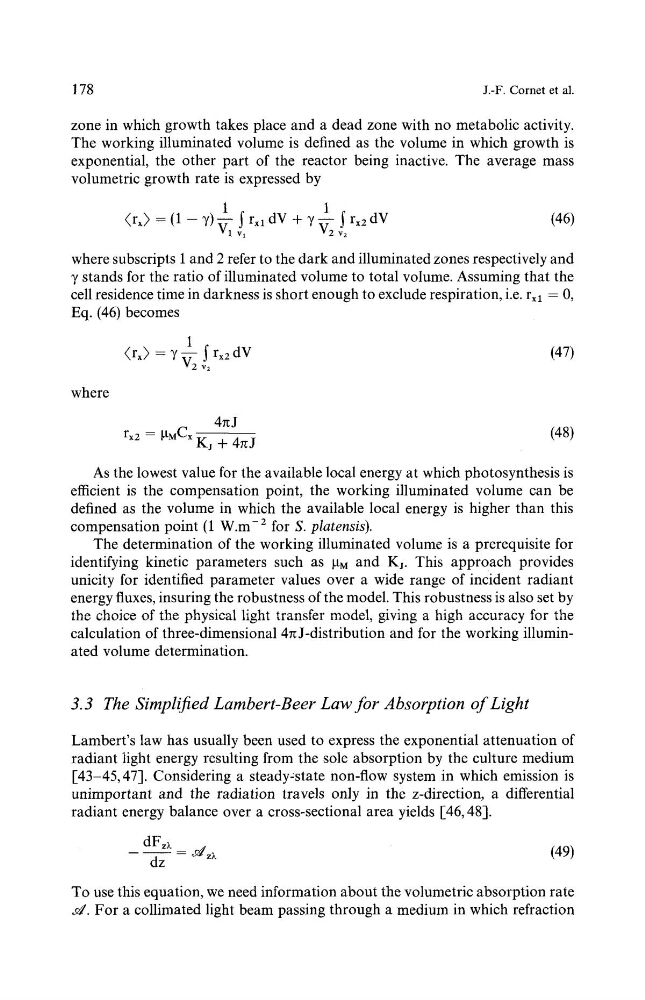
volumetric growth rate is expressed by
1
1
(rx) = (1 -- y)~-~l ~1 rxl dV +y V22 ~ rx2 dV
(46)
where subscripts 1 and 2 refer to the dark and illuminated zones respectively and
y stands for the ratio of illuminated volume to total volume. Assuming that the
cell residence time in darkness is short enough to exclude respiration, i.e. rxl = 0,
Eq. (46) becomes
1
(rx) = Y ;7-, .f rx2 dV
(47)
v2 ;2
where
4rtJ
rx2 = gMCx Kj n t- 4gJ
(48)
As the lowest value for the available local energy at which photosynthesis is
efficient is the compensation point, the working illuminated volume can be
defined as the volume in which the available local energy is higher than this
compensation point (1 W.m -2 for S. platensis).
The determination of the working illuminated volume is a prerequisite for
identifying kinetic parameters such as gM and Kj. This approach provides
unicity for identified parameter values over a wide range of incident radiant
energy fluxes, insuring the robustness of the model. This robustness is also set by
the choice of the physical light transfer model, giving a high accuracy for the
calculation of three-dimensional 4~zJ-distribution and for the working illuminated volume determination.
3.3 The Simplified Lambert-Beer Law for Absorption of Light
Lambert's law has usually been used to express the exponential attenuation of
radiant light energy resulting from the sole absorption by the culture medium
[43-45,47]. Considering a steady=state non-flow system in which emission is
unimportant and the radiation travels only in the z-direction, a differential
radiant energy balance over a cross-sectional area yields [46, 48].
dFz~
-- dz),
(49)
dz
To use this equation, we need information about the volumetric absorption rate
d. For a collimated light beam passing through a medium in which refraction
J.-F. Cornet et al.
zone in which growth takes place and a dead zone with no metabolic activity.
The working illuminated volume is defined as the volume in which growth is
exponential, the other part of the reactor being inactive. The average mass
volumetric growth rate is expressed by
1
1
(rx) = (1 -- y)~-~l ~1 rxl dV +y V22 ~ rx2 dV
(46)
where subscripts 1 and 2 refer to the dark and illuminated zones respectively and
y stands for the ratio of illuminated volume to total volume. Assuming that the
cell residence time in darkness is short enough to exclude respiration, i.e. rxl = 0,
Eq. (46) becomes
1
(rx) = Y ;7-, .f rx2 dV
(47)
v2 ;2
where
4rtJ
rx2 = gMCx Kj n t- 4gJ
(48)
As the lowest value for the available local energy at which photosynthesis is
efficient is the compensation point, the working illuminated volume can be
defined as the volume in which the available local energy is higher than this
compensation point (1 W.m -2 for S. platensis).
The determination of the working illuminated volume is a prerequisite for
identifying kinetic parameters such as gM and Kj. This approach provides
unicity for identified parameter values over a wide range of incident radiant
energy fluxes, insuring the robustness of the model. This robustness is also set by
the choice of the physical light transfer model, giving a high accuracy for the
calculation of three-dimensional 4~zJ-distribution and for the working illuminated volume determination.
3.3 The Simplified Lambert-Beer Law for Absorption of Light
Lambert's law has usually been used to express the exponential attenuation of
radiant light energy resulting from the sole absorption by the culture medium
[43-45,47]. Considering a steady=state non-flow system in which emission is
unimportant and the radiation travels only in the z-direction, a differential
radiant energy balance over a cross-sectional area yields [46, 48].
dFz~
-- dz),
(49)
dz
To use this equation, we need information about the volumetric absorption rate
d. For a collimated light beam passing through a medium in which refraction