

Kinetics and Energetics of Photosynthetic Micro-Organisms in Photobioreactors
177
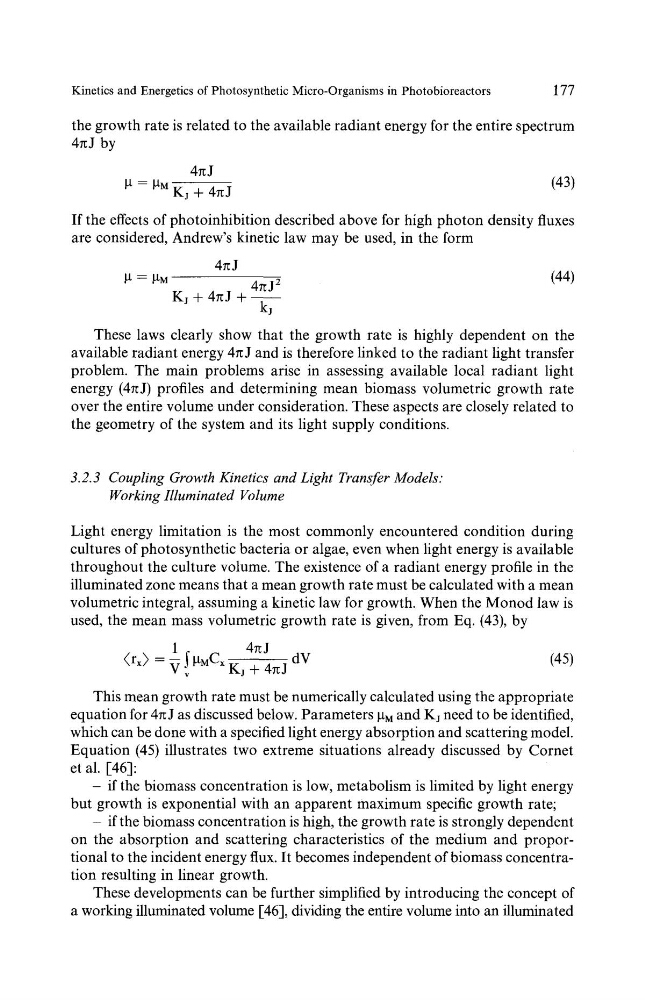
the growth rate is related to the available radiant energy for the entire spectrum
47tJ by
4rtJ
g = gM
(43)
Kj + 4rtJ
If the effects of photoinhibition described above for high photon density fluxes
are considered, Andrew's kinetic law may be used, in the form
4~tJ
g = gM
47zj2
(44)
Kj + 4~J + -
kj
These laws clearly show that the growth rate is highly dependent on the
available radiant energy 4TCJ and is therefore linked to the radiant light transfer
problem. The main problems arise in assessing available local radiant light
energy (4re J) profiles and determining mean biomass volumetric growth rate
over the entire volume under consideration. These aspects are closely related to
the geometry of the system and its light supply conditions.
3.2.3 Coupling Growth Kinetics and Light Transfer Models:
Working Illuminated Volume
Light energy limitation is the most commonly encountered condition during
cultures of photosynthetic bacteria or algae, even when light energy is available
throughout the culture volume. The existence of a radiant energy profile in the
illuminated zone means that a mean growth rate must be calculated with a mean
volumetric integral, assuming a kinetic law for growth. When the Monod law is
used, the mean mass volumetric growth rate is given, from Eq. (43), by
1
4rtJ
.
(rx) = ~ ! ~LMCx Kj + 4nJ dv
(45)
This mean growth rate must be numerically calculated using the appropriate
equation for 4r~J as discussed below. Parameters gM and Kj need to be identified,
which can be done with a specified light energy absorption and scattering model.
Equation (45) illustrates two extreme situations already discussed by Cornet
et al. [46]:
-
if the biomass concentration is low, metabolism is limited by light energy
but growth is exponential with an apparent maximum specific growth rate;
-
if the biomass concentration is high, the growth rate is strongly dependent
on the absorption and scattering characteristics of the medium and proportional to the incident energy flux. It becomes independent of biomass concentration resulting in linear growth.
These developments can be further simplified by introducing the concept of
a working illuminated volume [46], dividing the entire volume into an illuminated
177
the growth rate is related to the available radiant energy for the entire spectrum
47tJ by
4rtJ
g = gM
(43)
Kj + 4rtJ
If the effects of photoinhibition described above for high photon density fluxes
are considered, Andrew's kinetic law may be used, in the form
4~tJ
g = gM
47zj2
(44)
Kj + 4~J + -
kj
These laws clearly show that the growth rate is highly dependent on the
available radiant energy 4TCJ and is therefore linked to the radiant light transfer
problem. The main problems arise in assessing available local radiant light
energy (4re J) profiles and determining mean biomass volumetric growth rate
over the entire volume under consideration. These aspects are closely related to
the geometry of the system and its light supply conditions.
3.2.3 Coupling Growth Kinetics and Light Transfer Models:
Working Illuminated Volume
Light energy limitation is the most commonly encountered condition during
cultures of photosynthetic bacteria or algae, even when light energy is available
throughout the culture volume. The existence of a radiant energy profile in the
illuminated zone means that a mean growth rate must be calculated with a mean
volumetric integral, assuming a kinetic law for growth. When the Monod law is
used, the mean mass volumetric growth rate is given, from Eq. (43), by
1
4rtJ
.
(rx) = ~ ! ~LMCx Kj + 4nJ dv
(45)
This mean growth rate must be numerically calculated using the appropriate
equation for 4r~J as discussed below. Parameters gM and Kj need to be identified,
which can be done with a specified light energy absorption and scattering model.
Equation (45) illustrates two extreme situations already discussed by Cornet
et al. [46]:
-
if the biomass concentration is low, metabolism is limited by light energy
but growth is exponential with an apparent maximum specific growth rate;
-
if the biomass concentration is high, the growth rate is strongly dependent
on the absorption and scattering characteristics of the medium and proportional to the incident energy flux. It becomes independent of biomass concentration resulting in linear growth.
These developments can be further simplified by introducing the concept of
a working illuminated volume [46], dividing the entire volume into an illuminated