

Kinetics and Energetics of Photosynthetic Micro-Organisms in Photobioreactors
173
in the range 20-45 ~ giving a maximum activity for 36 ~
V.s
A exp(- Ah*/RT)
V~,sm~ 1 + B exp(-- Aha/RT)
Ah* = 8.30" 10 v J.kmol- 1
(37)
Ahd = 2.16" 108 J.kmo1-1
where V,s is the photosynthesis rate at temperature T and at a given radiant
light energy flux, in kmol O2.kg phycocyanins-l.h-1 and Vq, sm~ the maximum
photosynthesis rate at optimal temperature and in the same radiant light
conditions. Ah* and Ahd are respectively the activation and de-activation
enthalpies. The values calculated with Eq. (37) are in close agreement with those
obtained by Zarrouk [32] on growth rates and by Lee [33] on energy conversion yields vs temperature.
Photosynthetic saturation curves are required to relate growth rates or
photosynthetic activities to the available radiant light energy in the medium.
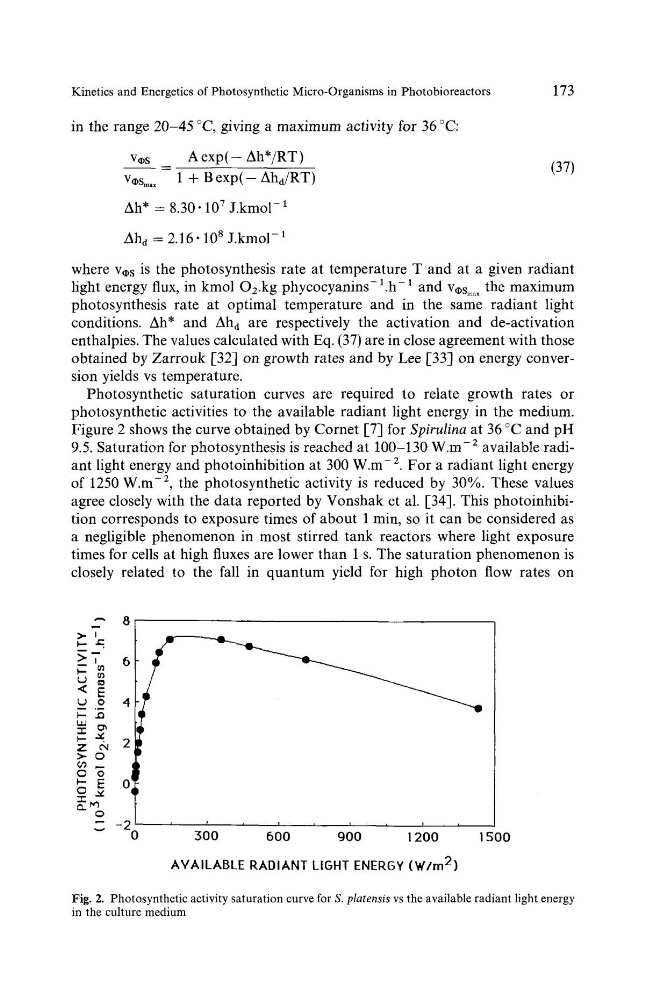
Figure 2 shows the curve obtained by Cornet [7] for Spirulina at 36 ~ and pH
9.5. Saturation for photosynthesis is reached at 100-130 W.m -2 available radiant light energy and photoinhibition at 300 W.m-z. For a radiant light energy
of 1250 W.m -2, the photosynthetic activity is reduced by 30%. These values
agree closely with the data reported by Vonshak et al. [34]. This photoinhibition corresponds to exposure times of about 1 rain, so it can be considered as
a negligible phenomenon in most stirred tank reactors where light exposure
times for cells at high fluxes are lower than 1 s. The saturation phenomenon is
closely related to the fall in quantum yield for high photon flow rates on
8
u o
4
m
,m
I-13
I.--.
,
z c~ 2
>- o
0 o
Oq
O
Z, -2
0
t
~
L
i
300
600
900
1200
ISO0
AVAILABLE RADIANT LIGHT ENERGY (~r
2)
Fig. 2. Photosynthetic activity saturation curve for S. platensis vs the available radiant light energy
in the culture medium
173
in the range 20-45 ~ giving a maximum activity for 36 ~
V.s
A exp(- Ah*/RT)
V~,sm~ 1 + B exp(-- Aha/RT)
Ah* = 8.30" 10 v J.kmol- 1
(37)
Ahd = 2.16" 108 J.kmo1-1
where V,s is the photosynthesis rate at temperature T and at a given radiant
light energy flux, in kmol O2.kg phycocyanins-l.h-1 and Vq, sm~ the maximum
photosynthesis rate at optimal temperature and in the same radiant light
conditions. Ah* and Ahd are respectively the activation and de-activation
enthalpies. The values calculated with Eq. (37) are in close agreement with those
obtained by Zarrouk [32] on growth rates and by Lee [33] on energy conversion yields vs temperature.
Photosynthetic saturation curves are required to relate growth rates or
photosynthetic activities to the available radiant light energy in the medium.
Figure 2 shows the curve obtained by Cornet [7] for Spirulina at 36 ~ and pH
9.5. Saturation for photosynthesis is reached at 100-130 W.m -2 available radiant light energy and photoinhibition at 300 W.m-z. For a radiant light energy
of 1250 W.m -2, the photosynthetic activity is reduced by 30%. These values
agree closely with the data reported by Vonshak et al. [34]. This photoinhibition corresponds to exposure times of about 1 rain, so it can be considered as
a negligible phenomenon in most stirred tank reactors where light exposure
times for cells at high fluxes are lower than 1 s. The saturation phenomenon is
closely related to the fall in quantum yield for high photon flow rates on
8
u o
4
m
,m
I-13
I.--.
,
z c~ 2
>- o
0 o
Oq
O
Z, -2
0
t
~
L
i
300
600
900
1200
ISO0
AVAILABLE RADIANT LIGHT ENERGY (~r
2)
Fig. 2. Photosynthetic activity saturation curve for S. platensis vs the available radiant light energy
in the culture medium