

172
J.-F. Cornet et al.
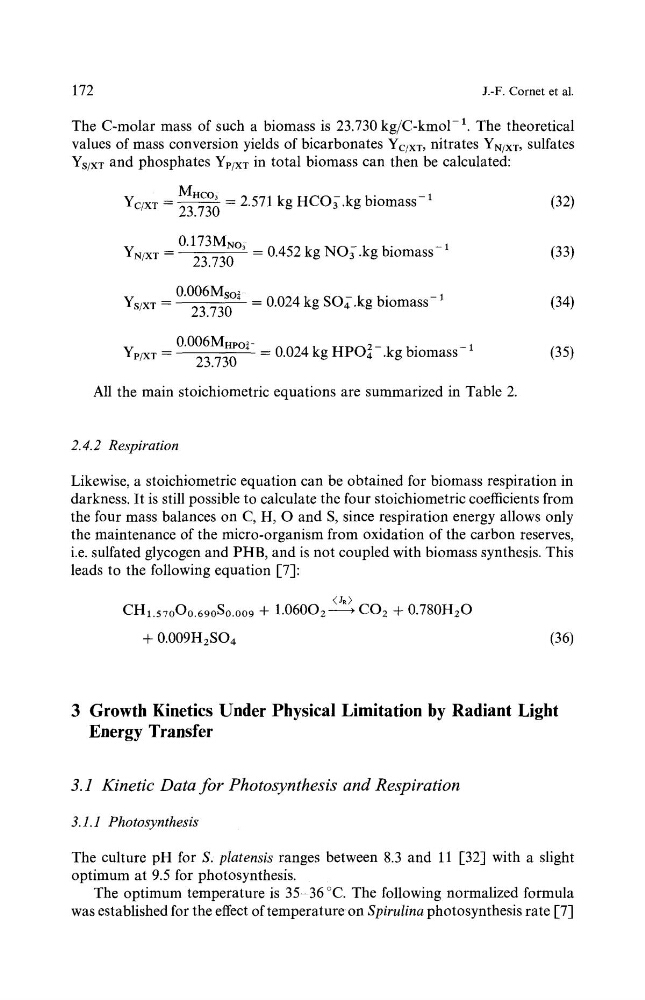
The C-molar mass of such a biomass is 23.730 kg/C-kmol- x. The theoretical
values of mass conversion yields of bicarbonates Yc/xv, nitrates YN/xT, sulfates
Ys/xT and phosphates YWxT in total biomass can then be calculated:
MRco; _ 2.571 kg HCO3.kg biomass- 1
(32)
Yc/xT 23.730
0.173MNo~
1
Yy/xx -
23.730 - 0.452kg NO3.kgbiomass(33)
0.006Msol
Ys/xr -
23.730 - 0.024 kg SO2.kg biomass-1
(34)
0.006MHpo,~YP/xx -
23.730
- 0.024 kg HPO]-.kg biomass- 1
(35)
All the main stoichiometric equations are summarized in Table 2.
2.4.2 Respiration
Likewise, a stoichiometric equation can be obtained for biomass respiration in
darkness. It is still possible to calculate the four stoichiometric coefficients from
the four mass balances on C, H, O and S, since respiration energy allows only
the maintenance of the micro-organism from oxidation of the carbon reserves,
i.e. sulfated glycogen and PHB, and is not coupled with biomass synthesis. This
leads to the following equation [7]:
CH1.5700o.69o80.o09 a t- 1.060Oa
+ 0.009H2804
(J")) CO 2 -~- 0.780H20
(36)
3 Growth Kinetics Under Physical Limitation by Radiant Light
Energy Transfer
3.1 Kinetic Data for Photosynthesis and Respiration
3.1.1 Photosynthesis
The culture pH for S. platensis ranges between 8.3 and 11 [-32] with a slight
optimum at 9.5 for photosynthesis.
The optimum temperature is 35-36 ~ The following normalized formula
was established for the effect of temperature on Spirulina photosynthesis rate [-7]
J.-F. Cornet et al.
The C-molar mass of such a biomass is 23.730 kg/C-kmol- x. The theoretical
values of mass conversion yields of bicarbonates Yc/xv, nitrates YN/xT, sulfates
Ys/xT and phosphates YWxT in total biomass can then be calculated:
MRco; _ 2.571 kg HCO3.kg biomass- 1
(32)
Yc/xT 23.730
0.173MNo~
1
Yy/xx -
23.730 - 0.452kg NO3.kgbiomass(33)
0.006Msol
Ys/xr -
23.730 - 0.024 kg SO2.kg biomass-1
(34)
0.006MHpo,~YP/xx -
23.730
- 0.024 kg HPO]-.kg biomass- 1
(35)
All the main stoichiometric equations are summarized in Table 2.
2.4.2 Respiration
Likewise, a stoichiometric equation can be obtained for biomass respiration in
darkness. It is still possible to calculate the four stoichiometric coefficients from
the four mass balances on C, H, O and S, since respiration energy allows only
the maintenance of the micro-organism from oxidation of the carbon reserves,
i.e. sulfated glycogen and PHB, and is not coupled with biomass synthesis. This
leads to the following equation [7]:
CH1.5700o.69o80.o09 a t- 1.060Oa
+ 0.009H2804
(J")) CO 2 -~- 0.780H20
(36)
3 Growth Kinetics Under Physical Limitation by Radiant Light
Energy Transfer
3.1 Kinetic Data for Photosynthesis and Respiration
3.1.1 Photosynthesis
The culture pH for S. platensis ranges between 8.3 and 11 [-32] with a slight
optimum at 9.5 for photosynthesis.
The optimum temperature is 35-36 ~ The following normalized formula
was established for the effect of temperature on Spirulina photosynthesis rate [-7]