

174
J.-F. Cornet et al.
photosystems, impairing thermodynamic photosynthetic efficiency. The photoinhibition is related to damage to reaction centre P680 or to a polypeptide D1 in
photosystem II.
The maximum photosynthetic rate obtained for S. platensis is 7.1- 10-3 kmol
Oz.kg biomass - ~.h- 1, which corresponds to 0.05 kmol O2.kg phycocyanins - 1.h - 1.
3.1.2 Respiration
The respiration rates in cyanobacteria have been found to be 10 to 50 times
lower than photosynthesis rates [35], respiration corresponding to a loss in
total cell mass for maintenance of micro-organisms. Also, it must be noted that
the time necessary to start respiration when the cells change over from light to
dark is about 1 rain [7]. This is most important to know as respiration in
photobioreactors can be neglected if the residence time of cells in darkness is
short enough.
The effect of temperature on the respiration rate for S. platensis has been
investigated and the following formula established in the range 20-45 ~ [7]:
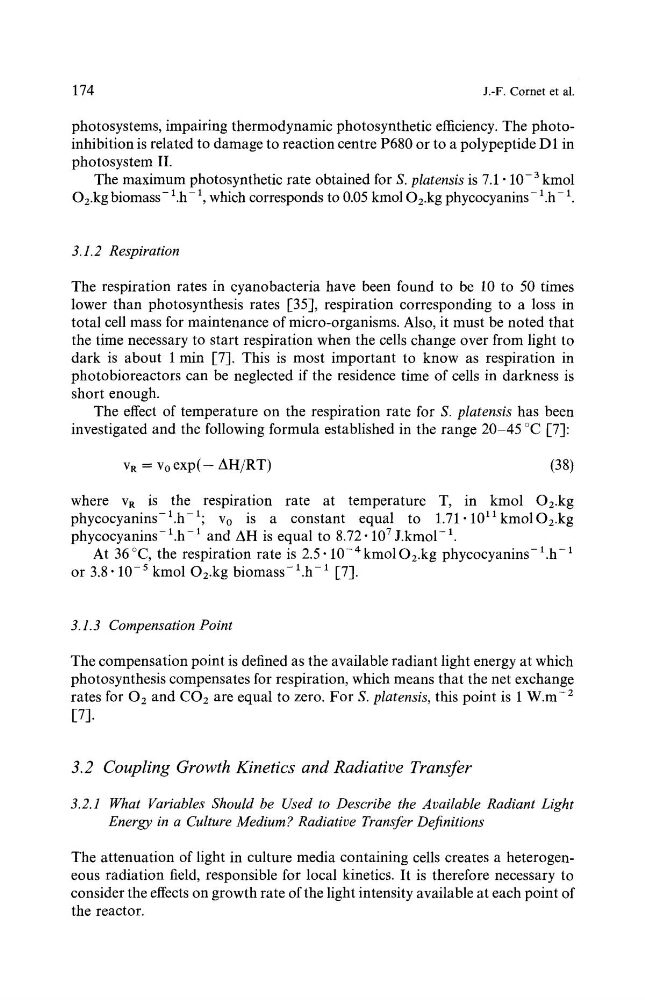
VR = V0 exp(-- AH/RT)
(38)
where VR is the respiration rate at temperature T, in kmol Oz.kg
phycocyanins-l.h-t; Vo is a constant equal to 1.71.10~lkmolOz.kg
phycocyanins-1.h-1 and AH is equal to 8.72.10 7 J.kmol-1.
At 36 ~ the respiration rate is 2.5.10-4kmol O2.kg phycocyanins-1.hor 3.8" 10-5 kmol O/.kg biomass-1.h-1 [7].
3.1.3 Compensation Point
The compensation point is defined as the available radiant light energy at which
photosynthesis compensates for respiration, which means that the net exchange
rates for 02 and CO2 are equal to zero. For S. platensis, this point is 1 W.m -2
E7].
3.2 Coupling Growth Kinetics and Radiative Transfer
3.2.1 What Variables Should be Used to Describe the Available Radiant Light
Energy in a Culture Medium? Radiative Transfer Definitions
The attenuation of light in culture media containing cells creates a heterogeneous radiation field, responsible for local kinetics. It is therefore necessary to
consider the effects on growth rate of the light intensity available at each point of
the reactor.
J.-F. Cornet et al.
photosystems, impairing thermodynamic photosynthetic efficiency. The photoinhibition is related to damage to reaction centre P680 or to a polypeptide D1 in
photosystem II.
The maximum photosynthetic rate obtained for S. platensis is 7.1- 10-3 kmol
Oz.kg biomass - ~.h- 1, which corresponds to 0.05 kmol O2.kg phycocyanins - 1.h - 1.
3.1.2 Respiration
The respiration rates in cyanobacteria have been found to be 10 to 50 times
lower than photosynthesis rates [35], respiration corresponding to a loss in
total cell mass for maintenance of micro-organisms. Also, it must be noted that
the time necessary to start respiration when the cells change over from light to
dark is about 1 rain [7]. This is most important to know as respiration in
photobioreactors can be neglected if the residence time of cells in darkness is
short enough.
The effect of temperature on the respiration rate for S. platensis has been
investigated and the following formula established in the range 20-45 ~ [7]:
VR = V0 exp(-- AH/RT)
(38)
where VR is the respiration rate at temperature T, in kmol Oz.kg
phycocyanins-l.h-t; Vo is a constant equal to 1.71.10~lkmolOz.kg
phycocyanins-1.h-1 and AH is equal to 8.72.10 7 J.kmol-1.
At 36 ~ the respiration rate is 2.5.10-4kmol O2.kg phycocyanins-1.hor 3.8" 10-5 kmol O/.kg biomass-1.h-1 [7].
3.1.3 Compensation Point
The compensation point is defined as the available radiant light energy at which
photosynthesis compensates for respiration, which means that the net exchange
rates for 02 and CO2 are equal to zero. For S. platensis, this point is 1 W.m -2
E7].
3.2 Coupling Growth Kinetics and Radiative Transfer
3.2.1 What Variables Should be Used to Describe the Available Radiant Light
Energy in a Culture Medium? Radiative Transfer Definitions
The attenuation of light in culture media containing cells creates a heterogeneous radiation field, responsible for local kinetics. It is therefore necessary to
consider the effects on growth rate of the light intensity available at each point of
the reactor.