

data by the electroosmotic flow model [137] was found useful in resolving two
paradoxes:
1. The direction of migration of drops is the opposite of that predicted by colloid electrokinetics.
2. The phase demixing rate increased irrespective of the sign of the applied
electric field.
In the case of normal polarity the field supplements the buoyant rise or fall
velocities of the phase drops thereby enhancing phase demixing rate over that
in the absence of a field. Interestingly, in reverse polarity, though the field works
against the buoyancy of the phase drops, it assists their growth in the dispersion
zone until buoyancy takes over causing faster phase demixing. As the buoyant
velocity of a drop is proportional to the square of its diameter while the
electrophoretic velocity is proportional to its diameter, the demixing rate is
faster in reverse polarity than in normal polarity.
3.3
Multistage Method
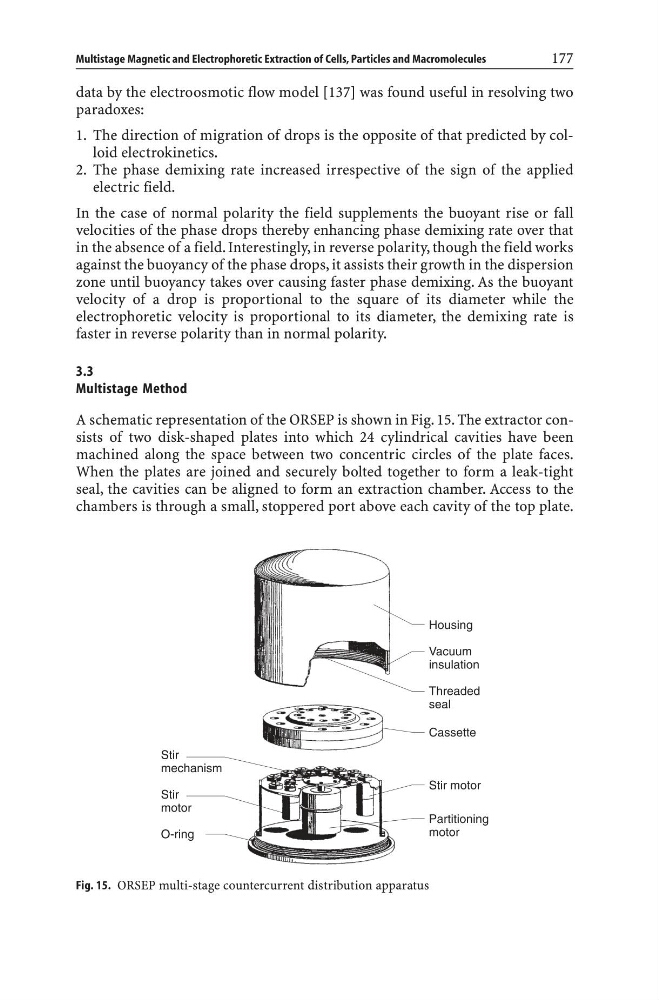
A schematic representation of the ORSEP is shown in Fig. 15. The extractor consists of two disk-shaped plates into which 24 cylindrical cavities have been
machined along the space between two concentric circles of the plate faces.
When the plates are joined and securely bolted together to form a leak-tight
seal, the cavities can be aligned to form an extraction chamber. Access to the
chambers is through a small, stoppered port above each cavity of the top plate.
Multistage Magnetic and Electrophoretic Extraction of Cells, Particles and Macromolecules
177
Fig. 15. ORSEP multi-stage countercurrent distribution apparatus
paradoxes:
1. The direction of migration of drops is the opposite of that predicted by colloid electrokinetics.
2. The phase demixing rate increased irrespective of the sign of the applied
electric field.
In the case of normal polarity the field supplements the buoyant rise or fall
velocities of the phase drops thereby enhancing phase demixing rate over that
in the absence of a field. Interestingly, in reverse polarity, though the field works
against the buoyancy of the phase drops, it assists their growth in the dispersion
zone until buoyancy takes over causing faster phase demixing. As the buoyant
velocity of a drop is proportional to the square of its diameter while the
electrophoretic velocity is proportional to its diameter, the demixing rate is
faster in reverse polarity than in normal polarity.
3.3
Multistage Method
A schematic representation of the ORSEP is shown in Fig. 15. The extractor consists of two disk-shaped plates into which 24 cylindrical cavities have been
machined along the space between two concentric circles of the plate faces.
When the plates are joined and securely bolted together to form a leak-tight
seal, the cavities can be aligned to form an extraction chamber. Access to the
chambers is through a small, stoppered port above each cavity of the top plate.
Multistage Magnetic and Electrophoretic Extraction of Cells, Particles and Macromolecules
177
Fig. 15. ORSEP multi-stage countercurrent distribution apparatus