

applied electric field [141–143]. It is therefore possible to control demixing
rates by application of an electric field to ATPS emulsions of appropriate
ionic composition. Brooks and Bamberger [136] initially demonstrated enhanced emulsion clearing on a 1-ml scale. They demonstrated qualitatively, by
monitoring the system turbidity in a 1-ml chamber, that electrophoretic
mobility of the phase droplets enhances the phase demixing.
The effects of the electric field strength, phosphate ion concentration, temperature, field polarity, and phase composition on the demixing rate of PEG/DX
system were evaluated quantitatively. It was found that an optimum field
strength of around 25 Vm –1 exists at which the demixing is most rapid. In an
optimized system this causes a twofold decrease in demixing time relative to
that at zero field using normal polarity and a sixfold decrease in demixing time
relative to that at zero field in the case of reverse polarity (electric field opposing gravitational settling). Normal polarity refers to anode at the top of the
column and reverse polarity refers to anode at the bottom. Paradoxically, both
normal and reverse polarity fields increased the demixing rate [91, 92].
Brooks and coworkers [136, 141] measured drop electrophoretic mobilities
in ATPSs. They were surprised to discover that the sign of the droplet mobilities
was opposite to that predicted from the phosphate partition and the Donnan
potential. They also found mobility to be directly proportional to drop radius,
which is a contradiction of standard colloid electrokinetic theory [144]. Levine
[140] and Brooks et al. [141] hypothesized that a dipole potential at the phase
boundary oriented in a way that reverses the potential gradient locally is
responsible for the paradox of the sign of electrophoretic mobilities of ATPS
droplets.
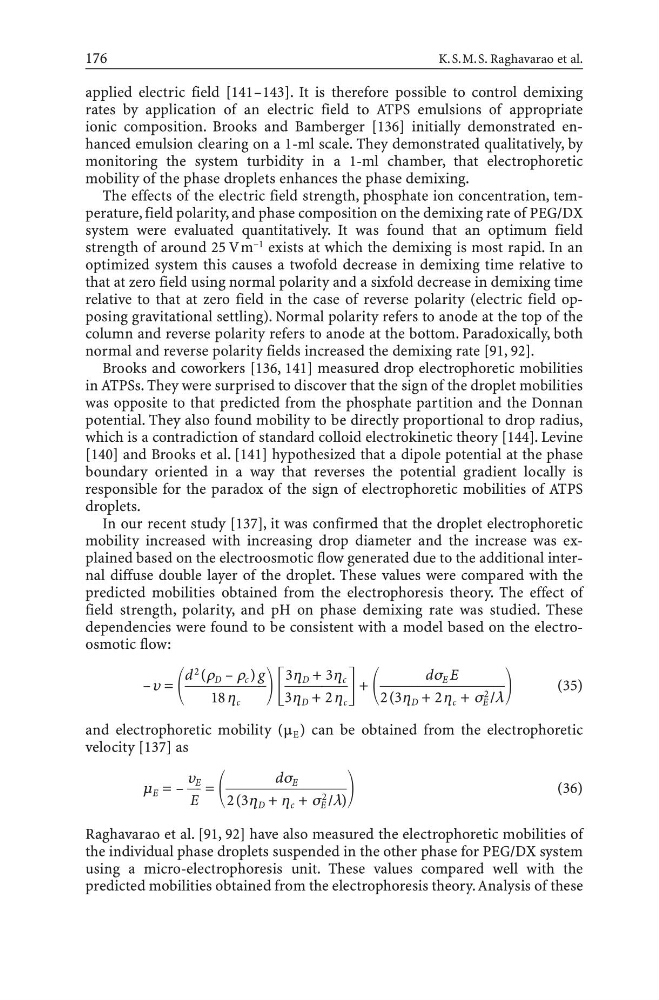
In our recent study [137], it was confirmed that the droplet electrophoretic
mobility increased with increasing drop diameter and the increase was explained based on the electroosmotic flow generated due to the additional internal diffuse double layer of the droplet. These values were compared with the
predicted mobilities obtained from the electrophoresis theory. The effect of
field strength, polarity, and pH on phase demixing rate was studied. These
dependencies were found to be consistent with a model based on the electroosmotic flow:
d
2 (Ç D – Ç c ) g 3h D + 3h c
ds E E
–u = 002 ΄ 07 ΅ + 0003 (35)
18h c
3h D + 2h c
2(3h D + 2h c + s E
2 /l
and electrophoretic mobility (m E ) can be obtained from the electrophoretic
velocity [137] as
u E
ds E
m E = – 31 = 0002
(36)
E
2(3h D + h c + s E
2 /l)
Raghavarao et al. [91, 92] have also measured the electrophoretic mobilities of
the individual phase droplets suspended in the other phase for PEG/DX system
using a micro-electrophoresis unit. These values compared well with the
predicted mobilities obtained from the electrophoresis theory. Analysis of these
176
K.S.M.S. Raghavarao et al.
rates by application of an electric field to ATPS emulsions of appropriate
ionic composition. Brooks and Bamberger [136] initially demonstrated enhanced emulsion clearing on a 1-ml scale. They demonstrated qualitatively, by
monitoring the system turbidity in a 1-ml chamber, that electrophoretic
mobility of the phase droplets enhances the phase demixing.
The effects of the electric field strength, phosphate ion concentration, temperature, field polarity, and phase composition on the demixing rate of PEG/DX
system were evaluated quantitatively. It was found that an optimum field
strength of around 25 Vm –1 exists at which the demixing is most rapid. In an
optimized system this causes a twofold decrease in demixing time relative to
that at zero field using normal polarity and a sixfold decrease in demixing time
relative to that at zero field in the case of reverse polarity (electric field opposing gravitational settling). Normal polarity refers to anode at the top of the
column and reverse polarity refers to anode at the bottom. Paradoxically, both
normal and reverse polarity fields increased the demixing rate [91, 92].
Brooks and coworkers [136, 141] measured drop electrophoretic mobilities
in ATPSs. They were surprised to discover that the sign of the droplet mobilities
was opposite to that predicted from the phosphate partition and the Donnan
potential. They also found mobility to be directly proportional to drop radius,
which is a contradiction of standard colloid electrokinetic theory [144]. Levine
[140] and Brooks et al. [141] hypothesized that a dipole potential at the phase
boundary oriented in a way that reverses the potential gradient locally is
responsible for the paradox of the sign of electrophoretic mobilities of ATPS
droplets.
In our recent study [137], it was confirmed that the droplet electrophoretic
mobility increased with increasing drop diameter and the increase was explained based on the electroosmotic flow generated due to the additional internal diffuse double layer of the droplet. These values were compared with the
predicted mobilities obtained from the electrophoresis theory. The effect of
field strength, polarity, and pH on phase demixing rate was studied. These
dependencies were found to be consistent with a model based on the electroosmotic flow:
d
2 (Ç D – Ç c ) g 3h D + 3h c
ds E E
–u = 002 ΄ 07 ΅ + 0003 (35)
18h c
3h D + 2h c
2(3h D + 2h c + s E
2 /l
and electrophoretic mobility (m E ) can be obtained from the electrophoretic
velocity [137] as
u E
ds E
m E = – 31 = 0002
(36)
E
2(3h D + h c + s E
2 /l)
Raghavarao et al. [91, 92] have also measured the electrophoretic mobilities of
the individual phase droplets suspended in the other phase for PEG/DX system
using a micro-electrophoresis unit. These values compared well with the
predicted mobilities obtained from the electrophoresis theory. Analysis of these
176
K.S.M.S. Raghavarao et al.