

In order to exploit surface tension driven phase separation, the top cover
plate is fabricated from a hydrophobic plastic (e.g., Plexiglas, Lexan, etc.) while
the bottom plate is machined from stainless steel. The entire unit is mounted to
a base consisting of 24 miniature stirbar drivers, which are intended to provide
adequate mixing by means of a stirbar installed in each chamber.
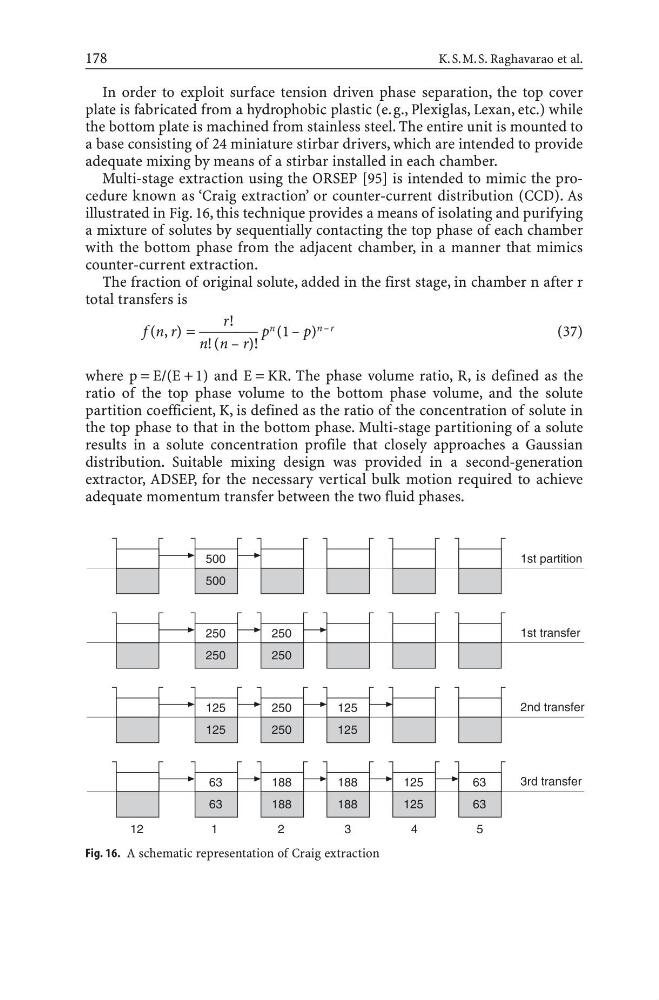
Multi-stage extraction using the ORSEP [95] is intended to mimic the procedure known as ‘Craig extraction’ or counter-current distribution (CCD). As
illustrated in Fig. 16, this technique provides a means of isolating and purifying
a mixture of solutes by sequentially contacting the top phase of each chamber
with the bottom phase from the adjacent chamber, in a manner that mimics
counter-current extraction.
The fraction of original solute, added in the first stage, in chamber n after r
total transfers is
r!
f (n, r) = 06 p n (1 – p) n – r
(37)
n! (n – r)!
where p = E/(E + 1) and E = KR. The phase volume ratio, R, is defined as the
ratio of the top phase volume to the bottom phase volume, and the solute
partition coefficient, K, is defined as the ratio of the concentration of solute in
the top phase to that in the bottom phase. Multi-stage partitioning of a solute
results in a solute concentration profile that closely approaches a Gaussian
distribution. Suitable mixing design was provided in a second-generation
extractor, ADSEP, for the necessary vertical bulk motion required to achieve
adequate momentum transfer between the two fluid phases.
178
K.S.M.S. Raghavarao et al.
Fig. 16. A schematic representation of Craig extraction
plate is fabricated from a hydrophobic plastic (e.g., Plexiglas, Lexan, etc.) while
the bottom plate is machined from stainless steel. The entire unit is mounted to
a base consisting of 24 miniature stirbar drivers, which are intended to provide
adequate mixing by means of a stirbar installed in each chamber.
Multi-stage extraction using the ORSEP [95] is intended to mimic the procedure known as ‘Craig extraction’ or counter-current distribution (CCD). As
illustrated in Fig. 16, this technique provides a means of isolating and purifying
a mixture of solutes by sequentially contacting the top phase of each chamber
with the bottom phase from the adjacent chamber, in a manner that mimics
counter-current extraction.
The fraction of original solute, added in the first stage, in chamber n after r
total transfers is
r!
f (n, r) = 06 p n (1 – p) n – r
(37)
n! (n – r)!
where p = E/(E + 1) and E = KR. The phase volume ratio, R, is defined as the
ratio of the top phase volume to the bottom phase volume, and the solute
partition coefficient, K, is defined as the ratio of the concentration of solute in
the top phase to that in the bottom phase. Multi-stage partitioning of a solute
results in a solute concentration profile that closely approaches a Gaussian
distribution. Suitable mixing design was provided in a second-generation
extractor, ADSEP, for the necessary vertical bulk motion required to achieve
adequate momentum transfer between the two fluid phases.
178
K.S.M.S. Raghavarao et al.
Fig. 16. A schematic representation of Craig extraction