

good agreement with the reported values. For instance, the average value for
fixed blood cells that we observed is 2.0 ¥ 10 –4 m 2 V –1 s –1 with the reported value
at similar buffering ion concentration being 2.1 ¥ 10 –4 m 2 V –1 s –1 .
2.2.3
Theory and Mathematical Models
In an electrophoretic counter current distribution (ECCD) apparatus, the
separation of bioparticles having different electrophoretic mobilities is
achieved by contacting the buffer solutions of top chambers with bottom
chambers containing the bioparticles in buffer or fermentation broth, and then
applying an electric field (E) at regular, predetermined intervals. The combination of electrophoresis and CCD involves the evaluation of the resulting
novel instrument in terms of Joule heating, electric field development, and its
ability to transfer particles. Modeling studies were undertaken in these areas,
and these were followed by experimental studies [72].
2.2.3.1
Mass Transfer
Electrophoretic extraction of cells is a rate process (not an equilibrium process)
and the particles having higher electrophoretic mobility are separated ahead of
those having relatively lower mobility. An ECCD apparatus has ‘n’ extraction
stages. Let us consider a situation in which all particles of electrophoretic
mobility m E are initially in one (first) bottom chamber.
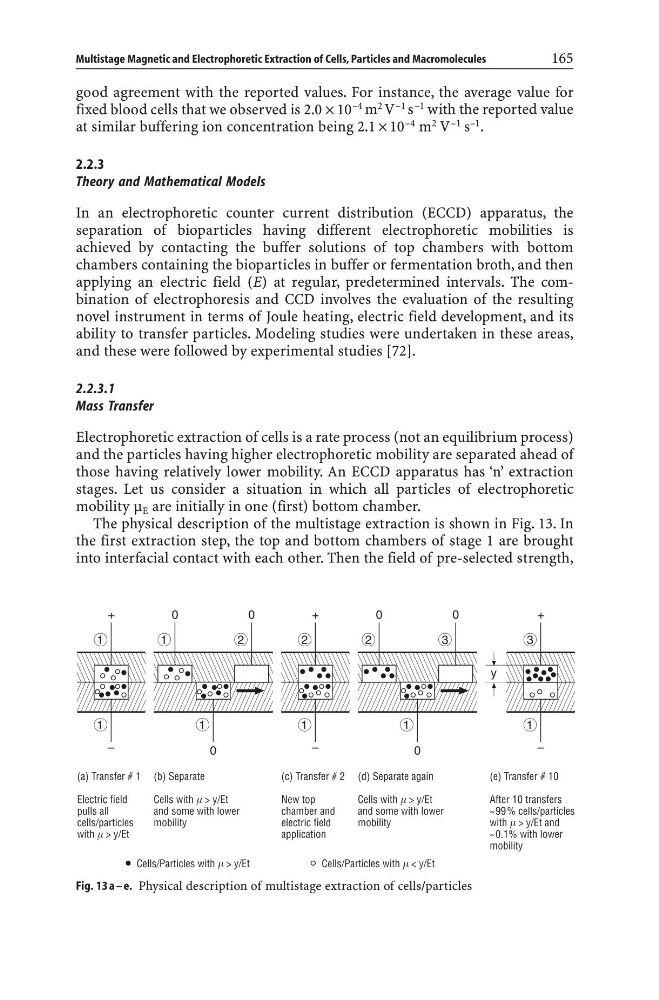
The physical description of the multistage extraction is shown in Fig. 13. In
the first extraction step, the top and bottom chambers of stage 1 are brought
into interfacial contact with each other. Then the field of pre-selected strength,
Multistage Magnetic and Electrophoretic Extraction of Cells, Particles and Macromolecules
165
Fig. 13 a – e. Physical description of multistage extraction of cells/particles
fixed blood cells that we observed is 2.0 ¥ 10 –4 m 2 V –1 s –1 with the reported value
at similar buffering ion concentration being 2.1 ¥ 10 –4 m 2 V –1 s –1 .
2.2.3
Theory and Mathematical Models
In an electrophoretic counter current distribution (ECCD) apparatus, the
separation of bioparticles having different electrophoretic mobilities is
achieved by contacting the buffer solutions of top chambers with bottom
chambers containing the bioparticles in buffer or fermentation broth, and then
applying an electric field (E) at regular, predetermined intervals. The combination of electrophoresis and CCD involves the evaluation of the resulting
novel instrument in terms of Joule heating, electric field development, and its
ability to transfer particles. Modeling studies were undertaken in these areas,
and these were followed by experimental studies [72].
2.2.3.1
Mass Transfer
Electrophoretic extraction of cells is a rate process (not an equilibrium process)
and the particles having higher electrophoretic mobility are separated ahead of
those having relatively lower mobility. An ECCD apparatus has ‘n’ extraction
stages. Let us consider a situation in which all particles of electrophoretic
mobility m E are initially in one (first) bottom chamber.
The physical description of the multistage extraction is shown in Fig. 13. In
the first extraction step, the top and bottom chambers of stage 1 are brought
into interfacial contact with each other. Then the field of pre-selected strength,
Multistage Magnetic and Electrophoretic Extraction of Cells, Particles and Macromolecules
165
Fig. 13 a – e. Physical description of multistage extraction of cells/particles