

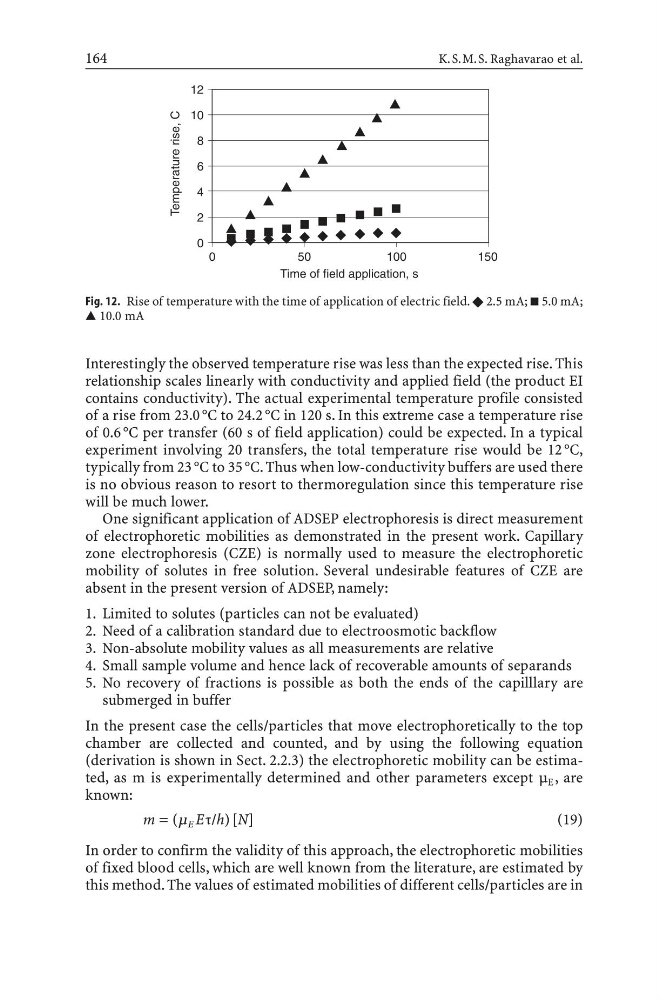
Interestingly the observed temperature rise was less than the expected rise. This
relationship scales linearly with conductivity and applied field (the product EI
contains conductivity). The actual experimental temperature profile consisted
of a rise from 23.0 °C to 24.2 °C in 120 s. In this extreme case a temperature rise
of 0.6 °C per transfer (60 s of field application) could be expected. In a typical
experiment involving 20 transfers, the total temperature rise would be 12 °C,
typically from 23 °C to 35 °C. Thus when low-conductivity buffers are used there
is no obvious reason to resort to thermoregulation since this temperature rise
will be much lower.
One significant application of ADSEP electrophoresis is direct measurement
of electrophoretic mobilities as demonstrated in the present work. Capillary
zone electrophoresis (CZE) is normally used to measure the electrophoretic
mobility of solutes in free solution. Several undesirable features of CZE are
absent in the present version of ADSEP, namely:
1. Limited to solutes (particles can not be evaluated)
2. Need of a calibration standard due to electroosmotic backflow
3. Non-absolute mobility values as all measurements are relative
4. Small sample volume and hence lack of recoverable amounts of separands
5. No recovery of fractions is possible as both the ends of the capilllary are
submerged in buffer
In the present case the cells/particles that move electrophoretically to the top
chamber are collected and counted, and by using the following equation
(derivation is shown in Sect. 2.2.3) the electrophoretic mobility can be estimated, as m is experimentally determined and other parameters except m E , are
known:
m = (m E Et/h) [N]
(19)
In order to confirm the validity of this approach, the electrophoretic mobilities
of fixed blood cells, which are well known from the literature, are estimated by
this method. The values of estimated mobilities of different cells/particles are in
164
K.S.M.S. Raghavarao et al.
Fig. 12. Rise of temperature with the time of application of electric field. v 2.5 mA; 5.0 mA;
̆ 10.0 mA
relationship scales linearly with conductivity and applied field (the product EI
contains conductivity). The actual experimental temperature profile consisted
of a rise from 23.0 °C to 24.2 °C in 120 s. In this extreme case a temperature rise
of 0.6 °C per transfer (60 s of field application) could be expected. In a typical
experiment involving 20 transfers, the total temperature rise would be 12 °C,
typically from 23 °C to 35 °C. Thus when low-conductivity buffers are used there
is no obvious reason to resort to thermoregulation since this temperature rise
will be much lower.
One significant application of ADSEP electrophoresis is direct measurement
of electrophoretic mobilities as demonstrated in the present work. Capillary
zone electrophoresis (CZE) is normally used to measure the electrophoretic
mobility of solutes in free solution. Several undesirable features of CZE are
absent in the present version of ADSEP, namely:
1. Limited to solutes (particles can not be evaluated)
2. Need of a calibration standard due to electroosmotic backflow
3. Non-absolute mobility values as all measurements are relative
4. Small sample volume and hence lack of recoverable amounts of separands
5. No recovery of fractions is possible as both the ends of the capilllary are
submerged in buffer
In the present case the cells/particles that move electrophoretically to the top
chamber are collected and counted, and by using the following equation
(derivation is shown in Sect. 2.2.3) the electrophoretic mobility can be estimated, as m is experimentally determined and other parameters except m E , are
known:
m = (m E Et/h) [N]
(19)
In order to confirm the validity of this approach, the electrophoretic mobilities
of fixed blood cells, which are well known from the literature, are estimated by
this method. The values of estimated mobilities of different cells/particles are in
164
K.S.M.S. Raghavarao et al.
Fig. 12. Rise of temperature with the time of application of electric field. v 2.5 mA; 5.0 mA;
̆ 10.0 mA