

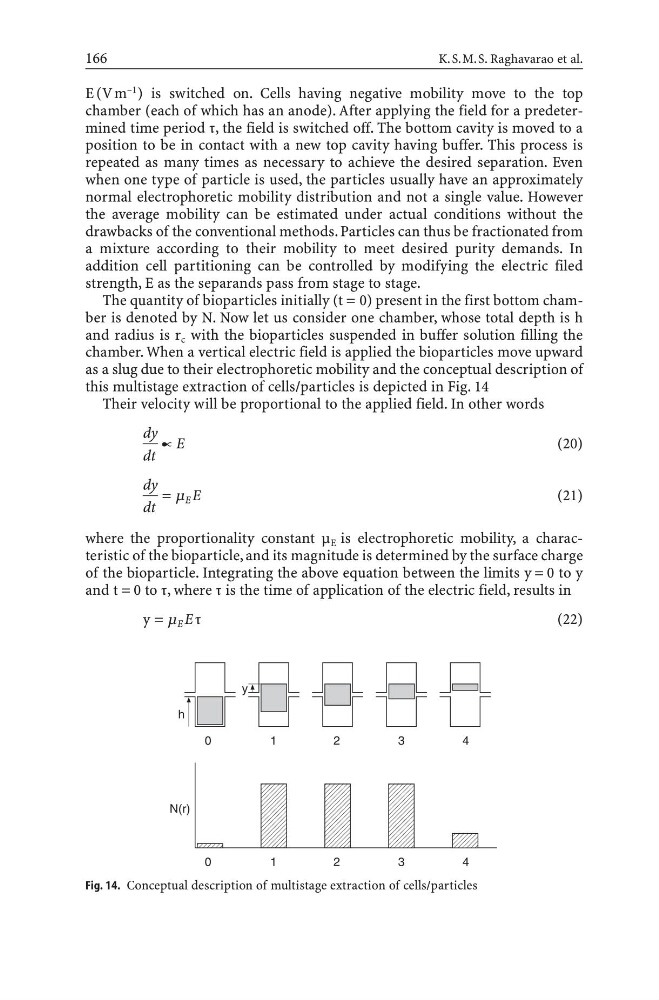
E (Vm –1 ) is switched on. Cells having negative mobility move to the top
chamber (each of which has an anode). After applying the field for a predetermined time period t, the field is switched off. The bottom cavity is moved to a
position to be in contact with a new top cavity having buffer. This process is
repeated as many times as necessary to achieve the desired separation. Even
when one type of particle is used, the particles usually have an approximately
normal electrophoretic mobility distribution and not a single value. However
the average mobility can be estimated under actual conditions without the
drawbacks of the conventional methods. Particles can thus be fractionated from
a mixture according to their mobility to meet desired purity demands. In
addition cell partitioning can be controlled by modifying the electric filed
strength, E as the separands pass from stage to stage.
The quantity of bioparticles initially (t = 0) present in the first bottom chamber is denoted by N. Now let us consider one chamber, whose total depth is h
and radius is r c with the bioparticles suspended in buffer solution filling the
chamber. When a vertical electric field is applied the bioparticles move upward
as a slug due to their electrophoretic mobility and the conceptual description of
this multistage extraction of cells/particles is depicted in Fig. 14
Their velocity will be proportional to the applied field. In other words
dy
4 µ E
(20)
dt
dy
4 = m E E
(21)
dt
where the proportionality constant m E is electrophoretic mobility, a characteristic of the bioparticle, and its magnitude is determined by the surface charge
of the bioparticle. Integrating the above equation between the limits y = 0 to y
and t = 0 to t, where t is the time of application of the electric field, results in
y = m E E t
(22)
166
K.S.M.S. Raghavarao et al.
Fig. 14. Conceptual description of multistage extraction of cells/particles
chamber (each of which has an anode). After applying the field for a predetermined time period t, the field is switched off. The bottom cavity is moved to a
position to be in contact with a new top cavity having buffer. This process is
repeated as many times as necessary to achieve the desired separation. Even
when one type of particle is used, the particles usually have an approximately
normal electrophoretic mobility distribution and not a single value. However
the average mobility can be estimated under actual conditions without the
drawbacks of the conventional methods. Particles can thus be fractionated from
a mixture according to their mobility to meet desired purity demands. In
addition cell partitioning can be controlled by modifying the electric filed
strength, E as the separands pass from stage to stage.
The quantity of bioparticles initially (t = 0) present in the first bottom chamber is denoted by N. Now let us consider one chamber, whose total depth is h
and radius is r c with the bioparticles suspended in buffer solution filling the
chamber. When a vertical electric field is applied the bioparticles move upward
as a slug due to their electrophoretic mobility and the conceptual description of
this multistage extraction of cells/particles is depicted in Fig. 14
Their velocity will be proportional to the applied field. In other words
dy
4 µ E
(20)
dt
dy
4 = m E E
(21)
dt
where the proportionality constant m E is electrophoretic mobility, a characteristic of the bioparticle, and its magnitude is determined by the surface charge
of the bioparticle. Integrating the above equation between the limits y = 0 to y
and t = 0 to t, where t is the time of application of the electric field, results in
y = m E E t
(22)
166
K.S.M.S. Raghavarao et al.
Fig. 14. Conceptual description of multistage extraction of cells/particles