

Overproduction, Purification and Structural Studies
279
Concerning the diffusion apparent in the purified protein (Fig. 2004), which
could be attributed to degradation, the results of the amino-terminal sequencing
showed that the protein is intact, at least at the amino-terminal region. Therefore,
if degradation exists, it should be limited very close to the carboxy-terminal
region. An alternate explanation for the diffusion might be the anomalous behaviour of highly charged polypeptides.
An interesting remark is that pure S14 protein, analysed on SDS-PAGE without
previous heating of the samples, exhibited several bands (Fig. 20.5, Lane 1). One
possible explanation is the formation of intramolecular disulphide bridges after
the removal of Zn from some TthS 14 molecules during purification. Indeed, after
addition of ~-mercaptoethanol and heating (at 90 °C-I00 °C for 3-5 mins), only
one band appears at the expected molecular mass of 7008 Da (Fig. 20.5, Lane 2).
5
Structural Studies
5.1
Limited Proteolysis Experiments
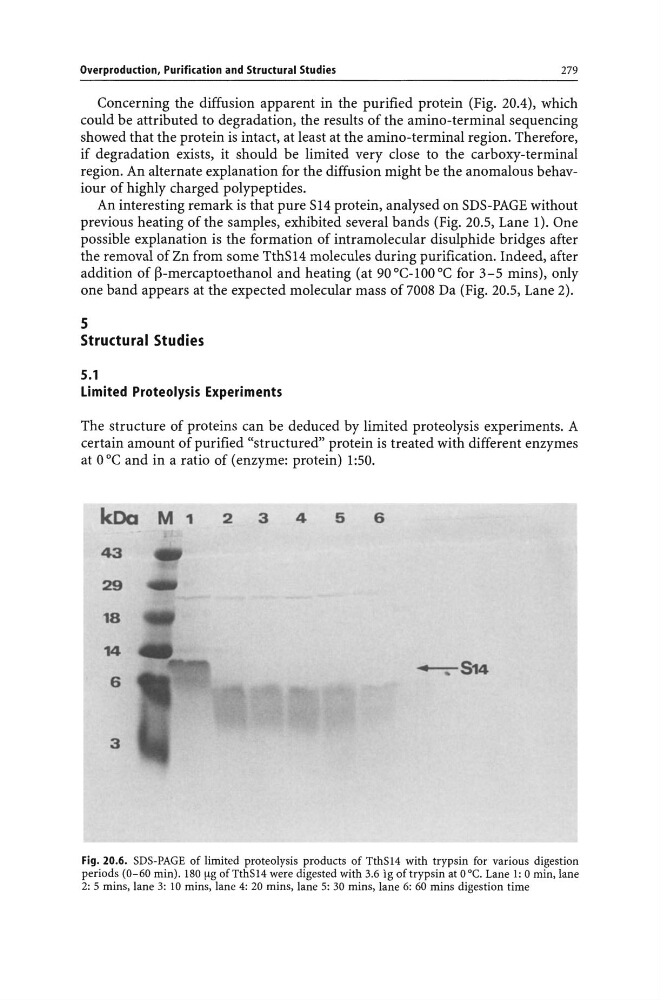
The structure of proteins can be deduced by limited proteolysis experiments. A
certain amount of purified "structured" protein is treated with different enzymes
at O°C and in a ratio of (enzyme: protein) 1:50.
koa M 1 2 3 4 5 6
43
29
18
14
--514
6
3
Fig. 20.6. SDS-PAGE of limited proteolysis products of TthS14 with trypsin for various digestion
periods (0-60 min). 180 !1g of TthS14 were digested with 3.6 19 of trypsin at DOC. Lane 1: 0 min, lane
2: 5 mins, lane 3: 10 mins, lane 4: 20 mins, lane 5: 30 mins, lane 6: 60 mins digestion time
279
Concerning the diffusion apparent in the purified protein (Fig. 2004), which
could be attributed to degradation, the results of the amino-terminal sequencing
showed that the protein is intact, at least at the amino-terminal region. Therefore,
if degradation exists, it should be limited very close to the carboxy-terminal
region. An alternate explanation for the diffusion might be the anomalous behaviour of highly charged polypeptides.
An interesting remark is that pure S14 protein, analysed on SDS-PAGE without
previous heating of the samples, exhibited several bands (Fig. 20.5, Lane 1). One
possible explanation is the formation of intramolecular disulphide bridges after
the removal of Zn from some TthS 14 molecules during purification. Indeed, after
addition of ~-mercaptoethanol and heating (at 90 °C-I00 °C for 3-5 mins), only
one band appears at the expected molecular mass of 7008 Da (Fig. 20.5, Lane 2).
5
Structural Studies
5.1
Limited Proteolysis Experiments
The structure of proteins can be deduced by limited proteolysis experiments. A
certain amount of purified "structured" protein is treated with different enzymes
at O°C and in a ratio of (enzyme: protein) 1:50.
koa M 1 2 3 4 5 6
43
29
18
14
--514
6
3
Fig. 20.6. SDS-PAGE of limited proteolysis products of TthS14 with trypsin for various digestion
periods (0-60 min). 180 !1g of TthS14 were digested with 3.6 19 of trypsin at DOC. Lane 1: 0 min, lane
2: 5 mins, lane 3: 10 mins, lane 4: 20 mins, lane 5: 30 mins, lane 6: 60 mins digestion time