

280
koa M 1
-~
43
29
18
14
6
3
P. TSIBOLI et al.
2
3
4
5
6
---514
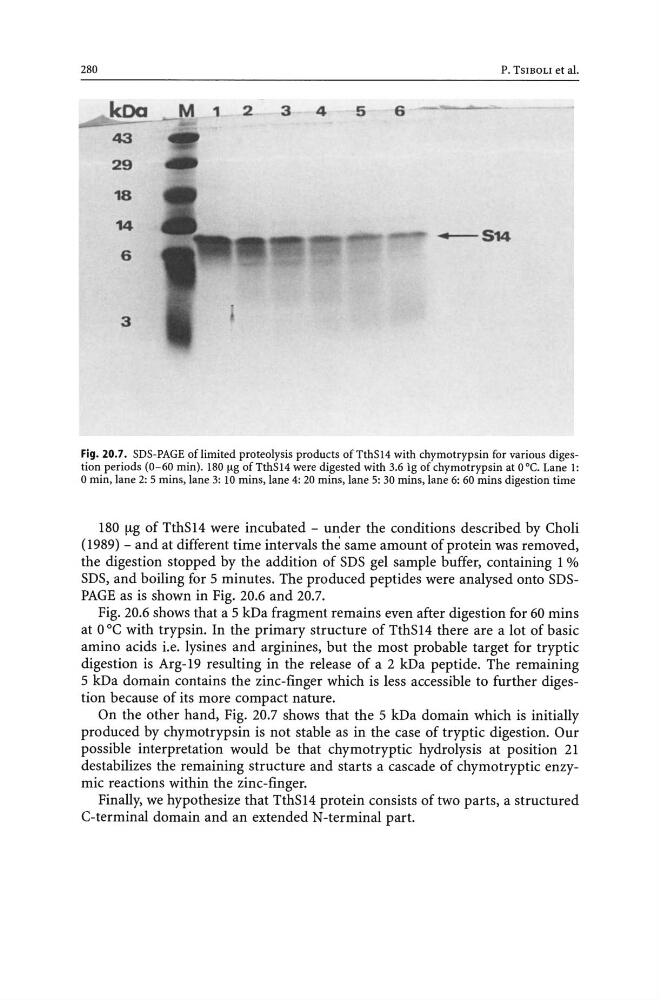
Fig. 20.7. SOS-PAGE of limited proteolysis products of TthS14 with chymotrypsin for various digestion periods (0-60 min). 180 ~g of TthS14 were digested with 3.6 ig of chymotrypsin at O°C. Lane 1:
o min, lane 2: 5 mins, lane 3: 10 mins, lane 4: 20 mins, lane 5: 30 mins, lane 6: 60 mins digestion time
180 !-tg of TthS14 were incubated - under the conditions described by Choli
(1989) - and at different time intervals the same amount of protein was removed,
the digestion stopped by the addition of SDS gel sample buffer, containing 1 %
SDS, and boiling for 5 minutes. The produced peptides were analysed onto SDSPAGE as is shown in Fig. 20.6 and 20.7.
Fig. 20.6 shows that a 5 kDa fragment remains even after digestion for 60 mins
at O°C with trypsin. In the primary structure of TthS14 there are a lot of basic
amino acids i.e. lysines and arginines, but the most probable target for tryptic
digestion is Arg-19 resulting in the release of a 2 kDa peptide. The remaining
5 kDa domain contains the zinc-finger which is less accessible to further digestion because of its more compact nature.
On the other hand, Fig. 20.7 shows that the 5 kDa domain which is initially
produced by chymotrypsin is not stable as in the case of tryptic digestion. Our
possible interpretation would be that chymotryptic hydrolysis at position 21
destabilizes the remaining structure and starts a cascade of chymotryptic enzymic reactions within the zinc-finger.
Finally, we hypothesize that TthS14 protein consists of two parts, a structured
C-terminal domain and an extended N-terminal part.
koa M 1
-~
43
29
18
14
6
3
P. TSIBOLI et al.
2
3
4
5
6
---514
Fig. 20.7. SOS-PAGE of limited proteolysis products of TthS14 with chymotrypsin for various digestion periods (0-60 min). 180 ~g of TthS14 were digested with 3.6 ig of chymotrypsin at O°C. Lane 1:
o min, lane 2: 5 mins, lane 3: 10 mins, lane 4: 20 mins, lane 5: 30 mins, lane 6: 60 mins digestion time
180 !-tg of TthS14 were incubated - under the conditions described by Choli
(1989) - and at different time intervals the same amount of protein was removed,
the digestion stopped by the addition of SDS gel sample buffer, containing 1 %
SDS, and boiling for 5 minutes. The produced peptides were analysed onto SDSPAGE as is shown in Fig. 20.6 and 20.7.
Fig. 20.6 shows that a 5 kDa fragment remains even after digestion for 60 mins
at O°C with trypsin. In the primary structure of TthS14 there are a lot of basic
amino acids i.e. lysines and arginines, but the most probable target for tryptic
digestion is Arg-19 resulting in the release of a 2 kDa peptide. The remaining
5 kDa domain contains the zinc-finger which is less accessible to further digestion because of its more compact nature.
On the other hand, Fig. 20.7 shows that the 5 kDa domain which is initially
produced by chymotrypsin is not stable as in the case of tryptic digestion. Our
possible interpretation would be that chymotryptic hydrolysis at position 21
destabilizes the remaining structure and starts a cascade of chymotryptic enzymic reactions within the zinc-finger.
Finally, we hypothesize that TthS14 protein consists of two parts, a structured
C-terminal domain and an extended N-terminal part.