

Structure, Dynamics and Function of the Proton Pump Bacteriorhodopsin
227
BR5! BR*
0.5 ps
5 ps
8ms
~N
1 fls
3 ms
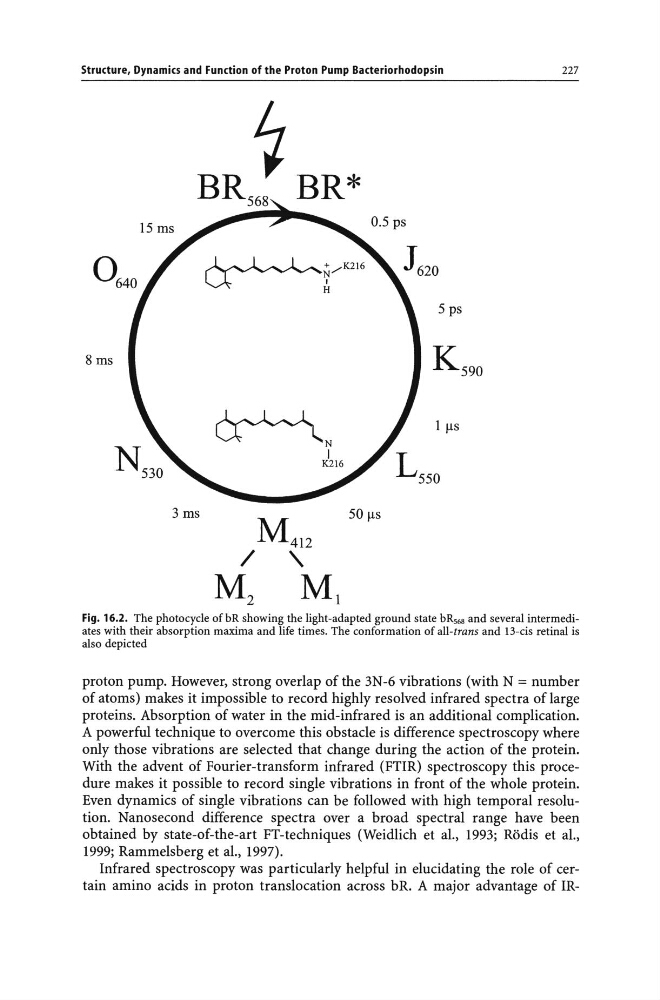
Fig. 16.2. The photo cycle ofbR showing the light-adapted ground state bR568 and several intermediates with their absorption maxima and life times. The conformation of all-trans and 13-cis retinal is
also depicted
proton pump. However, strong overlap of the 3N-6 vibrations (with N = number
of atoms) makes it impossible to record highly resolved infrared spectra oflarge
proteins. Absorption of water in the mid-infrared is an additional complication.
A powerful technique to overcome this obstacle is difference spectroscopy where
only those vibrations are selected that change during the action of the protein.
With the advent of Fourier-transform infrared (FTIR) spectroscopy this procedure makes it possible to record single vibrations in front of the whole protein.
Even dynamics of single vibrations can be followed with high temporal resolution. Nanosecond difference spectra over a broad spectral range have been
obtained by state-of-the-art FT-techniques (Weidlich et al., 1993; Rodis et aI.,
1999; Rammelsberg et aI., 1997).
Infrared spectroscopy was particularly helpful in elucidating the role of certain amino acids in proton translocation across bR. A major advantage of IR-
227
BR5! BR*
0.5 ps
5 ps
8ms
~N
1 fls
3 ms
Fig. 16.2. The photo cycle ofbR showing the light-adapted ground state bR568 and several intermediates with their absorption maxima and life times. The conformation of all-trans and 13-cis retinal is
also depicted
proton pump. However, strong overlap of the 3N-6 vibrations (with N = number
of atoms) makes it impossible to record highly resolved infrared spectra oflarge
proteins. Absorption of water in the mid-infrared is an additional complication.
A powerful technique to overcome this obstacle is difference spectroscopy where
only those vibrations are selected that change during the action of the protein.
With the advent of Fourier-transform infrared (FTIR) spectroscopy this procedure makes it possible to record single vibrations in front of the whole protein.
Even dynamics of single vibrations can be followed with high temporal resolution. Nanosecond difference spectra over a broad spectral range have been
obtained by state-of-the-art FT-techniques (Weidlich et al., 1993; Rodis et aI.,
1999; Rammelsberg et aI., 1997).
Infrared spectroscopy was particularly helpful in elucidating the role of certain amino acids in proton translocation across bR. A major advantage of IR-