

A New Method for the Isolation of the (-Terminal Peptide of Proteins
183
Upon reaching this point, however it is clear that this methodology is not compatible with the Edman sequencing because the C-terminal peptide is obtained as
an N-terminal blocked species. In 1969, Butler et al. reported that the f amino
group of lysine residues in polypeptide chains could be reversibly blocked when
maleic anhydride is used. Since the chemical nature of the f amino group of
lysine and the amino terminal group of peptides are very close, in similar conditions, the maleyl group at the amino terminal group of the C-terminal peptide
should be also released. By this procedure, this strategy could be compatible with
the automatic sequencing.
0.00
S oan a • . ,
A
I~n
B
)~~
. uu
s • ..., ," ;i:!:
0.00
S oon a l
.
~ C
0.00
.:,. • • :
'11-, .. 1
,
ct:: NnT . c nM " ~,, 27 - J.99A :r.:n: =::iR
- A -
30 00
L
r;:CSIJC.CAf"t
M uy - ;;':'/
~~~o
.L:): 4 G
n
::IO.DD
C:C$ u"fn .C RM
" 00., 20 - .I.9 SOfl 1 ' : 3 1. - .. -
90 . 00
3
2
.. ltlL.0 \J.
L
l!l.! PA ~:s;;r.:. L..:I'
1.:)90
1.3; 3 4
Mal- E-O-L-I-A-Y -L-K*-K*-A-T -N-E
C>
<0
z
u
r
u
' "
o
N
o
• <0
' 0
.,
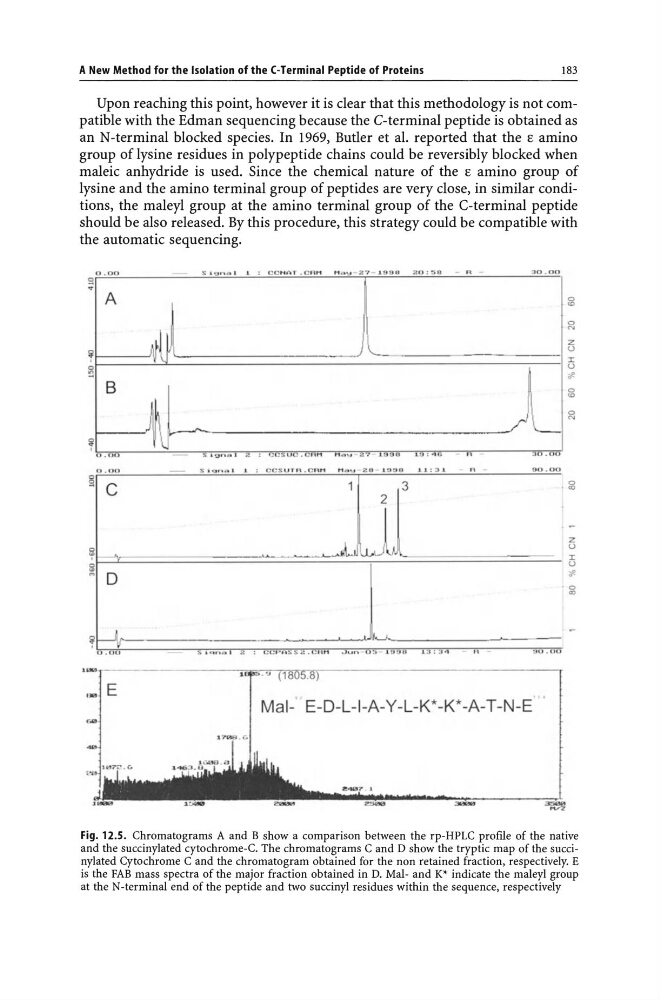
Fig. 12.5. Chromatograms A and B show a comparison between the rp-HPLC profIle of the native
and the succinylated cytochrome-Co The chromatograms C and D show the tryptic map of the succinylated Cytochrome C and the chromatogram obtained for the non retained fraction, respectively. E
is the FAB mass spectra of the major fraction obtained in D. Mal- and K* indicate the maleyl group
at the N -terminal end of the peptide and two succinyl residues within the sequence, respectively
183
Upon reaching this point, however it is clear that this methodology is not compatible with the Edman sequencing because the C-terminal peptide is obtained as
an N-terminal blocked species. In 1969, Butler et al. reported that the f amino
group of lysine residues in polypeptide chains could be reversibly blocked when
maleic anhydride is used. Since the chemical nature of the f amino group of
lysine and the amino terminal group of peptides are very close, in similar conditions, the maleyl group at the amino terminal group of the C-terminal peptide
should be also released. By this procedure, this strategy could be compatible with
the automatic sequencing.
0.00
S oan a • . ,
A
I~n
B
)~~
. uu
s • ..., ," ;i:!:
0.00
S oon a l
.
~ C
0.00
.:,. • • :
'11-, .. 1
,
ct:: NnT . c nM " ~,, 27 - J.99A :r.:n: =::iR
- A -
30 00
L
r;:CSIJC.CAf"t
M uy - ;;':'/
~~~o
.L:): 4 G
n
::IO.DD
C:C$ u"fn .C RM
" 00., 20 - .I.9 SOfl 1 ' : 3 1. - .. -
90 . 00
3
2
.. ltlL.0 \J.
L
l!l.! PA ~:s;;r.:. L..:I'
1.:)90
1.3; 3 4
Mal- E-O-L-I-A-Y -L-K*-K*-A-T -N-E
C>
<0
z
u
r
u
' "
o
N
o
• <0
' 0
.,
Fig. 12.5. Chromatograms A and B show a comparison between the rp-HPLC profIle of the native
and the succinylated cytochrome-Co The chromatograms C and D show the tryptic map of the succinylated Cytochrome C and the chromatogram obtained for the non retained fraction, respectively. E
is the FAB mass spectra of the major fraction obtained in D. Mal- and K* indicate the maleyl group
at the N -terminal end of the peptide and two succinyl residues within the sequence, respectively