

182
L. J. GONZALEZ et al.
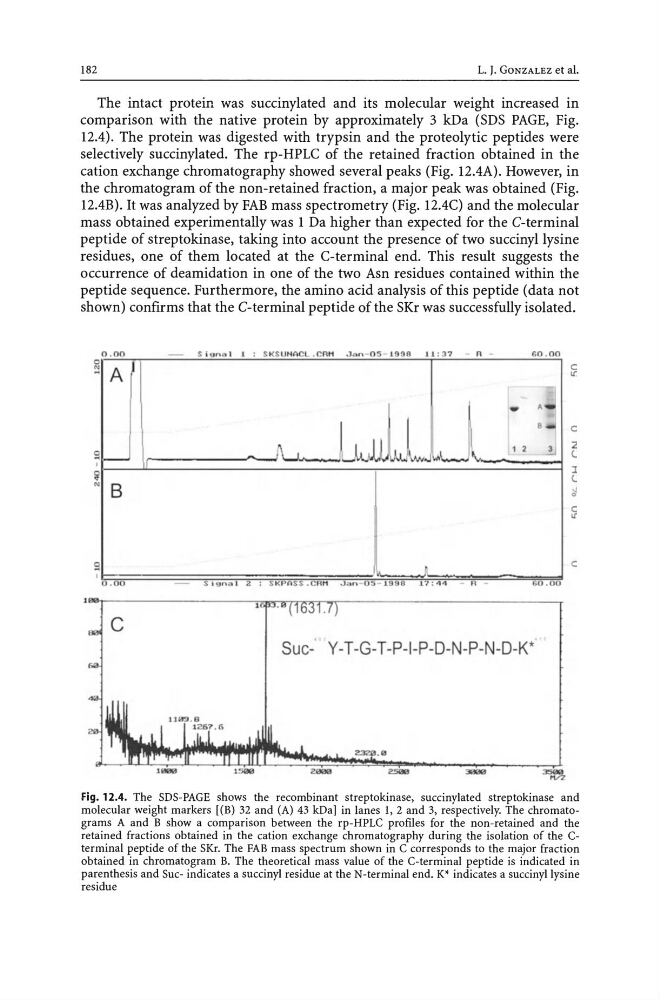
The intact protein was succinylated and its molecular weight increased in
comparison with the native protein by approximately 3 kDa (SDS PAGE, Fig.
12.4). The protein was digested with trypsin and the proteolytic peptides were
selectively succinylated. The rp-HPLC of the retained fraction obtained in the
cation exchange chromatography showed several peaks (Fig. 12.4A). However, in
the chromatogram of the non-retained fraction, a major peak was obtained (Fig.
12.4B). It was analyzed by FAB mass spectrometry (Fig. 12.4C) and the molecular
mass obtained experimentally was 1 Da higher than expected for the C-terminal
peptide of streptokinase, taking into account the presence of two succinyllysine
residues, one of them located at the C-terminal end. This result suggests the
occurrence of deamidation in one of the two Asn residues contained within the
peptide sequence. Furthermore, the amino acid analysis of this peptide (data not
shown) confirms that the C-terminal peptide of the SKr was successfully isolated.
o
' "
...
~
I
S
I
0 . 00
-
A'
-
f
B
0 . 00
$ ignO)t l : S KS UHACI_ .CRH
Jan - 0 5 - 1998
11 : 37
- R -
60.00
-
A . .
~lll_~,
B ...
1 2
.2J
~
- -
S lgn a l Z .
S KPA SS.C AM
JO)n O~ 1998
17 . 44
- A -
GO.OO
Suc-' Y -T -G-T -P-I-P-D-N-P-N-D-K*
. 0
c
2
l
J
l
c
I(
c
Fig. 12.4. The SDS-PAGE shows the recombinant streptokinase, succinylated streptokinase and
molecular weight markers [(B) 32 and (A) 43 kDal in lanes 1,2 and 3, respectively. The chromatograms A and B show a comparison between the rp-HPLC profiles for the non-retained and the
retained fractions obtained in the cation exchange chromatography during the isolation of the Cterminal peptide of the SKr. The FAB mass spectrum shown in C corresponds to the major fraction
obtained in chromatogram B. The theoretical mass value of the C-terminal peptide is indicated in
parenthesis and Suc- indicates a succinyl residue at the N -terminal end. K* indicates a succinyllysine
residue
L. J. GONZALEZ et al.
The intact protein was succinylated and its molecular weight increased in
comparison with the native protein by approximately 3 kDa (SDS PAGE, Fig.
12.4). The protein was digested with trypsin and the proteolytic peptides were
selectively succinylated. The rp-HPLC of the retained fraction obtained in the
cation exchange chromatography showed several peaks (Fig. 12.4A). However, in
the chromatogram of the non-retained fraction, a major peak was obtained (Fig.
12.4B). It was analyzed by FAB mass spectrometry (Fig. 12.4C) and the molecular
mass obtained experimentally was 1 Da higher than expected for the C-terminal
peptide of streptokinase, taking into account the presence of two succinyllysine
residues, one of them located at the C-terminal end. This result suggests the
occurrence of deamidation in one of the two Asn residues contained within the
peptide sequence. Furthermore, the amino acid analysis of this peptide (data not
shown) confirms that the C-terminal peptide of the SKr was successfully isolated.
o
' "
...
~
I
S
I
0 . 00
-
A'
-
f
B
0 . 00
$ ignO)t l : S KS UHACI_ .CRH
Jan - 0 5 - 1998
11 : 37
- R -
60.00
-
A . .
~lll_~,
B ...
1 2
.2J
~
- -
S lgn a l Z .
S KPA SS.C AM
JO)n O~ 1998
17 . 44
- A -
GO.OO
Suc-' Y -T -G-T -P-I-P-D-N-P-N-D-K*
. 0
c
2
l
J
l
c
I(
c
Fig. 12.4. The SDS-PAGE shows the recombinant streptokinase, succinylated streptokinase and
molecular weight markers [(B) 32 and (A) 43 kDal in lanes 1,2 and 3, respectively. The chromatograms A and B show a comparison between the rp-HPLC profiles for the non-retained and the
retained fractions obtained in the cation exchange chromatography during the isolation of the Cterminal peptide of the SKr. The FAB mass spectrum shown in C corresponds to the major fraction
obtained in chromatogram B. The theoretical mass value of the C-terminal peptide is indicated in
parenthesis and Suc- indicates a succinyl residue at the N -terminal end. K* indicates a succinyllysine
residue