

Elucidation of Functionally Significant Structural Modifications
133
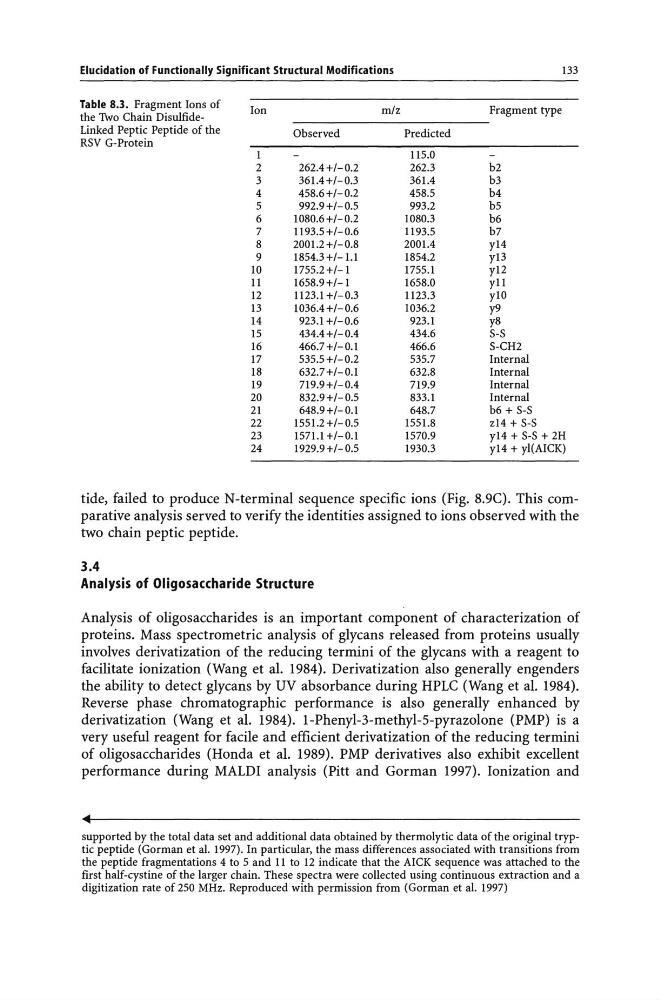
Table 8.3. Fragment Ions of
Ion
mlz
Fragment type
the Two Chain DisulfideLinked Peptic Peptide of the
Observed
Predicted
RSV G-Protein
1
115.0
2
262.4+/-0.2
262.3
b2
3
361.4+/-0.3
361.4
b3
4
458.6+/-0.2
458.5
b4
5
992.9+/-0.5
993.2
b5
6
1080.6+/-0.2
1080.3
b6
7
1193.5+/-0.6
1193.5
b7
8
2001.2+/-0.8
2001.4
y14
9
1854.3 +/-1.1
1854.2
y13
10
1755.2+/-1
1755.1
y12
11
1658.9+/-1
1658.0
y11
12
1123.1+/-0.3
1123.3
ylO
13
1036.4+/-0.6
1036.2
y9
14
923.1 +/- 0.6
923.1
y8
15
434.4+/-0.4
434.6
S-S
16
466.7+/-0.1
466.6
S-CH2
17
535.5+/-0.2
535.7
Internal
18
632.7 +/-0.1
632.8
Internal
19
719.9 +/- 0.4
719.9
Internal
20
832.9+/-0.5
833.1
Internal
21
648.9+/-0.1
648.7
b6 + S-S
22
1551.2+/-0.5
1551.8
z14 + S-S
23
1571.1 +/-0.1
1570.9
y14 + S-S + 2H
24
1929.9+/-0.5
1930.3
y14 + yl(AICK)
tide, failed to produce N-terminal sequence specific ions (Fig. 8.9C). This comparative analysis served to verify the identities assigned to ions observed with the
two chain peptic peptide.
3.4
Analysis of Oligosaccharide Structure
Analysis of oligosaccharides is an important component of characterization of
proteins. Mass spectrometric analysis of glycans released from proteins usually
involves derivatization of the reducing termini of the glycans with a reagent to
facilitate ionization (Wang et al. 1984). Derivatization also generally engenders
the ability to detect glycans by UV absorbance during HPLC (Wang et al. 1984).
Reverse phase chromatographic performance is also generally enhanced by
derivatization (Wang et al. 1984). 1-Phenyl-3-methyl-S-pyrazolone (PMP) is a
very useful reagent for facile and efficient derivatization of the reducing termini
of oligo saccharides (Honda et al. 1989). PMP derivatives also exhibit excellent
performance during MALDI analysis (Pitt and Gorman 1997). Ionization and
supported by the total data set and additional data obtained by thermolytic data of the original tryptic peptide (Gorman et al. 1997). In particular, the mass differences associated with transitions from
the peptide fragmentations 4 to 5 and 11 to 12 indicate that the AICK sequence was attached to the
first half-cystine of the larger chain. These spectra were collected using continuous extraction and a
digitization rate of 250 MHz. Reproduced with permission from (Gorman et al. 1997)
133
Table 8.3. Fragment Ions of
Ion
mlz
Fragment type
the Two Chain DisulfideLinked Peptic Peptide of the
Observed
Predicted
RSV G-Protein
1
115.0
2
262.4+/-0.2
262.3
b2
3
361.4+/-0.3
361.4
b3
4
458.6+/-0.2
458.5
b4
5
992.9+/-0.5
993.2
b5
6
1080.6+/-0.2
1080.3
b6
7
1193.5+/-0.6
1193.5
b7
8
2001.2+/-0.8
2001.4
y14
9
1854.3 +/-1.1
1854.2
y13
10
1755.2+/-1
1755.1
y12
11
1658.9+/-1
1658.0
y11
12
1123.1+/-0.3
1123.3
ylO
13
1036.4+/-0.6
1036.2
y9
14
923.1 +/- 0.6
923.1
y8
15
434.4+/-0.4
434.6
S-S
16
466.7+/-0.1
466.6
S-CH2
17
535.5+/-0.2
535.7
Internal
18
632.7 +/-0.1
632.8
Internal
19
719.9 +/- 0.4
719.9
Internal
20
832.9+/-0.5
833.1
Internal
21
648.9+/-0.1
648.7
b6 + S-S
22
1551.2+/-0.5
1551.8
z14 + S-S
23
1571.1 +/-0.1
1570.9
y14 + S-S + 2H
24
1929.9+/-0.5
1930.3
y14 + yl(AICK)
tide, failed to produce N-terminal sequence specific ions (Fig. 8.9C). This comparative analysis served to verify the identities assigned to ions observed with the
two chain peptic peptide.
3.4
Analysis of Oligosaccharide Structure
Analysis of oligosaccharides is an important component of characterization of
proteins. Mass spectrometric analysis of glycans released from proteins usually
involves derivatization of the reducing termini of the glycans with a reagent to
facilitate ionization (Wang et al. 1984). Derivatization also generally engenders
the ability to detect glycans by UV absorbance during HPLC (Wang et al. 1984).
Reverse phase chromatographic performance is also generally enhanced by
derivatization (Wang et al. 1984). 1-Phenyl-3-methyl-S-pyrazolone (PMP) is a
very useful reagent for facile and efficient derivatization of the reducing termini
of oligo saccharides (Honda et al. 1989). PMP derivatives also exhibit excellent
performance during MALDI analysis (Pitt and Gorman 1997). Ionization and
supported by the total data set and additional data obtained by thermolytic data of the original tryptic peptide (Gorman et al. 1997). In particular, the mass differences associated with transitions from
the peptide fragmentations 4 to 5 and 11 to 12 indicate that the AICK sequence was attached to the
first half-cystine of the larger chain. These spectra were collected using continuous extraction and a
digitization rate of 250 MHz. Reproduced with permission from (Gorman et al. 1997)