

hydrolase impurities have been shown to be responsible for the highly selective
transformation of substrates which were not accepted by purified ‘true PPL’. The
main hydrolase impurities are α-chymotrypsin, cholesterol esterase,
carboxypeptidase B, phospholipases, and other unknown hydrolases. Phospholipases can usually be neglected as undesired hydrolase impurities, because they
prefer negatively charged substrate esters which mimic their natural substrates –
phospholipids [399, 400]. On the other hand, α-chymotrypsin and cholesterol
esterase can be serious competitors in ester hydrolysis. Both of the latter proteins
can impair the selectivity of a desired PPL-catalyzed ester hydrolysis by exhibiting
a lower selectivity or even opposite stereopreference. Cholesterol esterase and
α-chymotrypsin prefer esters of primary and secondary alcohols, whereas ‘true
PPL’ is a highly selective catalyst for esters of primary alcohols only. Thus, any
models for PPL should be applied with great caution [401, 402]. Despite the
possible interference of different competing hydrolytic enzymes, numerous highly
selective applications have been reported with crude PPL [403–405]. Unless otherwise stated, all of the examples shown below have been performed with steapsin.
Regioselective reactions are particularly important in the synthesis of biologically interesting carbohydrates, where selective protection and deprotection of
hydroxyl groups is a central problem. Selective removal of acyl groups of
peracylated carbohydrates from the anomeric center [406] or from primary
hydroxyl groups [407, 408], leaving the secondary acyl groups intact, can be
achieved with hydrolytic enzymes or chemical methods, but the regioselective
discrimination between secondary acyl groups is a complicated task [409]. PPL
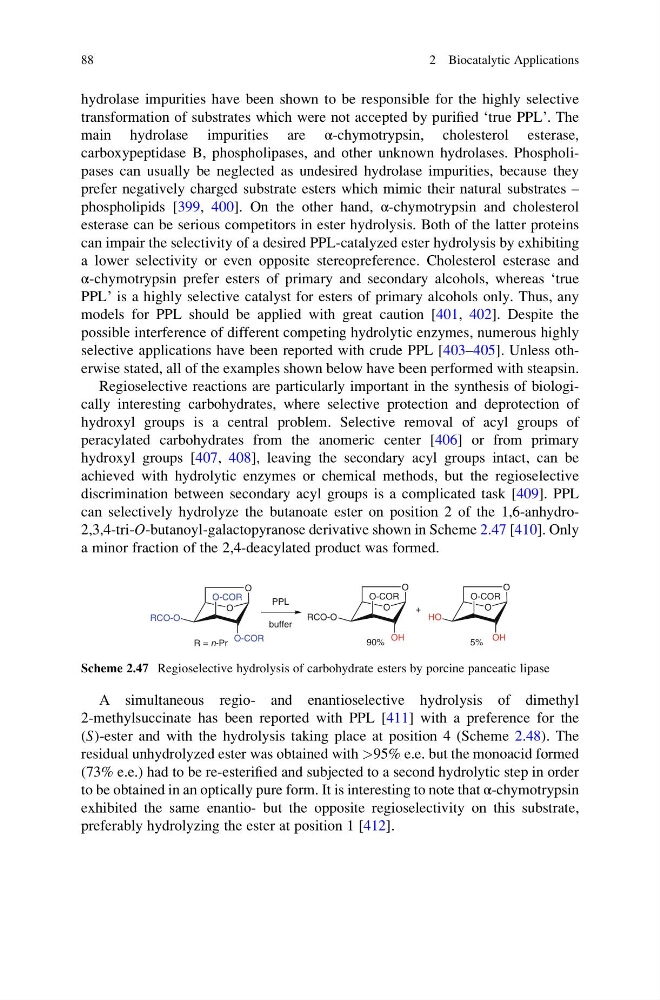
can selectively hydrolyze the butanoate ester on position 2 of the 1,6-anhydro2,3,4-tri-O-butanoyl-galactopyranose derivative shown in Scheme 2.47 [410]. Only
a minor fraction of the 2,4-deacylated product was formed.
A simultaneous regio- and enantioselective hydrolysis of dimethyl
2-methylsuccinate has been reported with PPL [411] with a preference for the
(S)-ester and with the hydrolysis taking place at position 4 (Scheme 2.48). The
residual unhydrolyzed ester was obtained with >95% e.e. but the monoacid formed
(73% e.e.) had to be re-esterified and subjected to a second hydrolytic step in order
to be obtained in an optically pure form. It is interesting to note that α-chymotrypsin
exhibited the same enantio- but the opposite regioselectivity on this substrate,
preferably hydrolyzing the ester at position 1 [412].
OH
O-COR
HO
O
O
OH
O-COR
RCO-O
O
O
O-COR
RCO-O
O-COR
O
O
R = n-Pr
5%
90%
+
buffer
PPL
Scheme 2.47 Regioselective hydrolysis of carbohydrate esters by porcine panceatic lipase
88
2 Biocatalytic Applications
transformation of substrates which were not accepted by purified ‘true PPL’. The
main hydrolase impurities are α-chymotrypsin, cholesterol esterase,
carboxypeptidase B, phospholipases, and other unknown hydrolases. Phospholipases can usually be neglected as undesired hydrolase impurities, because they
prefer negatively charged substrate esters which mimic their natural substrates –
phospholipids [399, 400]. On the other hand, α-chymotrypsin and cholesterol
esterase can be serious competitors in ester hydrolysis. Both of the latter proteins
can impair the selectivity of a desired PPL-catalyzed ester hydrolysis by exhibiting
a lower selectivity or even opposite stereopreference. Cholesterol esterase and
α-chymotrypsin prefer esters of primary and secondary alcohols, whereas ‘true
PPL’ is a highly selective catalyst for esters of primary alcohols only. Thus, any
models for PPL should be applied with great caution [401, 402]. Despite the
possible interference of different competing hydrolytic enzymes, numerous highly
selective applications have been reported with crude PPL [403–405]. Unless otherwise stated, all of the examples shown below have been performed with steapsin.
Regioselective reactions are particularly important in the synthesis of biologically interesting carbohydrates, where selective protection and deprotection of
hydroxyl groups is a central problem. Selective removal of acyl groups of
peracylated carbohydrates from the anomeric center [406] or from primary
hydroxyl groups [407, 408], leaving the secondary acyl groups intact, can be
achieved with hydrolytic enzymes or chemical methods, but the regioselective
discrimination between secondary acyl groups is a complicated task [409]. PPL
can selectively hydrolyze the butanoate ester on position 2 of the 1,6-anhydro2,3,4-tri-O-butanoyl-galactopyranose derivative shown in Scheme 2.47 [410]. Only
a minor fraction of the 2,4-deacylated product was formed.
A simultaneous regio- and enantioselective hydrolysis of dimethyl
2-methylsuccinate has been reported with PPL [411] with a preference for the
(S)-ester and with the hydrolysis taking place at position 4 (Scheme 2.48). The
residual unhydrolyzed ester was obtained with >95% e.e. but the monoacid formed
(73% e.e.) had to be re-esterified and subjected to a second hydrolytic step in order
to be obtained in an optically pure form. It is interesting to note that α-chymotrypsin
exhibited the same enantio- but the opposite regioselectivity on this substrate,
preferably hydrolyzing the ester at position 1 [412].
OH
O-COR
HO
O
O
OH
O-COR
RCO-O
O
O
O-COR
RCO-O
O-COR
O
O
R = n-Pr
5%
90%
+
buffer
PPL
Scheme 2.47 Regioselective hydrolysis of carbohydrate esters by porcine panceatic lipase
88
2 Biocatalytic Applications