

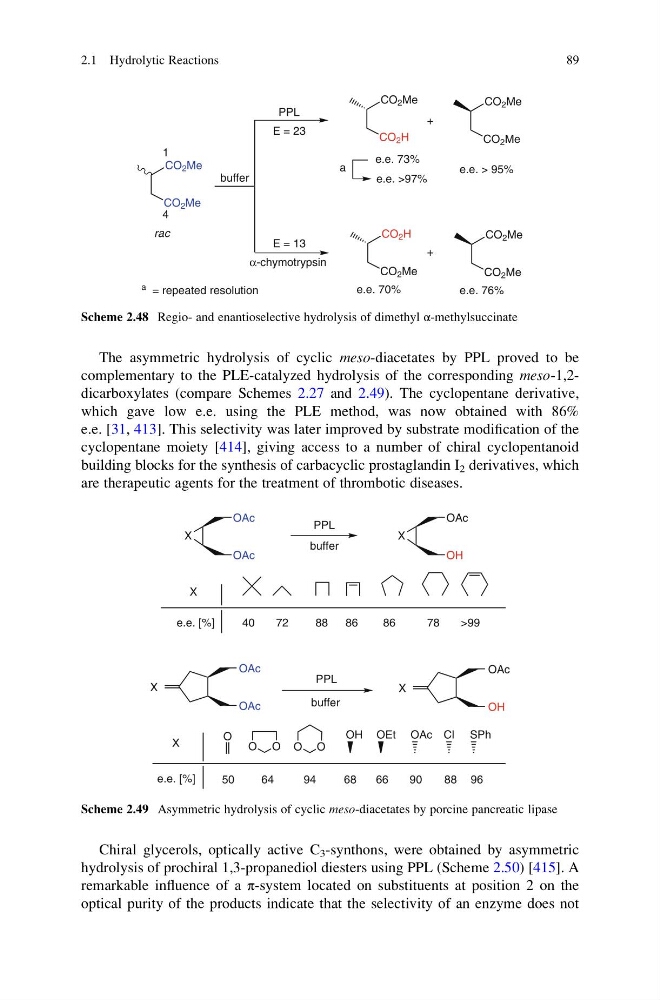
The asymmetric hydrolysis of cyclic meso-diacetates by PPL proved to be
complementary to the PLE-catalyzed hydrolysis of the corresponding meso-1,2dicarboxylates (compare Schemes 2.27 and 2.49). The cyclopentane derivative,
which gave low e.e. using the PLE method, was now obtained with 86%
e.e. [31, 413]. This selectivity was later improved by substrate modification of the
cyclopentane moiety [414], giving access to a number of chiral cyclopentanoid
building blocks for the synthesis of carbacyclic prostaglandin I 2 derivatives, which
are therapeutic agents for the treatment of thrombotic diseases.
Chiral glycerols, optically active C 3 -synthons, were obtained by asymmetric
hydrolysis of prochiral 1,3-propanediol diesters using PPL (Scheme 2.50) [415]. A
remarkable influence of a π-system located on substituents at position 2 on the
optical purity of the products indicate that the selectivity of an enzyme does not
CO 2 Me
CO 2 Me
CO 2 Me
CO 2 H
CO 2 Me
CO 2 Me
CO 2 H
CO 2 Me
CO 2 Me
CO 2 Me
E = 13
E = 23
buffer
α-chymotrypsin
PPL
rac
a
e.e. >97%
e.e. 73%
+
+
a = repeated resolution
e.e. 76%
e.e. 70%
e.e. > 95%
4
1
Scheme 2.48 Regio- and enantioselective hydrolysis of dimethyl α-methylsuccinate
OH
OAc
X
OAc
OAc
X
e.e. [%]
40
72
88
86
86
78
>99
buffer
PPL
X
X
OAc
OAc
X
OH
OAc
O
O O
O
O
OH OEt OAc Cl SPh
buffer
PPL
e.e. [%]
50
64
94
68
66
90
88 96
X
Scheme 2.49 Asymmetric hydrolysis of cyclic meso-diacetates by porcine pancreatic lipase
2.1 Hydrolytic Reactions
89
complementary to the PLE-catalyzed hydrolysis of the corresponding meso-1,2dicarboxylates (compare Schemes 2.27 and 2.49). The cyclopentane derivative,
which gave low e.e. using the PLE method, was now obtained with 86%
e.e. [31, 413]. This selectivity was later improved by substrate modification of the
cyclopentane moiety [414], giving access to a number of chiral cyclopentanoid
building blocks for the synthesis of carbacyclic prostaglandin I 2 derivatives, which
are therapeutic agents for the treatment of thrombotic diseases.
Chiral glycerols, optically active C 3 -synthons, were obtained by asymmetric
hydrolysis of prochiral 1,3-propanediol diesters using PPL (Scheme 2.50) [415]. A
remarkable influence of a π-system located on substituents at position 2 on the
optical purity of the products indicate that the selectivity of an enzyme does not
CO 2 Me
CO 2 Me
CO 2 Me
CO 2 H
CO 2 Me
CO 2 Me
CO 2 H
CO 2 Me
CO 2 Me
CO 2 Me
E = 13
E = 23
buffer
α-chymotrypsin
PPL
rac
a
e.e. >97%
e.e. 73%
+
+
a = repeated resolution
e.e. 76%
e.e. 70%
e.e. > 95%
4
1
Scheme 2.48 Regio- and enantioselective hydrolysis of dimethyl α-methylsuccinate
OH
OAc
X
OAc
OAc
X
e.e. [%]
40
72
88
86
86
78
>99
buffer
PPL
X
X
OAc
OAc
X
OH
OAc
O
O O
O
O
OH OEt OAc Cl SPh
buffer
PPL
e.e. [%]
50
64
94
68
66
90
88 96
X
Scheme 2.49 Asymmetric hydrolysis of cyclic meso-diacetates by porcine pancreatic lipase
2.1 Hydrolytic Reactions
89