

preparations, while these are usually not in the range of orders of magnitude [395].
14 The actual enzyme content of commercial lipase preparations
may vary significantly, from less than 1% up to ~70% – and the selectivity of
a lipase preparation from the same microbial source does not necessarily increase
with its price! Among the ever increasing number of commercially available
lipases only those which have been shown to be of a general applicability are
discussed below.
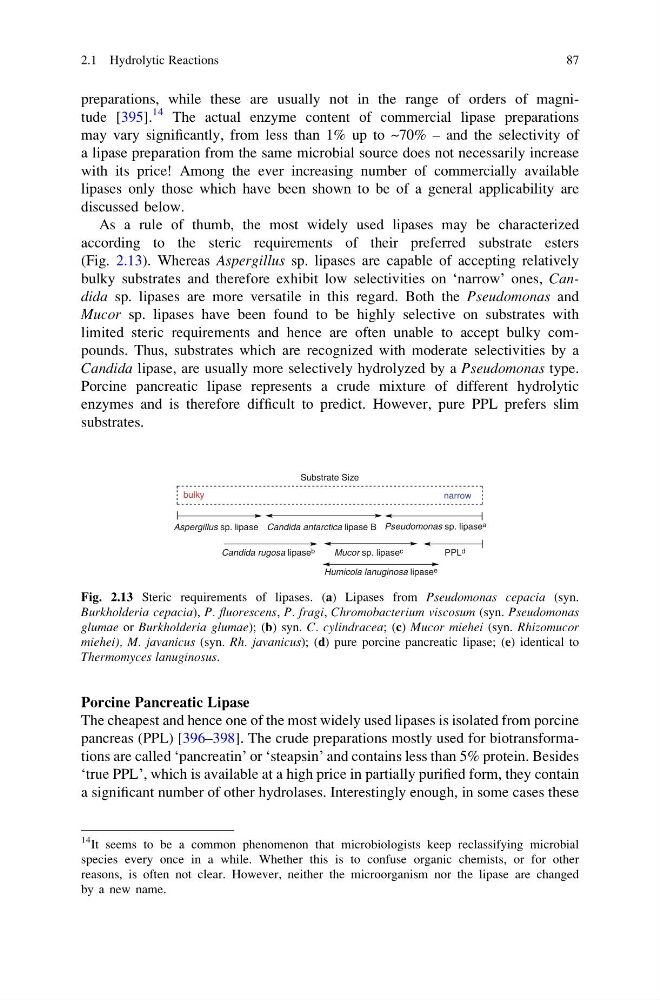
As a rule of thumb, the most widely used lipases may be characterized
according to the steric requirements of their preferred substrate esters
(Fig. 2.13). Whereas Aspergillus sp. lipases are capable of accepting relatively
bulky substrates and therefore exhibit low selectivities on ‘narrow’ ones, Candida sp. lipases are more versatile in this regard. Both the Pseudomonas and
Mucor sp. lipases have been found to be highly selective on substrates with
limited steric requirements and hence are often unable to accept bulky compounds. Thus, substrates which are recognized with moderate selectivities by a
Candida lipase, are usually more selectively hydrolyzed by a Pseudomonas type.
Porcine pancreatic lipase represents a crude mixture of different hydrolytic
enzymes and is therefore difficult to predict. However, pure PPL prefers slim
substrates.
Porcine Pancreatic Lipase
The cheapest and hence one of the most widely used lipases is isolated from porcine
pancreas (PPL) [396–398]. The crude preparations mostly used for biotransformations are called ‘pancreatin’ or ‘steapsin’ and contains less than 5% protein. Besides
‘true PPL’, which is available at a high price in partially purified form, they contain
a significant number of other hydrolases. Interestingly enough, in some cases these
Humicola lanuginosa lipase e
Candida rugosa lipase b
Pseudomonas sp. lipase a
Mucor sp. lipase c
Candida antarctica lipase B
Aspergillus sp. lipase
narrow
bulky
Substrate Size
PPL d
Fig. 2.13 Steric requirements of lipases. (a) Lipases from Pseudomonas cepacia (syn.
Burkholderia cepacia), P. fluorescens, P. fragi, Chromobacterium viscosum (syn. Pseudomonas
glumae or Burkholderia glumae); (b) syn. C. cylindracea; (c) Mucor miehei (syn. Rhizomucor
miehei), M. javanicus (syn. Rh. javanicus); (d) pure porcine pancreatic lipase; (e) identical to
Thermomyces lanuginosus.
14 It seems to be a common phenomenon that microbiologists keep reclassifying microbial
species every once in a while. Whether this is to confuse organic chemists, or for other
reasons, is often not clear. However, neither the microorganism nor the lipase are changed
by a new name.
2.1 Hydrolytic Reactions
87
14 The actual enzyme content of commercial lipase preparations
may vary significantly, from less than 1% up to ~70% – and the selectivity of
a lipase preparation from the same microbial source does not necessarily increase
with its price! Among the ever increasing number of commercially available
lipases only those which have been shown to be of a general applicability are
discussed below.
As a rule of thumb, the most widely used lipases may be characterized
according to the steric requirements of their preferred substrate esters
(Fig. 2.13). Whereas Aspergillus sp. lipases are capable of accepting relatively
bulky substrates and therefore exhibit low selectivities on ‘narrow’ ones, Candida sp. lipases are more versatile in this regard. Both the Pseudomonas and
Mucor sp. lipases have been found to be highly selective on substrates with
limited steric requirements and hence are often unable to accept bulky compounds. Thus, substrates which are recognized with moderate selectivities by a
Candida lipase, are usually more selectively hydrolyzed by a Pseudomonas type.
Porcine pancreatic lipase represents a crude mixture of different hydrolytic
enzymes and is therefore difficult to predict. However, pure PPL prefers slim
substrates.
Porcine Pancreatic Lipase
The cheapest and hence one of the most widely used lipases is isolated from porcine
pancreas (PPL) [396–398]. The crude preparations mostly used for biotransformations are called ‘pancreatin’ or ‘steapsin’ and contains less than 5% protein. Besides
‘true PPL’, which is available at a high price in partially purified form, they contain
a significant number of other hydrolases. Interestingly enough, in some cases these
Humicola lanuginosa lipase e
Candida rugosa lipase b
Pseudomonas sp. lipase a
Mucor sp. lipase c
Candida antarctica lipase B
Aspergillus sp. lipase
narrow
bulky
Substrate Size
PPL d
Fig. 2.13 Steric requirements of lipases. (a) Lipases from Pseudomonas cepacia (syn.
Burkholderia cepacia), P. fluorescens, P. fragi, Chromobacterium viscosum (syn. Pseudomonas
glumae or Burkholderia glumae); (b) syn. C. cylindracea; (c) Mucor miehei (syn. Rhizomucor
miehei), M. javanicus (syn. Rh. javanicus); (d) pure porcine pancreatic lipase; (e) identical to
Thermomyces lanuginosus.
14 It seems to be a common phenomenon that microbiologists keep reclassifying microbial
species every once in a while. Whether this is to confuse organic chemists, or for other
reasons, is often not clear. However, neither the microorganism nor the lipase are changed
by a new name.
2.1 Hydrolytic Reactions
87