

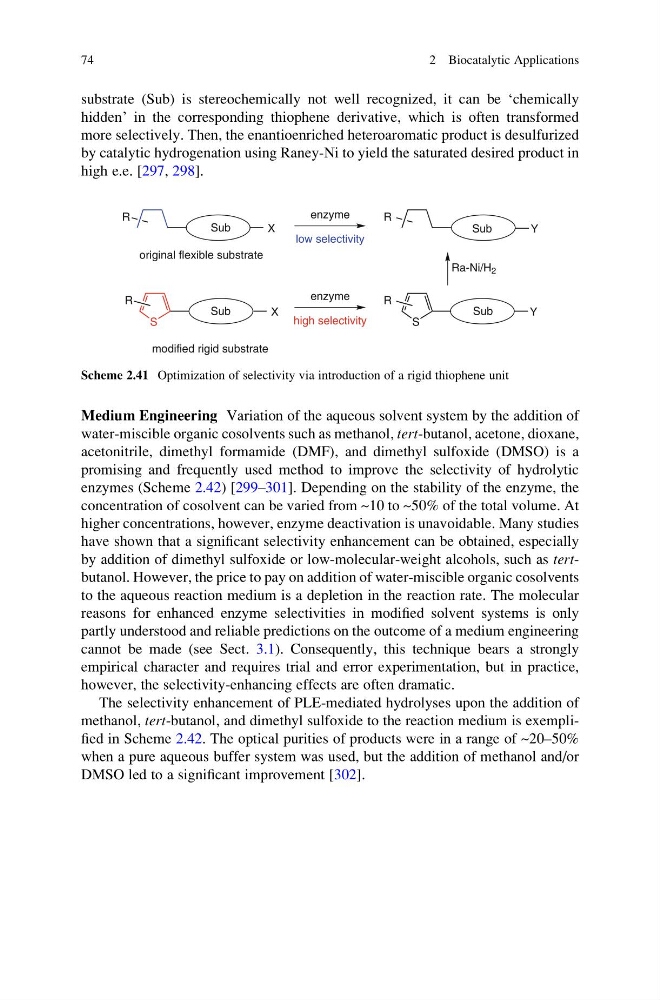
substrate (Sub) is stereochemically not well recognized, it can be ‘chemically
hidden’ in the corresponding thiophene derivative, which is often transformed
more selectively. Then, the enantioenriched heteroaromatic product is desulfurized
by catalytic hydrogenation using Raney-Ni to yield the saturated desired product in
high e.e. [297, 298].
Medium Engineering Variation of the aqueous solvent system by the addition of
water-miscible organic cosolvents such as methanol, tert-butanol, acetone, dioxane,
acetonitrile, dimethyl formamide (DMF), and dimethyl sulfoxide (DMSO) is a
promising and frequently used method to improve the selectivity of hydrolytic
enzymes (Scheme 2.42) [299–301]. Depending on the stability of the enzyme, the
concentration of cosolvent can be varied from ~10 to ~50% of the total volume. At
higher concentrations, however, enzyme deactivation is unavoidable. Many studies
have shown that a significant selectivity enhancement can be obtained, especially
by addition of dimethyl sulfoxide or low-molecular-weight alcohols, such as tertbutanol. However, the price to pay on addition of water-miscible organic cosolvents
to the aqueous reaction medium is a depletion in the reaction rate. The molecular
reasons for enhanced enzyme selectivities in modified solvent systems is only
partly understood and reliable predictions on the outcome of a medium engineering
cannot be made (see Sect. 3.1). Consequently, this technique bears a strongly
empirical character and requires trial and error experimentation, but in practice,
however, the selectivity-enhancing effects are often dramatic.
The selectivity enhancement of PLE-mediated hydrolyses upon the addition of
methanol, tert-butanol, and dimethyl sulfoxide to the reaction medium is exemplified in Scheme 2.42. The optical purities of products were in a range of ~20–50%
when a pure aqueous buffer system was used, but the addition of methanol and/or
DMSO led to a significant improvement [302].
R
X
R
Y
R
S
Y
R
S
X
modified rigid substrate
original flexible substrate
Sub
Ra-Ni/H 2
Sub
low selectivity
enzyme
high selectivity
enzyme
Sub
Sub
Scheme 2.41 Optimization of selectivity via introduction of a rigid thiophene unit
74
2 Biocatalytic Applications
hidden’ in the corresponding thiophene derivative, which is often transformed
more selectively. Then, the enantioenriched heteroaromatic product is desulfurized
by catalytic hydrogenation using Raney-Ni to yield the saturated desired product in
high e.e. [297, 298].
Medium Engineering Variation of the aqueous solvent system by the addition of
water-miscible organic cosolvents such as methanol, tert-butanol, acetone, dioxane,
acetonitrile, dimethyl formamide (DMF), and dimethyl sulfoxide (DMSO) is a
promising and frequently used method to improve the selectivity of hydrolytic
enzymes (Scheme 2.42) [299–301]. Depending on the stability of the enzyme, the
concentration of cosolvent can be varied from ~10 to ~50% of the total volume. At
higher concentrations, however, enzyme deactivation is unavoidable. Many studies
have shown that a significant selectivity enhancement can be obtained, especially
by addition of dimethyl sulfoxide or low-molecular-weight alcohols, such as tertbutanol. However, the price to pay on addition of water-miscible organic cosolvents
to the aqueous reaction medium is a depletion in the reaction rate. The molecular
reasons for enhanced enzyme selectivities in modified solvent systems is only
partly understood and reliable predictions on the outcome of a medium engineering
cannot be made (see Sect. 3.1). Consequently, this technique bears a strongly
empirical character and requires trial and error experimentation, but in practice,
however, the selectivity-enhancing effects are often dramatic.
The selectivity enhancement of PLE-mediated hydrolyses upon the addition of
methanol, tert-butanol, and dimethyl sulfoxide to the reaction medium is exemplified in Scheme 2.42. The optical purities of products were in a range of ~20–50%
when a pure aqueous buffer system was used, but the addition of methanol and/or
DMSO led to a significant improvement [302].
R
X
R
Y
R
S
Y
R
S
X
modified rigid substrate
original flexible substrate
Sub
Ra-Ni/H 2
Sub
low selectivity
enzyme
high selectivity
enzyme
Sub
Sub
Scheme 2.41 Optimization of selectivity via introduction of a rigid thiophene unit
74
2 Biocatalytic Applications