

enzyme class. Enzyme screening is certainly a good option for proteases and
lipases, but not within the relatively small group of esterases. The construction
of enzyme mutants possessing altered stereospecificities by enzyme engineering
is a laborious, but powerful strategy.
Substrate engineering is a promising technique, which is applicable to all types
of enzymatic transformations. As may be concluded from the foregoing examples,
the ability of an enzyme to ‘recognize’ the chirality of a given substrate predominantly depends on its steric shape. Although also electronic effects are involved,
they are usually less important [293–296]. Thus, by variation of the substrate
structure (most easily performed by chosing a protective group of different size
and/or polarity) an improved fit of the substrate can be achieved, which leads to an
enhanced selectivity of the enzyme.
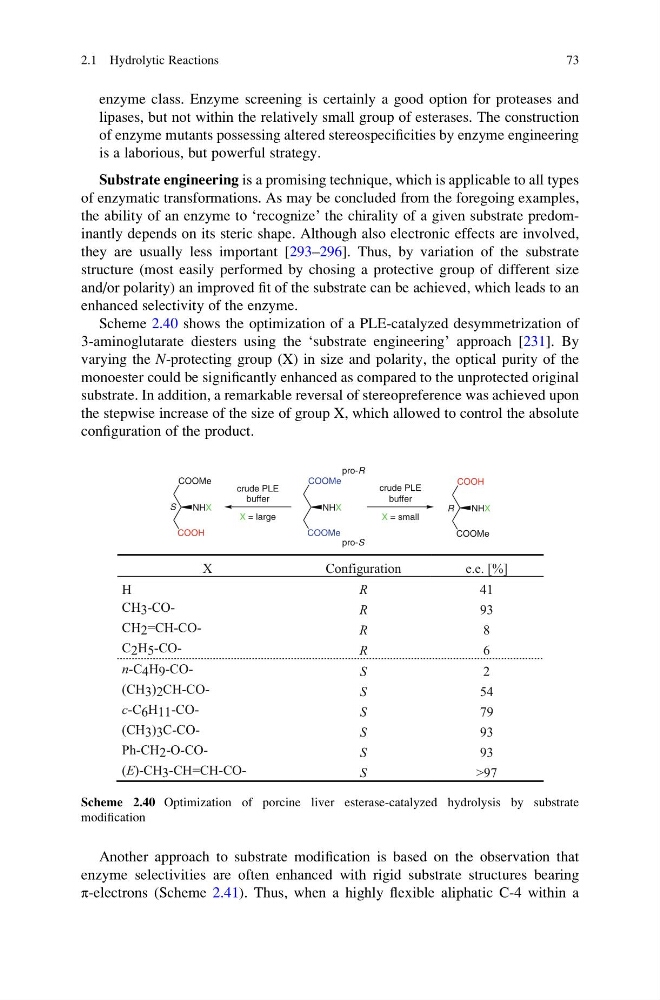
Scheme 2.40 shows the optimization of a PLE-catalyzed desymmetrization of
3-aminoglutarate diesters using the ‘substrate engineering’ approach [231]. By
varying the N-protecting group (X) in size and polarity, the optical purity of the
monoester could be significantly enhanced as compared to the unprotected original
substrate. In addition, a remarkable reversal of stereopreference was achieved upon
the stepwise increase of the size of group X, which allowed to control the absolute
configuration of the product.
Another approach to substrate modification is based on the observation that
enzyme selectivities are often enhanced with rigid substrate structures bearing
π-electrons (Scheme 2.41). Thus, when a highly flexible aliphatic C-4 within a
NHX
COOH
COOMe
NHX
COOMe
COOH
NHX
COOMe
COOMe
pro-S
pro-R
crude PLE
crude PLE
buffer
buffer
R
S
X = small
X = large
X
Configuration
e.e. [%]
H
R
41
CH 3 -COR
93
CH 2 =CH-COR
8
C 2 H 5 -COR
6
n-C 4 H 9 -COS
2
(CH 3 ) 2 CH-COS
54
c-C 6 H 11 -COS
79
(CH 3 ) 3 C-COS
93
Ph-CH 2 -O-COS
93
(E)-CH 3 -CH=CH-COS
>97
Scheme 2.40 Optimization of porcine liver esterase-catalyzed hydrolysis by substrate
modification
2.1 Hydrolytic Reactions
73
lipases, but not within the relatively small group of esterases. The construction
of enzyme mutants possessing altered stereospecificities by enzyme engineering
is a laborious, but powerful strategy.
Substrate engineering is a promising technique, which is applicable to all types
of enzymatic transformations. As may be concluded from the foregoing examples,
the ability of an enzyme to ‘recognize’ the chirality of a given substrate predominantly depends on its steric shape. Although also electronic effects are involved,
they are usually less important [293–296]. Thus, by variation of the substrate
structure (most easily performed by chosing a protective group of different size
and/or polarity) an improved fit of the substrate can be achieved, which leads to an
enhanced selectivity of the enzyme.
Scheme 2.40 shows the optimization of a PLE-catalyzed desymmetrization of
3-aminoglutarate diesters using the ‘substrate engineering’ approach [231]. By
varying the N-protecting group (X) in size and polarity, the optical purity of the
monoester could be significantly enhanced as compared to the unprotected original
substrate. In addition, a remarkable reversal of stereopreference was achieved upon
the stepwise increase of the size of group X, which allowed to control the absolute
configuration of the product.
Another approach to substrate modification is based on the observation that
enzyme selectivities are often enhanced with rigid substrate structures bearing
π-electrons (Scheme 2.41). Thus, when a highly flexible aliphatic C-4 within a
NHX
COOH
COOMe
NHX
COOMe
COOH
NHX
COOMe
COOMe
pro-S
pro-R
crude PLE
crude PLE
buffer
buffer
R
S
X = small
X = large
X
Configuration
e.e. [%]
H
R
41
CH 3 -COR
93
CH 2 =CH-COR
8
C 2 H 5 -COR
6
n-C 4 H 9 -COS
2
(CH 3 ) 2 CH-COS
54
c-C 6 H 11 -COS
79
(CH 3 ) 3 C-COS
93
Ph-CH 2 -O-COS
93
(E)-CH 3 -CH=CH-COS
>97
Scheme 2.40 Optimization of porcine liver esterase-catalyzed hydrolysis by substrate
modification
2.1 Hydrolytic Reactions
73