

In biotransformations performed with crude enzyme preparations (e.g. lipases)
or whole microbial cells (e.g. baker’s yeast) stereoselectivities can be improved by
addition of ‘enhancers’ (e.g. amines, alcohols), which act as noncompetitive inhibitors for competing (iso)enzymes possessing lower (or even opposite) selectivities
[303]. This phenomenon is discussed on pp. 102–103 and p. 149, respectively.
Variation of pH Reactions catalyzed by hydrolases are usually performed in
aqueous buffer systems with a pH close to that of the pH optimum of the enzyme.
Because the conformation of an enzyme depends on its ionization state (among
others), variation of the pH and the type of buffer will influence the selectivity of a
given reaction. Such variations are facilitated by the fact that the pH activity profile
of the more commonly used hydrolytic enzymes is rather broad and thus allows pH
variations while maintaining an adequately high activity [304–307].
Variation of Temperature Enzymes, like other catalysts, generally are considered to exhibit their highest selectivity at low temperatures, as supported by
experimental observations with hydrolases [308]. A rational understanding of
temperature effects on enzyme stereoselectivity was proposed using dehydrogenases [309, 310]. It is based on the so-called ‘racemic temperature’ (T rac ) at which a
given enzymatic reaction will proceed without stereochemical discrimination due
to the fact that the activation energy of the reaction is the same for both stereochemical directions. In other words, there is no difference in free energy between
[EnzA]
6 ¼ and [EnzB]
6 ¼ , consequently ΔΔG
6 ¼
¼ 0 (Fig. 1.8).
ΔΔG
6 ¼
¼ ΔΔH
6 ¼
À T Á ΔΔS
6 ¼
If ΔΔG
6 ¼
¼ 0 then T ¼ T rac ¼
ΔΔH
6 ¼
ΔΔS
6 ¼
T rac ¼ ‘Racemic Temperature’
OAc
OAc
OAc
OH
CO 2 Me
CO 2 Me
N-Bn
CO 2 H
CO 2 Me
N-Bn
R
CO 2 Me
CO 2 Me
R
CO 2 Me
CO 2 H
96
94
84
72
59
55
e.e. [%]
44
70
35
28
70
100
Relative Rate [%]
t-BuOH (10%)
t-BuOH (5%)
DMF (20%)
DMSO (40%)
DMSO (20%)
Organic Cosolvent
None
buffer
crude PLE
crude PLE
buffer
buffer
crude PLE
R = 3,4-dimethoxyphenyl
Bn = -CH 2 -Ph
cosolvent
cosolvent
cosolvent
Organic Cosolvent
None
MeOH (10%)
DMSO (25%)
>97
>97
17
e.e. [%]
Organic Cosolvent
e.e. [%]
25
93
None
DMSO (50%)
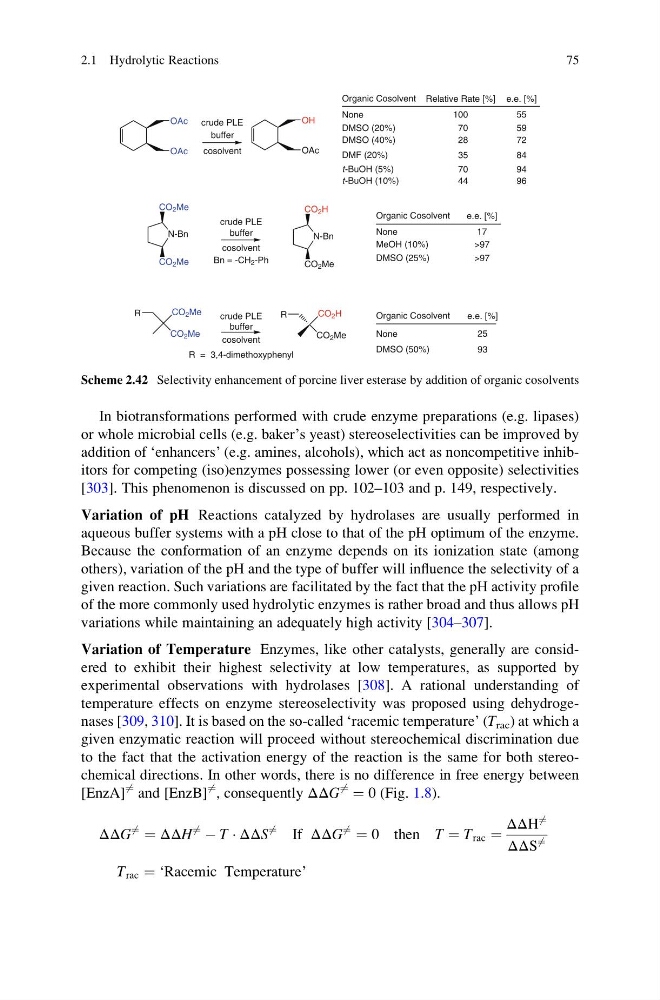
Scheme 2.42 Selectivity enhancement of porcine liver esterase by addition of organic cosolvents
2.1 Hydrolytic Reactions
75
or whole microbial cells (e.g. baker’s yeast) stereoselectivities can be improved by
addition of ‘enhancers’ (e.g. amines, alcohols), which act as noncompetitive inhibitors for competing (iso)enzymes possessing lower (or even opposite) selectivities
[303]. This phenomenon is discussed on pp. 102–103 and p. 149, respectively.
Variation of pH Reactions catalyzed by hydrolases are usually performed in
aqueous buffer systems with a pH close to that of the pH optimum of the enzyme.
Because the conformation of an enzyme depends on its ionization state (among
others), variation of the pH and the type of buffer will influence the selectivity of a
given reaction. Such variations are facilitated by the fact that the pH activity profile
of the more commonly used hydrolytic enzymes is rather broad and thus allows pH
variations while maintaining an adequately high activity [304–307].
Variation of Temperature Enzymes, like other catalysts, generally are considered to exhibit their highest selectivity at low temperatures, as supported by
experimental observations with hydrolases [308]. A rational understanding of
temperature effects on enzyme stereoselectivity was proposed using dehydrogenases [309, 310]. It is based on the so-called ‘racemic temperature’ (T rac ) at which a
given enzymatic reaction will proceed without stereochemical discrimination due
to the fact that the activation energy of the reaction is the same for both stereochemical directions. In other words, there is no difference in free energy between
[EnzA]
6 ¼ and [EnzB]
6 ¼ , consequently ΔΔG
6 ¼
¼ 0 (Fig. 1.8).
ΔΔG
6 ¼
¼ ΔΔH
6 ¼
À T Á ΔΔS
6 ¼
If ΔΔG
6 ¼
¼ 0 then T ¼ T rac ¼
ΔΔH
6 ¼
ΔΔS
6 ¼
T rac ¼ ‘Racemic Temperature’
OAc
OAc
OAc
OH
CO 2 Me
CO 2 Me
N-Bn
CO 2 H
CO 2 Me
N-Bn
R
CO 2 Me
CO 2 Me
R
CO 2 Me
CO 2 H
96
94
84
72
59
55
e.e. [%]
44
70
35
28
70
100
Relative Rate [%]
t-BuOH (10%)
t-BuOH (5%)
DMF (20%)
DMSO (40%)
DMSO (20%)
Organic Cosolvent
None
buffer
crude PLE
crude PLE
buffer
buffer
crude PLE
R = 3,4-dimethoxyphenyl
Bn = -CH 2 -Ph
cosolvent
cosolvent
cosolvent
Organic Cosolvent
None
MeOH (10%)
DMSO (25%)
>97
>97
17
e.e. [%]
Organic Cosolvent
e.e. [%]
25
93
None
DMSO (50%)
Scheme 2.42 Selectivity enhancement of porcine liver esterase by addition of organic cosolvents
2.1 Hydrolytic Reactions
75