

analog was not suitable. It should be noted that a desymmetrization of the
corresponding cis-meso-1,2-diacetates is impeded by nonenzymic acyl migration
which leads to facile racemization of any chiral monoester that is formed.
Inspired by the broad substrate range of porcine liver esterase, cloning and
overexpression of PLE isoenzymes was persued over the past years in order to
provide a reliable enzyme source and to overcome imperfect stereoselectivities
of crude PLE preparations [259–261]. In addition, for the application of PLEderived pharma products in humans, the use of enzymes from animal sources is
undesirable due to the risk of contaminations by viruses and prions and due to the
fact that products derived from pigs are considered impure by several world
religions.
Analysis of the amino acid sequences of PLE isoenzymes revealed that the
remarkably small differences of ca. 20 amino acids are not distributed randomly
but are located within distinct conserved areas. Among the different isoenzymes,
PLE-1 (also termed γ-PLE) and an isoenzyme termed A-PLE (‘alternative pig
liver esterase’) [261, 262] were shown to be most useful for stereoselective
ester hydrolysis. The latter enzyme, which was expressed at a high level in
Pichia pastoris, is remarkably stable and showed perfect enantioselectivity for
the industrial-scale resolution of methyl (4E)-5-chloro-2-isopropyl-4-pentenoate,
which is a key building block for the synthesis of the renin inhibitor Aliskiren,
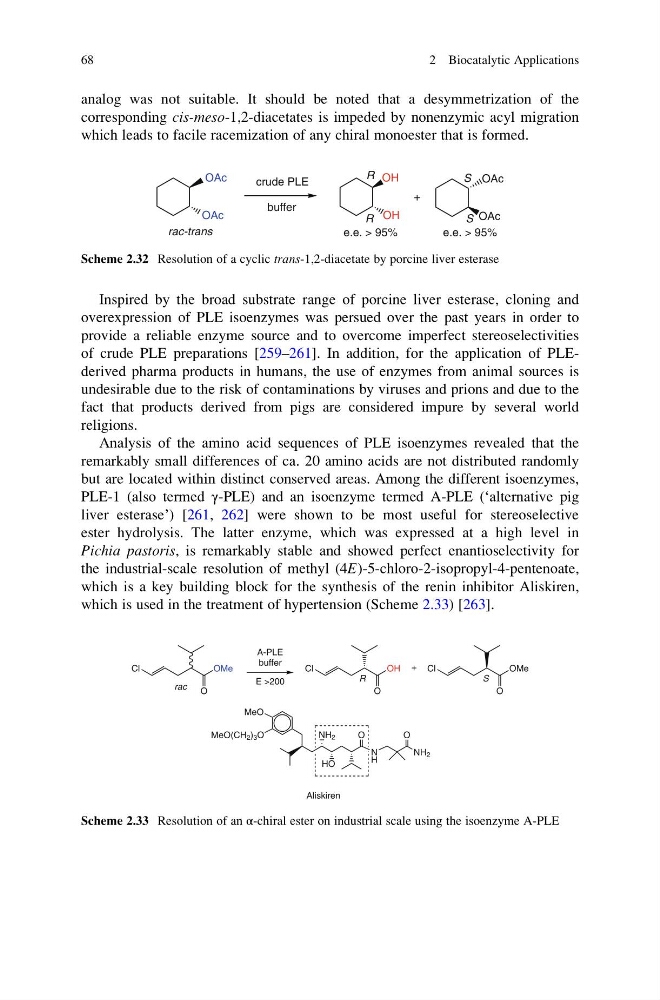
which is used in the treatment of hypertension (Scheme 2.33) [263].
OAc
OAc
OH
OH
OAc
OAc
rac-trans
+
e.e. > 95%
e.e. > 95%
crude PLE
buffer
R
R
S
S
Scheme 2.32 Resolution of a cyclic trans-1,2-diacetate by porcine liver esterase
O
OMe
Cl
O
OH
Cl
O
OMe
Cl
MeO(CH 2 ) 3 O
N
H
O
NH 2
O
HO
NH 2
MeO
rac
+
A-PLE
buffer
E >200
Aliskiren
S
R
Scheme 2.33 Resolution of an α-chiral ester on industrial scale using the isoenzyme A-PLE
68
2 Biocatalytic Applications
corresponding cis-meso-1,2-diacetates is impeded by nonenzymic acyl migration
which leads to facile racemization of any chiral monoester that is formed.
Inspired by the broad substrate range of porcine liver esterase, cloning and
overexpression of PLE isoenzymes was persued over the past years in order to
provide a reliable enzyme source and to overcome imperfect stereoselectivities
of crude PLE preparations [259–261]. In addition, for the application of PLEderived pharma products in humans, the use of enzymes from animal sources is
undesirable due to the risk of contaminations by viruses and prions and due to the
fact that products derived from pigs are considered impure by several world
religions.
Analysis of the amino acid sequences of PLE isoenzymes revealed that the
remarkably small differences of ca. 20 amino acids are not distributed randomly
but are located within distinct conserved areas. Among the different isoenzymes,
PLE-1 (also termed γ-PLE) and an isoenzyme termed A-PLE (‘alternative pig
liver esterase’) [261, 262] were shown to be most useful for stereoselective
ester hydrolysis. The latter enzyme, which was expressed at a high level in
Pichia pastoris, is remarkably stable and showed perfect enantioselectivity for
the industrial-scale resolution of methyl (4E)-5-chloro-2-isopropyl-4-pentenoate,
which is a key building block for the synthesis of the renin inhibitor Aliskiren,
which is used in the treatment of hypertension (Scheme 2.33) [263].
OAc
OAc
OH
OH
OAc
OAc
rac-trans
+
e.e. > 95%
e.e. > 95%
crude PLE
buffer
R
R
S
S
Scheme 2.32 Resolution of a cyclic trans-1,2-diacetate by porcine liver esterase
O
OMe
Cl
O
OH
Cl
O
OMe
Cl
MeO(CH 2 ) 3 O
N
H
O
NH 2
O
HO
NH 2
MeO
rac
+
A-PLE
buffer
E >200
Aliskiren
S
R
Scheme 2.33 Resolution of an α-chiral ester on industrial scale using the isoenzyme A-PLE
68
2 Biocatalytic Applications