

Microbial Esterases
Complementary to the use of isolated enzymes, whole microbial cells have also
been used to catalyze esterolytic reactions. Interesting cases are reported from
bacteria, yeasts, and fungi, such as Bacillus subtilis [264], Brevibacterium
ammoniagenes [265], Bacillus coagulans [266], Pichia miso [26], and Rhizopus
nigricans [267]. Although the reaction control becomes more complex on using
whole microbial cells, the selectivities achieved are sometimes surprisingly high
[268]. Since hydrolytic reactions do not require any cofactors, which are usually
recycled by the metabolism of a ‘living’ fermenting organism, lyophilized ‘resting’
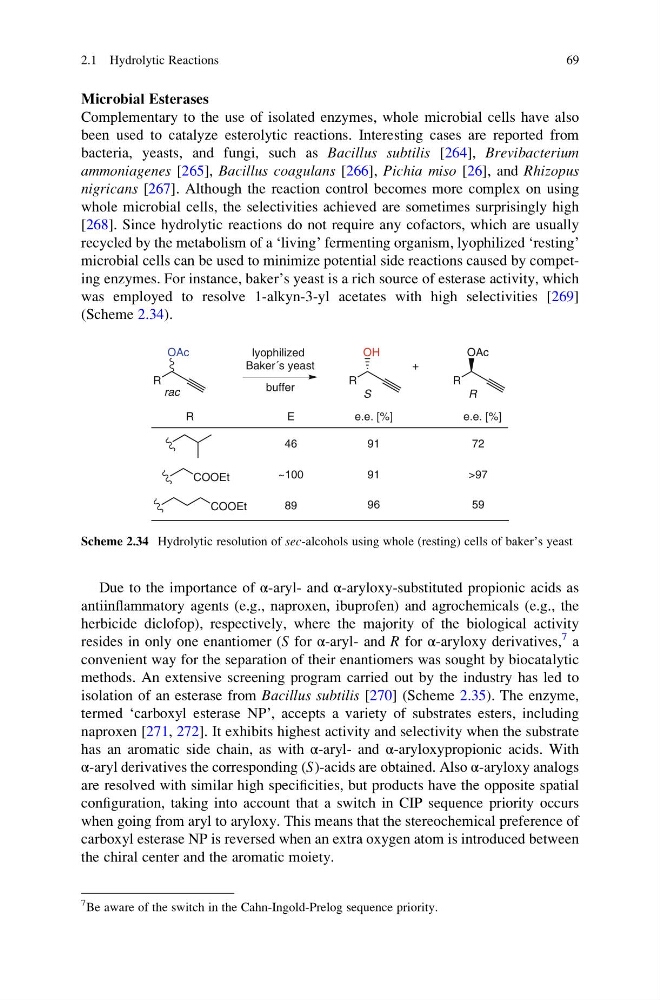
microbial cells can be used to minimize potential side reactions caused by competing enzymes. For instance, baker’s yeast is a rich source of esterase activity, which
was employed to resolve 1-alkyn-3-yl acetates with high selectivities [269]
(Scheme 2.34).
Due to the importance of α-aryl- and α-aryloxy-substituted propionic acids as
antiinflammatory agents (e.g., naproxen, ibuprofen) and agrochemicals (e.g., the
herbicide diclofop), respectively, where the majority of the biological activity
resides in only one enantiomer (S for α-aryl- and R for α-aryloxy derivatives,
7 a
convenient way for the separation of their enantiomers was sought by biocatalytic
methods. An extensive screening program carried out by the industry has led to
isolation of an esterase from Bacillus subtilis [270] (Scheme 2.35). The enzyme,
termed ‘carboxyl esterase NP’, accepts a variety of substrates esters, including
naproxen [271, 272]. It exhibits highest activity and selectivity when the substrate
has an aromatic side chain, as with α-aryl- and α-aryloxypropionic acids. With
α-aryl derivatives the corresponding (S)-acids are obtained. Also α-aryloxy analogs
are resolved with similar high specificities, but products have the opposite spatial
configuration, taking into account that a switch in CIP sequence priority occurs
when going from aryl to aryloxy. This means that the stereochemical preference of
carboxyl esterase NP is reversed when an extra oxygen atom is introduced between
the chiral center and the aromatic moiety.
COOEt
COOEt
OAc
R
OH
R
OAc
R
89
~100
46
E
59
96
>97
91
72
91
e.e. [%]
e.e. [%]
+
rac
buffer
lyophilized
Baker´s yeast
R
R
S
Scheme 2.34 Hydrolytic resolution of sec-alcohols using whole (resting) cells of baker’s yeast
7 Be aware of the switch in the Cahn-Ingold-Prelog sequence priority.
2.1 Hydrolytic Reactions
69
Complementary to the use of isolated enzymes, whole microbial cells have also
been used to catalyze esterolytic reactions. Interesting cases are reported from
bacteria, yeasts, and fungi, such as Bacillus subtilis [264], Brevibacterium
ammoniagenes [265], Bacillus coagulans [266], Pichia miso [26], and Rhizopus
nigricans [267]. Although the reaction control becomes more complex on using
whole microbial cells, the selectivities achieved are sometimes surprisingly high
[268]. Since hydrolytic reactions do not require any cofactors, which are usually
recycled by the metabolism of a ‘living’ fermenting organism, lyophilized ‘resting’
microbial cells can be used to minimize potential side reactions caused by competing enzymes. For instance, baker’s yeast is a rich source of esterase activity, which
was employed to resolve 1-alkyn-3-yl acetates with high selectivities [269]
(Scheme 2.34).
Due to the importance of α-aryl- and α-aryloxy-substituted propionic acids as
antiinflammatory agents (e.g., naproxen, ibuprofen) and agrochemicals (e.g., the
herbicide diclofop), respectively, where the majority of the biological activity
resides in only one enantiomer (S for α-aryl- and R for α-aryloxy derivatives,
7 a
convenient way for the separation of their enantiomers was sought by biocatalytic
methods. An extensive screening program carried out by the industry has led to
isolation of an esterase from Bacillus subtilis [270] (Scheme 2.35). The enzyme,
termed ‘carboxyl esterase NP’, accepts a variety of substrates esters, including
naproxen [271, 272]. It exhibits highest activity and selectivity when the substrate
has an aromatic side chain, as with α-aryl- and α-aryloxypropionic acids. With
α-aryl derivatives the corresponding (S)-acids are obtained. Also α-aryloxy analogs
are resolved with similar high specificities, but products have the opposite spatial
configuration, taking into account that a switch in CIP sequence priority occurs
when going from aryl to aryloxy. This means that the stereochemical preference of
carboxyl esterase NP is reversed when an extra oxygen atom is introduced between
the chiral center and the aromatic moiety.
COOEt
COOEt
OAc
R
OH
R
OAc
R
89
~100
46
E
59
96
>97
91
72
91
e.e. [%]
e.e. [%]
+
rac
buffer
lyophilized
Baker´s yeast
R
R
S
Scheme 2.34 Hydrolytic resolution of sec-alcohols using whole (resting) cells of baker’s yeast
7 Be aware of the switch in the Cahn-Ingold-Prelog sequence priority.
2.1 Hydrolytic Reactions
69