

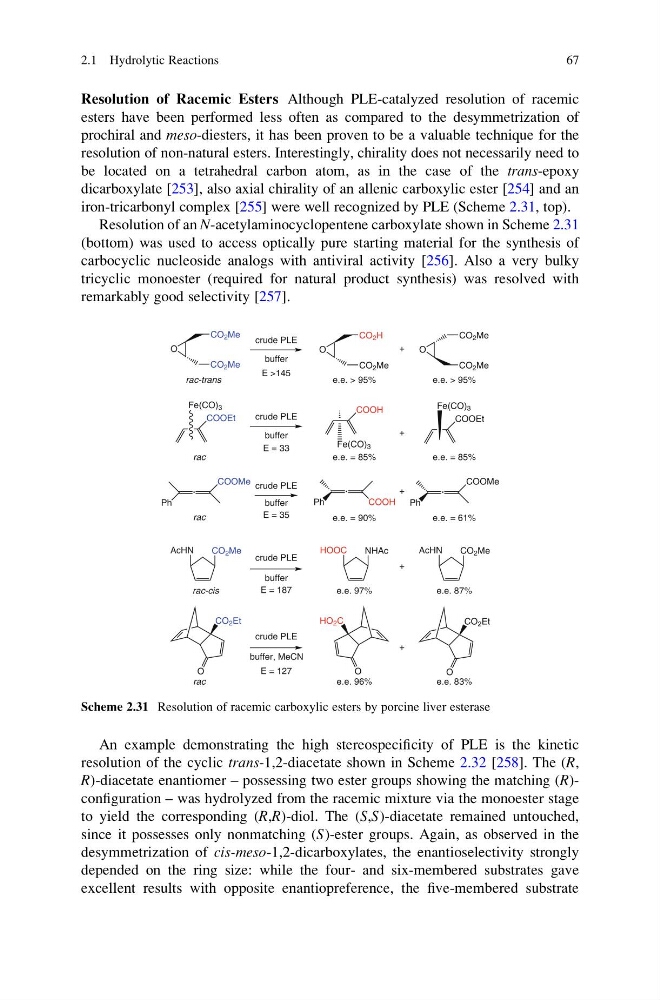
Resolution of Racemic Esters Although PLE-catalyzed resolution of racemic
esters have been performed less often as compared to the desymmetrization of
prochiral and meso-diesters, it has been proven to be a valuable technique for the
resolution of non-natural esters. Interestingly, chirality does not necessarily need to
be located on a tetrahedral carbon atom, as in the case of the trans-epoxy
dicarboxylate [253], also axial chirality of an allenic carboxylic ester [254] and an
iron-tricarbonyl complex [255] were well recognized by PLE (Scheme 2.31, top).
Resolution of an N-acetylaminocyclopentene carboxylate shown in Scheme 2.31
(bottom) was used to access optically pure starting material for the synthesis of
carbocyclic nucleoside analogs with antiviral activity [256]. Also a very bulky
tricyclic monoester (required for natural product synthesis) was resolved with
remarkably good selectivity [257].
An example demonstrating the high stereospecificity of PLE is the kinetic
resolution of the cyclic trans-1,2-diacetate shown in Scheme 2.32 [258]. The (R,
R)-diacetate enantiomer – possessing two ester groups showing the matching (R)configuration – was hydrolyzed from the racemic mixture via the monoester stage
to yield the corresponding (R,R)-diol. The (S,S)-diacetate remained untouched,
since it possesses only nonmatching (S)-ester groups. Again, as observed in the
desymmetrization of cis-meso-1,2-dicarboxylates, the enantioselectivity strongly
depended on the ring size: while the four- and six-membered substrates gave
excellent results with opposite enantiopreference, the five-membered substrate
Fe(CO) 3
COOEt
COOH
Fe(CO) 3
COOMe
Ph
.
COOH
Ph
.
COOMe
Ph
.
Fe(CO) 3
COOEt
CO 2 Me
CO 2 Me
O
CO 2 Me
CO 2 H
O
CO 2 Me
CO 2 Me
O
E = 35
E = 33
E >145
e.e. = 85%
e.e. = 85%
e.e. = 61%
e.e. = 90%
rac
crude PLE
buffer
+
+
buffer
crude PLE
rac
rac-trans
+
e.e. > 95%
e.e. > 95%
crude PLE
buffer
AcHN
CO 2 Me
AcHN
CO 2 Me
HOOC
NHAc
CO 2 Et
O
CO 2 Et
O
HO 2 C
O
rac-cis
buffer
crude PLE
+
e.e. 97%
e.e. 87%
rac
+
crude PLE
buffer, MeCN
e.e. 96%
e.e. 83%
E = 187
E = 127
Scheme 2.31 Resolution of racemic carboxylic esters by porcine liver esterase
2.1 Hydrolytic Reactions
67
esters have been performed less often as compared to the desymmetrization of
prochiral and meso-diesters, it has been proven to be a valuable technique for the
resolution of non-natural esters. Interestingly, chirality does not necessarily need to
be located on a tetrahedral carbon atom, as in the case of the trans-epoxy
dicarboxylate [253], also axial chirality of an allenic carboxylic ester [254] and an
iron-tricarbonyl complex [255] were well recognized by PLE (Scheme 2.31, top).
Resolution of an N-acetylaminocyclopentene carboxylate shown in Scheme 2.31
(bottom) was used to access optically pure starting material for the synthesis of
carbocyclic nucleoside analogs with antiviral activity [256]. Also a very bulky
tricyclic monoester (required for natural product synthesis) was resolved with
remarkably good selectivity [257].
An example demonstrating the high stereospecificity of PLE is the kinetic
resolution of the cyclic trans-1,2-diacetate shown in Scheme 2.32 [258]. The (R,
R)-diacetate enantiomer – possessing two ester groups showing the matching (R)configuration – was hydrolyzed from the racemic mixture via the monoester stage
to yield the corresponding (R,R)-diol. The (S,S)-diacetate remained untouched,
since it possesses only nonmatching (S)-ester groups. Again, as observed in the
desymmetrization of cis-meso-1,2-dicarboxylates, the enantioselectivity strongly
depended on the ring size: while the four- and six-membered substrates gave
excellent results with opposite enantiopreference, the five-membered substrate
Fe(CO) 3
COOEt
COOH
Fe(CO) 3
COOMe
Ph
.
COOH
Ph
.
COOMe
Ph
.
Fe(CO) 3
COOEt
CO 2 Me
CO 2 Me
O
CO 2 Me
CO 2 H
O
CO 2 Me
CO 2 Me
O
E = 35
E = 33
E >145
e.e. = 85%
e.e. = 85%
e.e. = 61%
e.e. = 90%
rac
crude PLE
buffer
+
+
buffer
crude PLE
rac
rac-trans
+
e.e. > 95%
e.e. > 95%
crude PLE
buffer
AcHN
CO 2 Me
AcHN
CO 2 Me
HOOC
NHAc
CO 2 Et
O
CO 2 Et
O
HO 2 C
O
rac-cis
buffer
crude PLE
+
e.e. 97%
e.e. 87%
rac
+
crude PLE
buffer, MeCN
e.e. 96%
e.e. 83%
E = 187
E = 127
Scheme 2.31 Resolution of racemic carboxylic esters by porcine liver esterase
2.1 Hydrolytic Reactions
67