

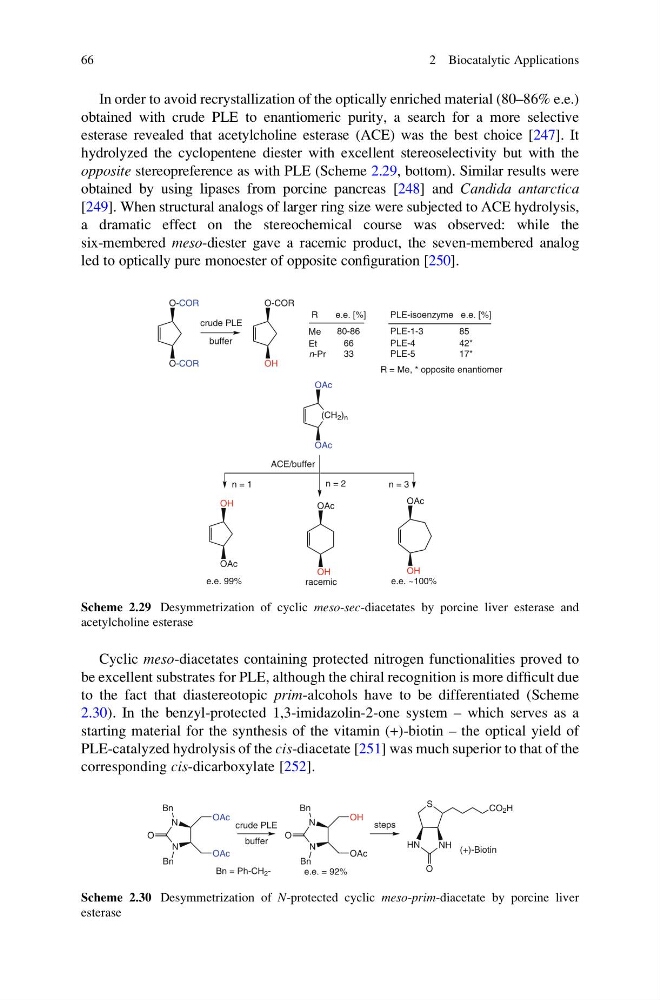
In order to avoid recrystallization of the optically enriched material (80–86% e.e.)
obtained with crude PLE to enantiomeric purity, a search for a more selective
esterase revealed that acetylcholine esterase (ACE) was the best choice [247]. It
hydrolyzed the cyclopentene diester with excellent stereoselectivity but with the
opposite stereopreference as with PLE (Scheme 2.29, bottom). Similar results were
obtained by using lipases from porcine pancreas [248] and Candida antarctica
[249]. When structural analogs of larger ring size were subjected to ACE hydrolysis,
a dramatic effect on the stereochemical course was observed: while the
six-membered meso-diester gave a racemic product, the seven-membered analog
led to optically pure monoester of opposite configuration [250].
Cyclic meso-diacetates containing protected nitrogen functionalities proved to
be excellent substrates for PLE, although the chiral recognition is more difficult due
to the fact that diastereotopic prim-alcohols have to be differentiated (Scheme
2.30). In the benzyl-protected 1,3-imidazolin-2-one system – which serves as a
starting material for the synthesis of the vitamin (+)-biotin – the optical yield of
PLE-catalyzed hydrolysis of the cis-diacetate [251] was much superior to that of the
corresponding cis-dicarboxylate [252].
O-COR
O-COR
OH
OAc
O-COR
OH
OH
OAc
OAc
OAc
(CH 2 ) n
OH
OAc
R = Me, * opposite enantiomer
17*
PLE-5
42*
PLE-4
85
PLE-1-3
PLE-isoenzyme e.e. [%]
33
66
80-86
R
e.e. [%]
buffer
crude PLE
ACE/buffer
e.e. 99%
e.e. ~100%
n = 2
n =
n
1
= 3
racemic
n-Pr
Et
Me
Scheme 2.29 Desymmetrization of cyclic meso-sec-diacetates by porcine liver esterase and
acetylcholine esterase
HN
NH
O
S
OAc
OH
Bn
Bn
O
N
N
OAc
OAc
Bn
Bn
O
N
N
(+)-Biotin
e.e. = 92%
steps
crude PLE
buffer
CO 2 H
Bn = Ph-CH 2 -
Scheme 2.30 Desymmetrization of N-protected cyclic meso-prim-diacetate by porcine liver
esterase
66
2 Biocatalytic Applications
obtained with crude PLE to enantiomeric purity, a search for a more selective
esterase revealed that acetylcholine esterase (ACE) was the best choice [247]. It
hydrolyzed the cyclopentene diester with excellent stereoselectivity but with the
opposite stereopreference as with PLE (Scheme 2.29, bottom). Similar results were
obtained by using lipases from porcine pancreas [248] and Candida antarctica
[249]. When structural analogs of larger ring size were subjected to ACE hydrolysis,
a dramatic effect on the stereochemical course was observed: while the
six-membered meso-diester gave a racemic product, the seven-membered analog
led to optically pure monoester of opposite configuration [250].
Cyclic meso-diacetates containing protected nitrogen functionalities proved to
be excellent substrates for PLE, although the chiral recognition is more difficult due
to the fact that diastereotopic prim-alcohols have to be differentiated (Scheme
2.30). In the benzyl-protected 1,3-imidazolin-2-one system – which serves as a
starting material for the synthesis of the vitamin (+)-biotin – the optical yield of
PLE-catalyzed hydrolysis of the cis-diacetate [251] was much superior to that of the
corresponding cis-dicarboxylate [252].
O-COR
O-COR
OH
OAc
O-COR
OH
OH
OAc
OAc
OAc
(CH 2 ) n
OH
OAc
R = Me, * opposite enantiomer
17*
PLE-5
42*
PLE-4
85
PLE-1-3
PLE-isoenzyme e.e. [%]
33
66
80-86
R
e.e. [%]
buffer
crude PLE
ACE/buffer
e.e. 99%
e.e. ~100%
n = 2
n =
n
1
= 3
racemic
n-Pr
Et
Me
Scheme 2.29 Desymmetrization of cyclic meso-sec-diacetates by porcine liver esterase and
acetylcholine esterase
HN
NH
O
S
OAc
OH
Bn
Bn
O
N
N
OAc
OAc
Bn
Bn
O
N
N
(+)-Biotin
e.e. = 92%
steps
crude PLE
buffer
CO 2 H
Bn = Ph-CH 2 -
Scheme 2.30 Desymmetrization of N-protected cyclic meso-prim-diacetate by porcine liver
esterase
66
2 Biocatalytic Applications