

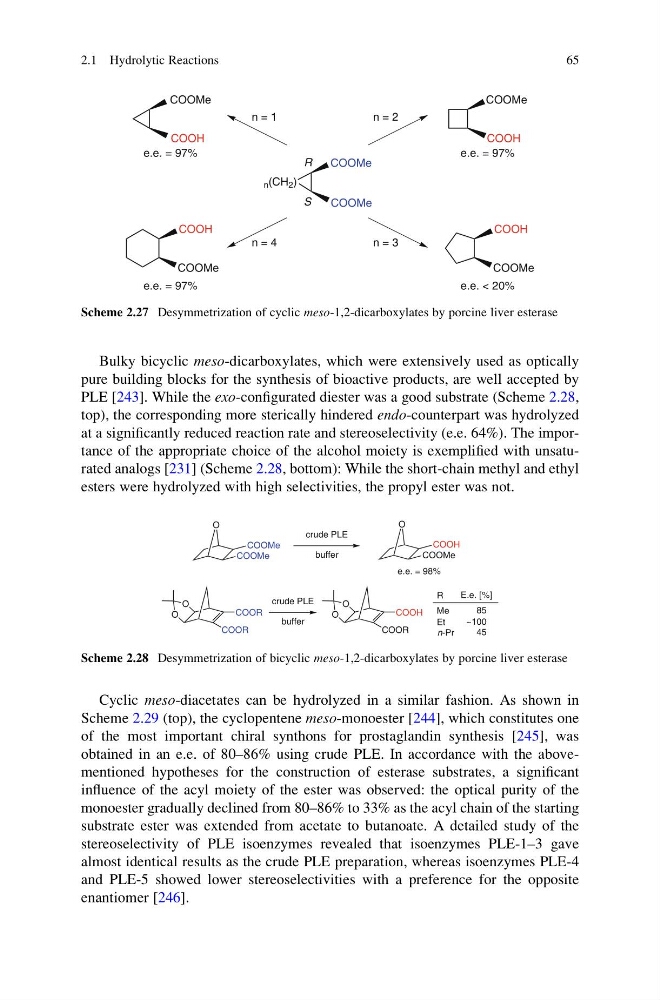
Bulky bicyclic meso-dicarboxylates, which were extensively used as optically
pure building blocks for the synthesis of bioactive products, are well accepted by
PLE [243]. While the exo-configurated diester was a good substrate (Scheme 2.28,
top), the corresponding more sterically hindered endo-counterpart was hydrolyzed
at a significantly reduced reaction rate and stereoselectivity (e.e. 64%). The importance of the appropriate choice of the alcohol moiety is exemplified with unsaturated analogs [231] (Scheme 2.28, bottom): While the short-chain methyl and ethyl
esters were hydrolyzed with high selectivities, the propyl ester was not.
Cyclic meso-diacetates can be hydrolyzed in a similar fashion. As shown in
Scheme 2.29 (top), the cyclopentene meso-monoester [244], which constitutes one
of the most important chiral synthons for prostaglandin synthesis [245], was
obtained in an e.e. of 80–86% using crude PLE. In accordance with the abovementioned hypotheses for the construction of esterase substrates, a significant
influence of the acyl moiety of the ester was observed: the optical purity of the
monoester gradually declined from 80–86% to 33% as the acyl chain of the starting
substrate ester was extended from acetate to butanoate. A detailed study of the
stereoselectivity of PLE isoenzymes revealed that isoenzymes PLE-1–3 gave
almost identical results as the crude PLE preparation, whereas isoenzymes PLE-4
and PLE-5 showed lower stereoselectivities with a preference for the opposite
enantiomer [246].
n (CH 2 )
COOMe
COOMe
COOH
COOMe
COOH
COOMe
COOMe
COOH
COOMe
COOH
e.e. = 97%
e.e. < 20%
e.e. = 97%
e.e. = 97%
n = 4
n = 3
n = 2
n = 1
S
R
Scheme 2.27 Desymmetrization of cyclic meso-1,2-dicarboxylates by porcine liver esterase
COOMe
COOMe
O
COOR
COOR
COOH
COOMe
O
COOR
COOH
buffer
crude PLE
buffer
crude PLE
e.e. = 98%
O
O
O
O
R
E.e. [%]
Me
Et
n-Pr
85
~100
45
Scheme 2.28 Desymmetrization of bicyclic meso-1,2-dicarboxylates by porcine liver esterase
2.1 Hydrolytic Reactions
65
pure building blocks for the synthesis of bioactive products, are well accepted by
PLE [243]. While the exo-configurated diester was a good substrate (Scheme 2.28,
top), the corresponding more sterically hindered endo-counterpart was hydrolyzed
at a significantly reduced reaction rate and stereoselectivity (e.e. 64%). The importance of the appropriate choice of the alcohol moiety is exemplified with unsaturated analogs [231] (Scheme 2.28, bottom): While the short-chain methyl and ethyl
esters were hydrolyzed with high selectivities, the propyl ester was not.
Cyclic meso-diacetates can be hydrolyzed in a similar fashion. As shown in
Scheme 2.29 (top), the cyclopentene meso-monoester [244], which constitutes one
of the most important chiral synthons for prostaglandin synthesis [245], was
obtained in an e.e. of 80–86% using crude PLE. In accordance with the abovementioned hypotheses for the construction of esterase substrates, a significant
influence of the acyl moiety of the ester was observed: the optical purity of the
monoester gradually declined from 80–86% to 33% as the acyl chain of the starting
substrate ester was extended from acetate to butanoate. A detailed study of the
stereoselectivity of PLE isoenzymes revealed that isoenzymes PLE-1–3 gave
almost identical results as the crude PLE preparation, whereas isoenzymes PLE-4
and PLE-5 showed lower stereoselectivities with a preference for the opposite
enantiomer [246].
n (CH 2 )
COOMe
COOMe
COOH
COOMe
COOH
COOMe
COOMe
COOH
COOMe
COOH
e.e. = 97%
e.e. < 20%
e.e. = 97%
e.e. = 97%
n = 4
n = 3
n = 2
n = 1
S
R
Scheme 2.27 Desymmetrization of cyclic meso-1,2-dicarboxylates by porcine liver esterase
COOMe
COOMe
O
COOR
COOR
COOH
COOMe
O
COOR
COOH
buffer
crude PLE
buffer
crude PLE
e.e. = 98%
O
O
O
O
R
E.e. [%]
Me
Et
n-Pr
85
~100
45
Scheme 2.28 Desymmetrization of bicyclic meso-1,2-dicarboxylates by porcine liver esterase
2.1 Hydrolytic Reactions
65