

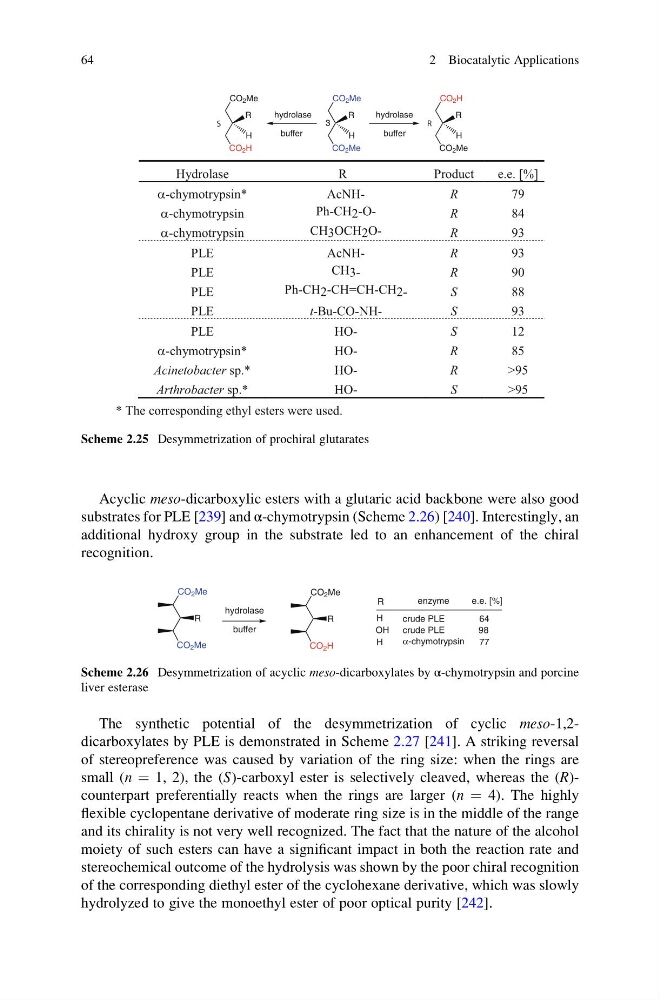
Acyclic meso-dicarboxylic esters with a glutaric acid backbone were also good
substrates for PLE [239] and α-chymotrypsin (Scheme 2.26) [240]. Interestingly, an
additional hydroxy group in the substrate led to an enhancement of the chiral
recognition.
The synthetic potential of the desymmetrization of cyclic meso-1,2dicarboxylates by PLE is demonstrated in Scheme 2.27 [241]. A striking reversal
of stereopreference was caused by variation of the ring size: when the rings are
small (n ¼ 1, 2), the (S)-carboxyl ester is selectively cleaved, whereas the (R)counterpart preferentially reacts when the rings are larger (n ¼ 4). The highly
flexible cyclopentane derivative of moderate ring size is in the middle of the range
and its chirality is not very well recognized. The fact that the nature of the alcohol
moiety of such esters can have a significant impact in both the reaction rate and
stereochemical outcome of the hydrolysis was shown by the poor chiral recognition
of the corresponding diethyl ester of the cyclohexane derivative, which was slowly
hydrolyzed to give the monoethyl ester of poor optical purity [242].
Hydrolase
R
α-chymotrypsin*
AcNHα-chymotrypsin
Ph-CH 2 -Oα-chymotrypsin
CH 3 OCH 2 OPLE
AcNHPLE
CH 3PLE
Ph-CH 2 -CH=CH-CH 2PLE
t-Bu-CO-NHPLE
HOα-chymotrypsin*
HOAcinetobacter sp.*
HOArthrobacter sp.*
HOProduct
e.e. [%]
R
79
R
84
R
93
R
93
R
90
S
88
S
93
S
12
R
85
R
>95
S
>95
* The corresponding ethyl esters were used.
H
R
CO 2 Me
CO 2 H
H
R
CO 2 Me
CO 2 Me
H
R
CO 2 H
CO 2 Me
3
hydrolase
hydrolase
buffer
buffer
R
S
Scheme 2.25 Desymmetrization of prochiral glutarates
R
CO 2 H
CO 2 Me
R
CO 2 Me
CO 2 Me
hydrolase
buffer
77
α-chymotrypsin
98
crude PLE
64
crude PLE
e.e. [%]
enzyme
H
OH
H
R
Scheme 2.26 Desymmetrization of acyclic meso-dicarboxylates by α-chymotrypsin and porcine
liver esterase
64
2 Biocatalytic Applications
substrates for PLE [239] and α-chymotrypsin (Scheme 2.26) [240]. Interestingly, an
additional hydroxy group in the substrate led to an enhancement of the chiral
recognition.
The synthetic potential of the desymmetrization of cyclic meso-1,2dicarboxylates by PLE is demonstrated in Scheme 2.27 [241]. A striking reversal
of stereopreference was caused by variation of the ring size: when the rings are
small (n ¼ 1, 2), the (S)-carboxyl ester is selectively cleaved, whereas the (R)counterpart preferentially reacts when the rings are larger (n ¼ 4). The highly
flexible cyclopentane derivative of moderate ring size is in the middle of the range
and its chirality is not very well recognized. The fact that the nature of the alcohol
moiety of such esters can have a significant impact in both the reaction rate and
stereochemical outcome of the hydrolysis was shown by the poor chiral recognition
of the corresponding diethyl ester of the cyclohexane derivative, which was slowly
hydrolyzed to give the monoethyl ester of poor optical purity [242].
Hydrolase
R
α-chymotrypsin*
AcNHα-chymotrypsin
Ph-CH 2 -Oα-chymotrypsin
CH 3 OCH 2 OPLE
AcNHPLE
CH 3PLE
Ph-CH 2 -CH=CH-CH 2PLE
t-Bu-CO-NHPLE
HOα-chymotrypsin*
HOAcinetobacter sp.*
HOArthrobacter sp.*
HOProduct
e.e. [%]
R
79
R
84
R
93
R
93
R
90
S
88
S
93
S
12
R
85
R
>95
S
>95
* The corresponding ethyl esters were used.
H
R
CO 2 Me
CO 2 H
H
R
CO 2 Me
CO 2 Me
H
R
CO 2 H
CO 2 Me
3
hydrolase
hydrolase
buffer
buffer
R
S
Scheme 2.25 Desymmetrization of prochiral glutarates
R
CO 2 H
CO 2 Me
R
CO 2 Me
CO 2 Me
hydrolase
buffer
77
α-chymotrypsin
98
crude PLE
64
crude PLE
e.e. [%]
enzyme
H
OH
H
R
Scheme 2.26 Desymmetrization of acyclic meso-dicarboxylates by α-chymotrypsin and porcine
liver esterase
64
2 Biocatalytic Applications