

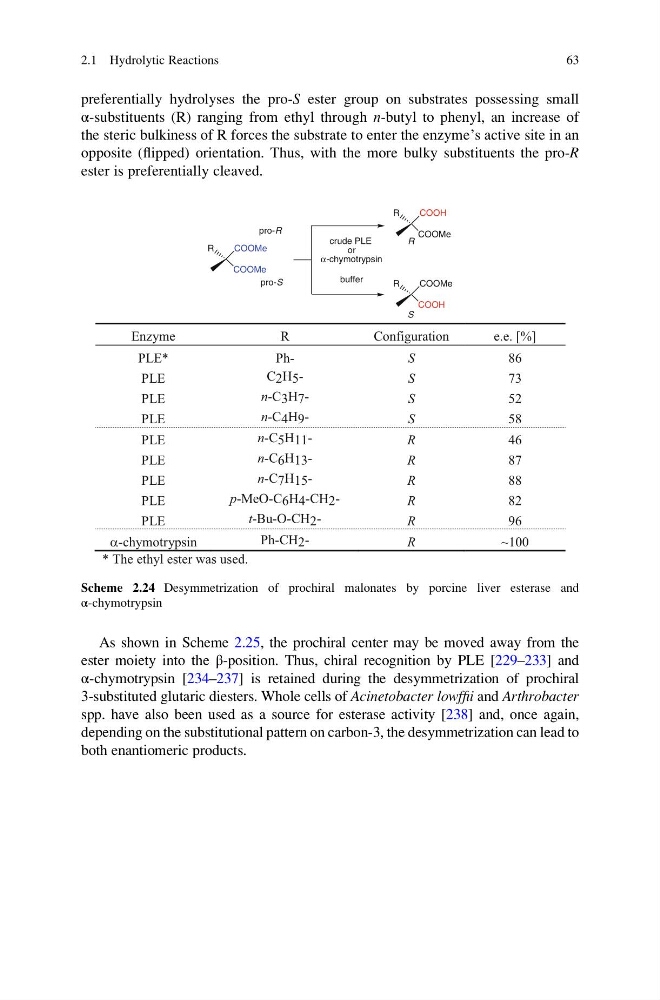
preferentially hydrolyses the pro-S ester group on substrates possessing small
α-substituents (R) ranging from ethyl through n-butyl to phenyl, an increase of
the steric bulkiness of R forces the substrate to enter the enzyme’s active site in an
opposite (flipped) orientation. Thus, with the more bulky substituents the pro-R
ester is preferentially cleaved.
As shown in Scheme 2.25, the prochiral center may be moved away from the
ester moiety into the β-position. Thus, chiral recognition by PLE [229–233] and
α-chymotrypsin [234–237] is retained during the desymmetrization of prochiral
3-substituted glutaric diesters. Whole cells of Acinetobacter lowffii and Arthrobacter
spp. have also been used as a source for esterase activity [238] and, once again,
depending on the substitutional pattern on carbon-3, the desymmetrization can lead to
both enantiomeric products.
R
COOMe
COOH
R
COOMe
COOMe
R
COOH
COOMe
pro-S
pro-R
crude PLE
or
α-chymotrypsin
buffer
S
R
Enzyme
R
Configuration
e.e. [%]
PLE*
PhS
86
PLE
C 2 H 5 -
S
73
PLE
n-C 3 H 7 -
S
52
PLE
n-C 4 H 9 -
S
58
PLE
n-C 5 H 11 -
R
46
PLE
n-C 6 H 13 -
R
87
PLE
n-C 7 H 15 -
R
88
PLE
p-MeO-C 6 H 4 -CH 2 -
R
82
PLE
t-Bu-O-CH 2 -
R
96
α-chymotrypsin
Ph-CH 2 -
R
~100
* The ethyl ester was used.
Scheme 2.24 Desymmetrization of prochiral malonates by porcine liver esterase and
α-chymotrypsin
2.1 Hydrolytic Reactions
63
α-substituents (R) ranging from ethyl through n-butyl to phenyl, an increase of
the steric bulkiness of R forces the substrate to enter the enzyme’s active site in an
opposite (flipped) orientation. Thus, with the more bulky substituents the pro-R
ester is preferentially cleaved.
As shown in Scheme 2.25, the prochiral center may be moved away from the
ester moiety into the β-position. Thus, chiral recognition by PLE [229–233] and
α-chymotrypsin [234–237] is retained during the desymmetrization of prochiral
3-substituted glutaric diesters. Whole cells of Acinetobacter lowffii and Arthrobacter
spp. have also been used as a source for esterase activity [238] and, once again,
depending on the substitutional pattern on carbon-3, the desymmetrization can lead to
both enantiomeric products.
R
COOMe
COOH
R
COOMe
COOMe
R
COOH
COOMe
pro-S
pro-R
crude PLE
or
α-chymotrypsin
buffer
S
R
Enzyme
R
Configuration
e.e. [%]
PLE*
PhS
86
PLE
C 2 H 5 -
S
73
PLE
n-C 3 H 7 -
S
52
PLE
n-C 4 H 9 -
S
58
PLE
n-C 5 H 11 -
R
46
PLE
n-C 6 H 13 -
R
87
PLE
n-C 7 H 15 -
R
88
PLE
p-MeO-C 6 H 4 -CH 2 -
R
82
PLE
t-Bu-O-CH 2 -
R
96
α-chymotrypsin
Ph-CH 2 -
R
~100
* The ethyl ester was used.
Scheme 2.24 Desymmetrization of prochiral malonates by porcine liver esterase and
α-chymotrypsin
2.1 Hydrolytic Reactions
63