

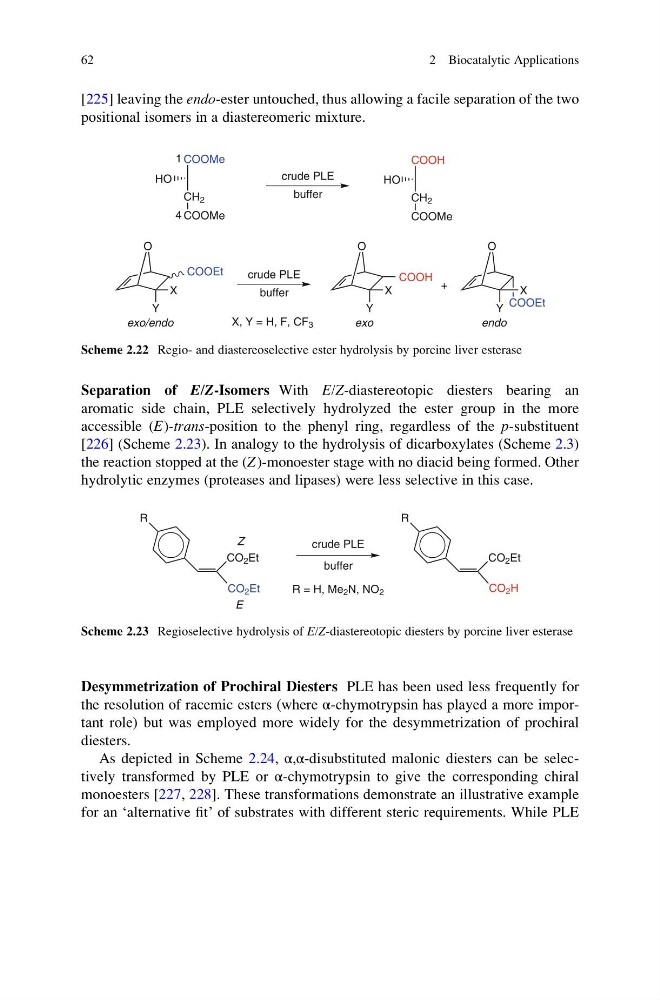
[225] leaving the endo-ester untouched, thus allowing a facile separation of the two
positional isomers in a diastereomeric mixture.
Separation of E/Z-Isomers With E/Z-diastereotopic diesters bearing an
aromatic side chain, PLE selectively hydrolyzed the ester group in the more
accessible (E)-trans-position to the phenyl ring, regardless of the p-substituent
[226] (Scheme 2.23). In analogy to the hydrolysis of dicarboxylates (Scheme 2.3)
the reaction stopped at the (Z )-monoester stage with no diacid being formed. Other
hydrolytic enzymes (proteases and lipases) were less selective in this case.
Desymmetrization of Prochiral Diesters PLE has been used less frequently for
the resolution of racemic esters (where α-chymotrypsin has played a more important role) but was employed more widely for the desymmetrization of prochiral
diesters.
As depicted in Scheme 2.24, α,α-disubstituted malonic diesters can be selectively transformed by PLE or α-chymotrypsin to give the corresponding chiral
monoesters [227, 228]. These transformations demonstrate an illustrative example
for an ‘alternative fit’ of substrates with different steric requirements. While PLE
COOMe
HO
CH 2
COOMe
COOMe
HO
CH 2
COOH
COOEt
X
Y
O
COOH
X
Y
O
X
COOEt
Y
O
buffer
crude PLE
1
4
exo/endo
exo
endo
crude PLE
buffer
+
X, Y = H, F, CF 3
Scheme 2.22 Regio- and diastereoselective ester hydrolysis by porcine liver esterase
R
CO 2 H
CO 2 Et
R
CO 2 Et
CO 2 Et
R = H, Me 2 N, NO 2
crude PLE
buffer
Z
E
Scheme 2.23 Regioselective hydrolysis of E/Z-diastereotopic diesters by porcine liver esterase
62
2 Biocatalytic Applications
positional isomers in a diastereomeric mixture.
Separation of E/Z-Isomers With E/Z-diastereotopic diesters bearing an
aromatic side chain, PLE selectively hydrolyzed the ester group in the more
accessible (E)-trans-position to the phenyl ring, regardless of the p-substituent
[226] (Scheme 2.23). In analogy to the hydrolysis of dicarboxylates (Scheme 2.3)
the reaction stopped at the (Z )-monoester stage with no diacid being formed. Other
hydrolytic enzymes (proteases and lipases) were less selective in this case.
Desymmetrization of Prochiral Diesters PLE has been used less frequently for
the resolution of racemic esters (where α-chymotrypsin has played a more important role) but was employed more widely for the desymmetrization of prochiral
diesters.
As depicted in Scheme 2.24, α,α-disubstituted malonic diesters can be selectively transformed by PLE or α-chymotrypsin to give the corresponding chiral
monoesters [227, 228]. These transformations demonstrate an illustrative example
for an ‘alternative fit’ of substrates with different steric requirements. While PLE
COOMe
HO
CH 2
COOMe
COOMe
HO
CH 2
COOH
COOEt
X
Y
O
COOH
X
Y
O
X
COOEt
Y
O
buffer
crude PLE
1
4
exo/endo
exo
endo
crude PLE
buffer
+
X, Y = H, F, CF 3
Scheme 2.22 Regio- and diastereoselective ester hydrolysis by porcine liver esterase
R
CO 2 H
CO 2 Et
R
CO 2 Et
CO 2 Et
R = H, Me 2 N, NO 2
crude PLE
buffer
Z
E
Scheme 2.23 Regioselective hydrolysis of E/Z-diastereotopic diesters by porcine liver esterase
62
2 Biocatalytic Applications