

However, they can be resolved using a special group of proteases acting on cyclic
amide bonds – lactamases [172].
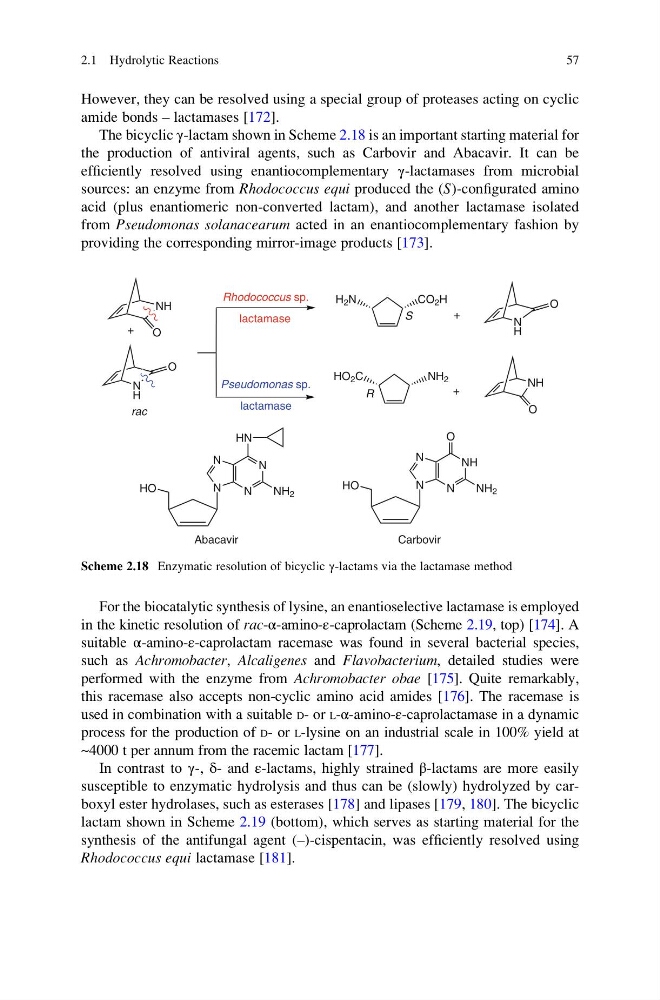
The bicyclic γ-lactam shown in Scheme 2.18 is an important starting material for
the production of antiviral agents, such as Carbovir and Abacavir. It can be
efficiently resolved using enantiocomplementary γ-lactamases from microbial
sources: an enzyme from Rhodococcus equi produced the (S)-configurated amino
acid (plus enantiomeric non-converted lactam), and another lactamase isolated
from Pseudomonas solanacearum acted in an enantiocomplementary fashion by
providing the corresponding mirror-image products [173].
For the biocatalytic synthesis of lysine, an enantioselective lactamase is employed
in the kinetic resolution of rac-α-amino-ε-caprolactam (Scheme 2.19, top) [174]. A
suitable α-amino-ε-caprolactam racemase was found in several bacterial species,
such as Achromobacter, Alcaligenes and Flavobacterium, detailed studies were
performed with the enzyme from Achromobacter obae [175]. Quite remarkably,
this racemase also accepts non-cyclic amino acid amides [176]. The racemase is
used in combination with a suitable D- or L-α-amino-ε-caprolactamase in a dynamic
process for the production of D- or L-lysine on an industrial scale in 100% yield at
~4000 t per annum from the racemic lactam [177].
In contrast to γ-, δ- and ε-lactams, highly strained β-lactams are more easily
susceptible to enzymatic hydrolysis and thus can be (slowly) hydrolyzed by carboxyl ester hydrolases, such as esterases [178] and lipases [179, 180]. The bicyclic
lactam shown in Scheme 2.19 (bottom), which serves as starting material for the
synthesis of the antifungal agent (–)-cispentacin, was efficiently resolved using
Rhodococcus equi lactamase [181].
HN
NH 2
N
N
N
N
HO
O
NH
O
NH
CO 2 H
H 2 N
NH 2
HO 2 C
O
NH 2
N
N
NH
N
HO
N
H
O
N
H
O
Abacavir
+
rac
+
+
Carbovir
Pseudomonas sp.
lactamase
Rhodococcus sp.
lactamase
S
R
Scheme 2.18 Enzymatic resolution of bicyclic γ-lactams via the lactamase method
2.1 Hydrolytic Reactions
57
amide bonds – lactamases [172].
The bicyclic γ-lactam shown in Scheme 2.18 is an important starting material for
the production of antiviral agents, such as Carbovir and Abacavir. It can be
efficiently resolved using enantiocomplementary γ-lactamases from microbial
sources: an enzyme from Rhodococcus equi produced the (S)-configurated amino
acid (plus enantiomeric non-converted lactam), and another lactamase isolated
from Pseudomonas solanacearum acted in an enantiocomplementary fashion by
providing the corresponding mirror-image products [173].
For the biocatalytic synthesis of lysine, an enantioselective lactamase is employed
in the kinetic resolution of rac-α-amino-ε-caprolactam (Scheme 2.19, top) [174]. A
suitable α-amino-ε-caprolactam racemase was found in several bacterial species,
such as Achromobacter, Alcaligenes and Flavobacterium, detailed studies were
performed with the enzyme from Achromobacter obae [175]. Quite remarkably,
this racemase also accepts non-cyclic amino acid amides [176]. The racemase is
used in combination with a suitable D- or L-α-amino-ε-caprolactamase in a dynamic
process for the production of D- or L-lysine on an industrial scale in 100% yield at
~4000 t per annum from the racemic lactam [177].
In contrast to γ-, δ- and ε-lactams, highly strained β-lactams are more easily
susceptible to enzymatic hydrolysis and thus can be (slowly) hydrolyzed by carboxyl ester hydrolases, such as esterases [178] and lipases [179, 180]. The bicyclic
lactam shown in Scheme 2.19 (bottom), which serves as starting material for the
synthesis of the antifungal agent (–)-cispentacin, was efficiently resolved using
Rhodococcus equi lactamase [181].
HN
NH 2
N
N
N
N
HO
O
NH
O
NH
CO 2 H
H 2 N
NH 2
HO 2 C
O
NH 2
N
N
NH
N
HO
N
H
O
N
H
O
Abacavir
+
rac
+
+
Carbovir
Pseudomonas sp.
lactamase
Rhodococcus sp.
lactamase
S
R
Scheme 2.18 Enzymatic resolution of bicyclic γ-lactams via the lactamase method
2.1 Hydrolytic Reactions
57