

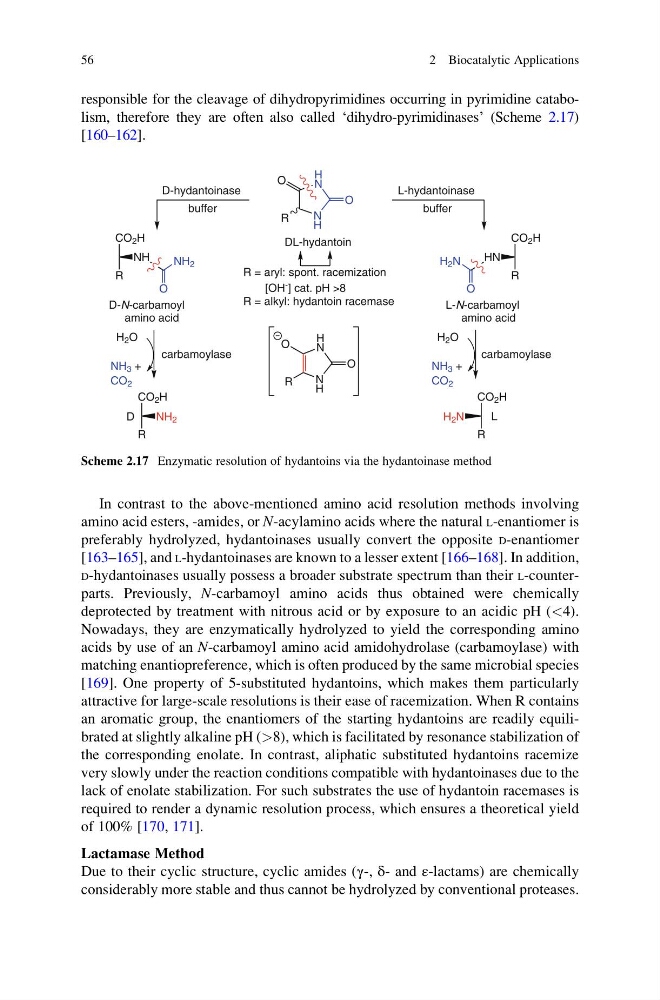
responsible for the cleavage of dihydropyrimidines occurring in pyrimidine catabolism, therefore they are often also called ‘dihydro-pyrimidinases’ (Scheme 2.17)
[160–162].
In contrast to the above-mentioned amino acid resolution methods involving
amino acid esters, -amides, or N-acylamino acids where the natural L-enantiomer is
preferably hydrolyzed, hydantoinases usually convert the opposite D-enantiomer
[163–165], and L-hydantoinases are known to a lesser extent [166–168]. In addition,
D-hydantoinases usually possess a broader substrate spectrum than their L-counterparts. Previously, N-carbamoyl amino acids thus obtained were chemically
deprotected by treatment with nitrous acid or by exposure to an acidic pH (<4).
Nowadays, they are enzymatically hydrolyzed to yield the corresponding amino
acids by use of an N-carbamoyl amino acid amidohydrolase (carbamoylase) with
matching enantiopreference, which is often produced by the same microbial species
[169]. One property of 5-substituted hydantoins, which makes them particularly
attractive for large-scale resolutions is their ease of racemization. When R contains
an aromatic group, the enantiomers of the starting hydantoins are readily equilibrated at slightly alkaline pH (>8), which is facilitated by resonance stabilization of
the corresponding enolate. In contrast, aliphatic substituted hydantoins racemize
very slowly under the reaction conditions compatible with hydantoinases due to the
lack of enolate stabilization. For such substrates the use of hydantoin racemases is
required to render a dynamic resolution process, which ensures a theoretical yield
of 100% [170, 171].
Lactamase Method
Due to their cyclic structure, cyclic amides (γ-, δ- and ε-lactams) are chemically
considerably more stable and thus cannot be hydrolyzed by conventional proteases.
R
O
O
H
N
N
H
O
H 2 N
HN
R
CO 2 H
R
O
O
H
N
N
H
O
NH 2
NH
R
CO 2 H
NH 2
R
CO 2 H
H 2 N
R
CO 2 H
NH 3 +
CO 2
carbamoylase
carbamoylase
D-N-carbamoyl
amino acid
L-N-carbamoyl
amino acid
R = alkyl: hydantoin racemase
R = aryl: spont. racemization
[OH
- ] cat. pH >8
DL-hydantoin
L
D-hydantoinase
buffer
L-hydantoinase
buffer
H 2 O
D
NH 3 +
CO 2
H 2 O
Scheme 2.17 Enzymatic resolution of hydantoins via the hydantoinase method
56
2 Biocatalytic Applications
[160–162].
In contrast to the above-mentioned amino acid resolution methods involving
amino acid esters, -amides, or N-acylamino acids where the natural L-enantiomer is
preferably hydrolyzed, hydantoinases usually convert the opposite D-enantiomer
[163–165], and L-hydantoinases are known to a lesser extent [166–168]. In addition,
D-hydantoinases usually possess a broader substrate spectrum than their L-counterparts. Previously, N-carbamoyl amino acids thus obtained were chemically
deprotected by treatment with nitrous acid or by exposure to an acidic pH (<4).
Nowadays, they are enzymatically hydrolyzed to yield the corresponding amino
acids by use of an N-carbamoyl amino acid amidohydrolase (carbamoylase) with
matching enantiopreference, which is often produced by the same microbial species
[169]. One property of 5-substituted hydantoins, which makes them particularly
attractive for large-scale resolutions is their ease of racemization. When R contains
an aromatic group, the enantiomers of the starting hydantoins are readily equilibrated at slightly alkaline pH (>8), which is facilitated by resonance stabilization of
the corresponding enolate. In contrast, aliphatic substituted hydantoins racemize
very slowly under the reaction conditions compatible with hydantoinases due to the
lack of enolate stabilization. For such substrates the use of hydantoin racemases is
required to render a dynamic resolution process, which ensures a theoretical yield
of 100% [170, 171].
Lactamase Method
Due to their cyclic structure, cyclic amides (γ-, δ- and ε-lactams) are chemically
considerably more stable and thus cannot be hydrolyzed by conventional proteases.
R
O
O
H
N
N
H
O
H 2 N
HN
R
CO 2 H
R
O
O
H
N
N
H
O
NH 2
NH
R
CO 2 H
NH 2
R
CO 2 H
H 2 N
R
CO 2 H
NH 3 +
CO 2
carbamoylase
carbamoylase
D-N-carbamoyl
amino acid
L-N-carbamoyl
amino acid
R = alkyl: hydantoin racemase
R = aryl: spont. racemization
[OH
- ] cat. pH >8
DL-hydantoin
L
D-hydantoinase
buffer
L-hydantoinase
buffer
H 2 O
D
NH 3 +
CO 2
H 2 O
Scheme 2.17 Enzymatic resolution of hydantoins via the hydantoinase method
56
2 Biocatalytic Applications