

On a laboratory scale, the readily available amino acylase from hog kidney is
recommended [141]. It proved to be extremely substrate-tolerant, allowing variations
of the alkyl- or aryl-moiety R within a wide structural range while retaining very high
specificities for L-enantiomers, which made it a reliable tool for the synthesis of
bioactive compounds [142–144]. Unwanted enantiomers of N-acetyl amino acids can
be racemized ex-situ by heating with acetic anhydride, which involves activation of
the acid moiety via a mixed anhydride, which undergoes cyclization to form an
oxazolinone (azlactone). The latter is subject to racemization via an intermediate
achiral enol. Like the amidase process, on large scale the acylase method was
converted into a dynamic process by in-situ racemization of the nonreacting Nacylamino acid using an N-acylamino acid racemase [145–147]. In contrast to the
majority of amino acid racemases, which are cofactor-dependent (usually pyridoxal5-phosphate), an enzyme which was isolated from Amycolatopsis sp. requires a
divalent metal ion such as Co, Mn, or Mg for catalytic activity [148].
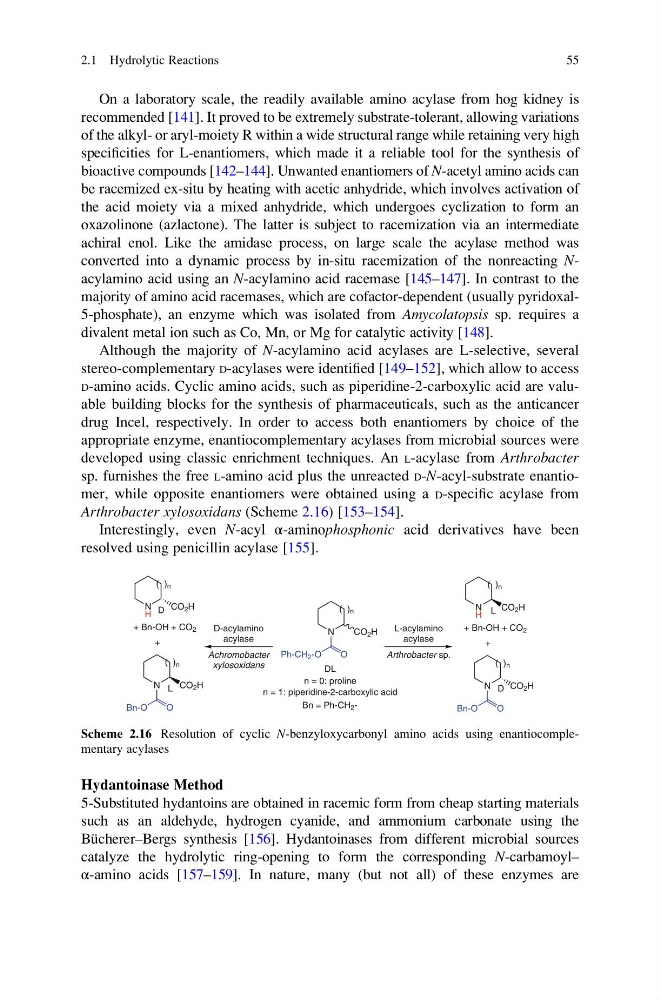
Although the majority of N-acylamino acid acylases are L-selective, several
stereo-complementary D-acylases were identified [149–152], which allow to access
D-amino acids. Cyclic amino acids, such as piperidine-2-carboxylic acid are valuable building blocks for the synthesis of pharmaceuticals, such as the anticancer
drug Incel, respectively. In order to access both enantiomers by choice of the
appropriate enzyme, enantiocomplementary acylases from microbial sources were
developed using classic enrichment techniques. An L-acylase from Arthrobacter
sp. furnishes the free L-amino acid plus the unreacted D-N-acyl-substrate enantiomer, while opposite enantiomers were obtained using a D-specific acylase from
Arthrobacter xylosoxidans (Scheme 2.16) [153–154].
Interestingly, even N-acyl α-aminophosphonic acid derivatives have been
resolved using penicillin acylase [155].
Hydantoinase Method
5-Substituted hydantoins are obtained in racemic form from cheap starting materials
such as an aldehyde, hydrogen cyanide, and ammonium carbonate using the
Bücherer–Bergs synthesis [156]. Hydantoinases from different microbial sources
catalyze the hydrolytic ring-opening to form the corresponding N-carbamoyl–
α-amino acids [157–159]. In nature, many (but not all) of these enzymes are
CO 2 H
Ph-CH 2 -O
O
N
CO 2 H
Bn-O
O
N
CO 2 H
Bn-O
O
N
CO 2 H
N
H
CO 2 H
N
H
n = 1: piperidine-2-carboxylic acid
n = 0: proline
( ) n
( ) n
( ) n
( ) n
( ) n
+
+ Bn-OH + CO 2
L
D-acylamino
acylase
Achromobacter
xylosoxidans
L-acylamino
acylase
Arthrobacter sp.
DL
+
+ Bn-OH + CO 2
L
D
D
Bn = Ph-CH 2 -
Scheme 2.16 Resolution of cyclic N-benzyloxycarbonyl amino acids using enantiocomplementary acylases
2.1 Hydrolytic Reactions
55
recommended [141]. It proved to be extremely substrate-tolerant, allowing variations
of the alkyl- or aryl-moiety R within a wide structural range while retaining very high
specificities for L-enantiomers, which made it a reliable tool for the synthesis of
bioactive compounds [142–144]. Unwanted enantiomers of N-acetyl amino acids can
be racemized ex-situ by heating with acetic anhydride, which involves activation of
the acid moiety via a mixed anhydride, which undergoes cyclization to form an
oxazolinone (azlactone). The latter is subject to racemization via an intermediate
achiral enol. Like the amidase process, on large scale the acylase method was
converted into a dynamic process by in-situ racemization of the nonreacting Nacylamino acid using an N-acylamino acid racemase [145–147]. In contrast to the
majority of amino acid racemases, which are cofactor-dependent (usually pyridoxal5-phosphate), an enzyme which was isolated from Amycolatopsis sp. requires a
divalent metal ion such as Co, Mn, or Mg for catalytic activity [148].
Although the majority of N-acylamino acid acylases are L-selective, several
stereo-complementary D-acylases were identified [149–152], which allow to access
D-amino acids. Cyclic amino acids, such as piperidine-2-carboxylic acid are valuable building blocks for the synthesis of pharmaceuticals, such as the anticancer
drug Incel, respectively. In order to access both enantiomers by choice of the
appropriate enzyme, enantiocomplementary acylases from microbial sources were
developed using classic enrichment techniques. An L-acylase from Arthrobacter
sp. furnishes the free L-amino acid plus the unreacted D-N-acyl-substrate enantiomer, while opposite enantiomers were obtained using a D-specific acylase from
Arthrobacter xylosoxidans (Scheme 2.16) [153–154].
Interestingly, even N-acyl α-aminophosphonic acid derivatives have been
resolved using penicillin acylase [155].
Hydantoinase Method
5-Substituted hydantoins are obtained in racemic form from cheap starting materials
such as an aldehyde, hydrogen cyanide, and ammonium carbonate using the
Bücherer–Bergs synthesis [156]. Hydantoinases from different microbial sources
catalyze the hydrolytic ring-opening to form the corresponding N-carbamoyl–
α-amino acids [157–159]. In nature, many (but not all) of these enzymes are
CO 2 H
Ph-CH 2 -O
O
N
CO 2 H
Bn-O
O
N
CO 2 H
Bn-O
O
N
CO 2 H
N
H
CO 2 H
N
H
n = 1: piperidine-2-carboxylic acid
n = 0: proline
( ) n
( ) n
( ) n
( ) n
( ) n
+
+ Bn-OH + CO 2
L
D-acylamino
acylase
Achromobacter
xylosoxidans
L-acylamino
acylase
Arthrobacter sp.
DL
+
+ Bn-OH + CO 2
L
D
D
Bn = Ph-CH 2 -
Scheme 2.16 Resolution of cyclic N-benzyloxycarbonyl amino acids using enantiocomplementary acylases
2.1 Hydrolytic Reactions
55