

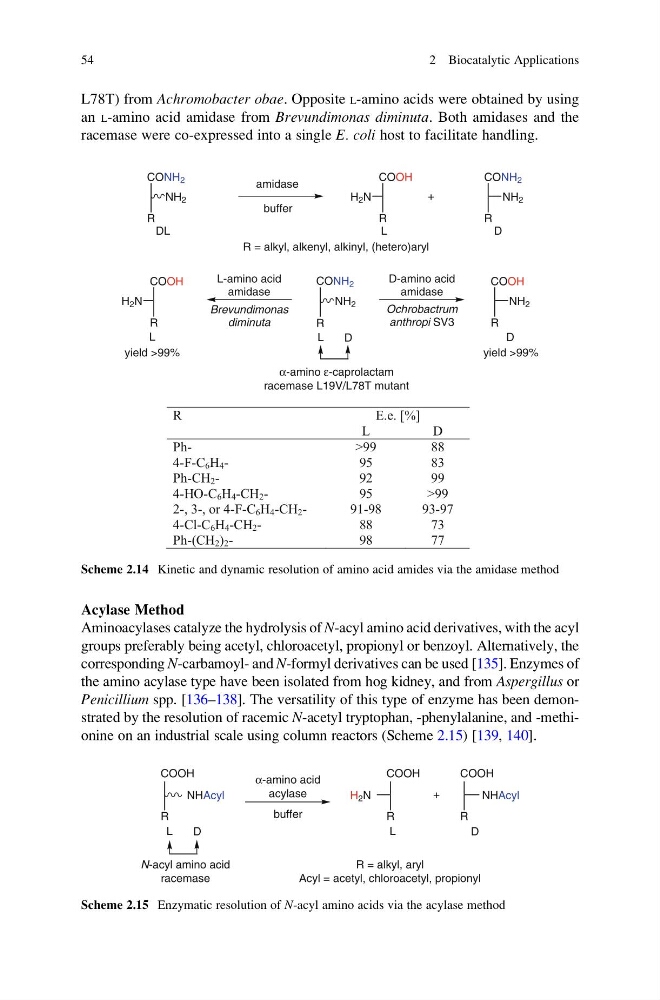
L78T) from Achromobacter obae. Opposite L-amino acids were obtained by using
an L-amino acid amidase from Brevundimonas diminuta. Both amidases and the
racemase were co-expressed into a single E. coli host to facilitate handling.
Acylase Method
Aminoacylases catalyze the hydrolysis of N-acyl amino acid derivatives, with the acyl
groups preferably being acetyl, chloroacetyl, propionyl or benzoyl. Alternatively, the
corresponding N-carbamoyl- and N-formyl derivatives can be used [135]. Enzymes of
the amino acylase type have been isolated from hog kidney, and from Aspergillus or
Penicillium spp. [136–138]. The versatility of this type of enzyme has been demonstrated by the resolution of racemic N-acetyl tryptophan, -phenylalanine, and -methionine on an industrial scale using column reactors (Scheme 2.15) [139, 140].
NH 2
R
CONH 2
NH 2
R
CONH 2
H 2 N
R
COOH
amidase
buffer
+
DL
L
R = alkyl, alkenyl, alkinyl, (hetero)aryl
D
NH 2
R
CONH 2
H 2 N
R
COOH
L
NH 2
R
COOH
D
D-amino acid
amidase
L-amino acid
amidase
L
D
α-amino ε-caprolactam
racemase L19V/L78T mutant
yield >99%
yield >99%
Ochrobactrum
anthropi SV3
Brevundimonas
diminuta
R
E.e. [%]
L
D
Ph>99
88
4-F-C 6 H 4 -
9 5
8 3
Ph-CH 2 -
9 2
9 9
4-HO-C 6 H 4 -CH 2 -
9 5
> 9 9
2-, 3-, or 4-F-C 6 H 4 -CH 2 -
91-98
93-97
4-Cl-C 6 H 4 -CH 2 -
8 8
7 3
Ph-(CH 2 ) 2 -
9 8
7 7
Scheme 2.14 Kinetic and dynamic resolution of amino acid amides via the amidase method
H 2 N
R
COOH
NHAcyl
R
COOH
NHAcyl
R
COOH
R = alkyl, aryl
Acyl = acetyl, chloroacetyl, propionyl
L
+
buffer
α-amino acid
acylase
D
L
D
N-acyl amino acid
racemase
Scheme 2.15 Enzymatic resolution of N-acyl amino acids via the acylase method
54
2 Biocatalytic Applications
an L-amino acid amidase from Brevundimonas diminuta. Both amidases and the
racemase were co-expressed into a single E. coli host to facilitate handling.
Acylase Method
Aminoacylases catalyze the hydrolysis of N-acyl amino acid derivatives, with the acyl
groups preferably being acetyl, chloroacetyl, propionyl or benzoyl. Alternatively, the
corresponding N-carbamoyl- and N-formyl derivatives can be used [135]. Enzymes of
the amino acylase type have been isolated from hog kidney, and from Aspergillus or
Penicillium spp. [136–138]. The versatility of this type of enzyme has been demonstrated by the resolution of racemic N-acetyl tryptophan, -phenylalanine, and -methionine on an industrial scale using column reactors (Scheme 2.15) [139, 140].
NH 2
R
CONH 2
NH 2
R
CONH 2
H 2 N
R
COOH
amidase
buffer
+
DL
L
R = alkyl, alkenyl, alkinyl, (hetero)aryl
D
NH 2
R
CONH 2
H 2 N
R
COOH
L
NH 2
R
COOH
D
D-amino acid
amidase
L-amino acid
amidase
L
D
α-amino ε-caprolactam
racemase L19V/L78T mutant
yield >99%
yield >99%
Ochrobactrum
anthropi SV3
Brevundimonas
diminuta
R
E.e. [%]
L
D
Ph>99
88
4-F-C 6 H 4 -
9 5
8 3
Ph-CH 2 -
9 2
9 9
4-HO-C 6 H 4 -CH 2 -
9 5
> 9 9
2-, 3-, or 4-F-C 6 H 4 -CH 2 -
91-98
93-97
4-Cl-C 6 H 4 -CH 2 -
8 8
7 3
Ph-(CH 2 ) 2 -
9 8
7 7
Scheme 2.14 Kinetic and dynamic resolution of amino acid amides via the amidase method
H 2 N
R
COOH
NHAcyl
R
COOH
NHAcyl
R
COOH
R = alkyl, aryl
Acyl = acetyl, chloroacetyl, propionyl
L
+
buffer
α-amino acid
acylase
D
L
D
N-acyl amino acid
racemase
Scheme 2.15 Enzymatic resolution of N-acyl amino acids via the acylase method
54
2 Biocatalytic Applications