

Amidase Method
α-Amino acid amides are hydrolyzed enantioselectively by amino acid amidases
(occasionally also termed aminopeptidases) obtained from various sources, such
as kidney and pancreas [129] and from different microorganisms, in particular
Pseudomonas, Aspergillus, or Rhodococcus spp. (Scheme 2.14, top) [130]. For
industrial applications, special amidases (e.g., from Mycobacterium neoaurum
and Ochrobactrum anthropi) have been developed [131, 132]. They are also accept
α-substituted α-amino acid amides, which are otherwise not easily hydrolyzed due
to steric hindrance [108]. Unreacted D-amino acid amides can be separated from the
L-amino acids by extraction into organic solvents due to their different solubility at
various pH. After separation, unreacted D-amino acid amides can be recycled
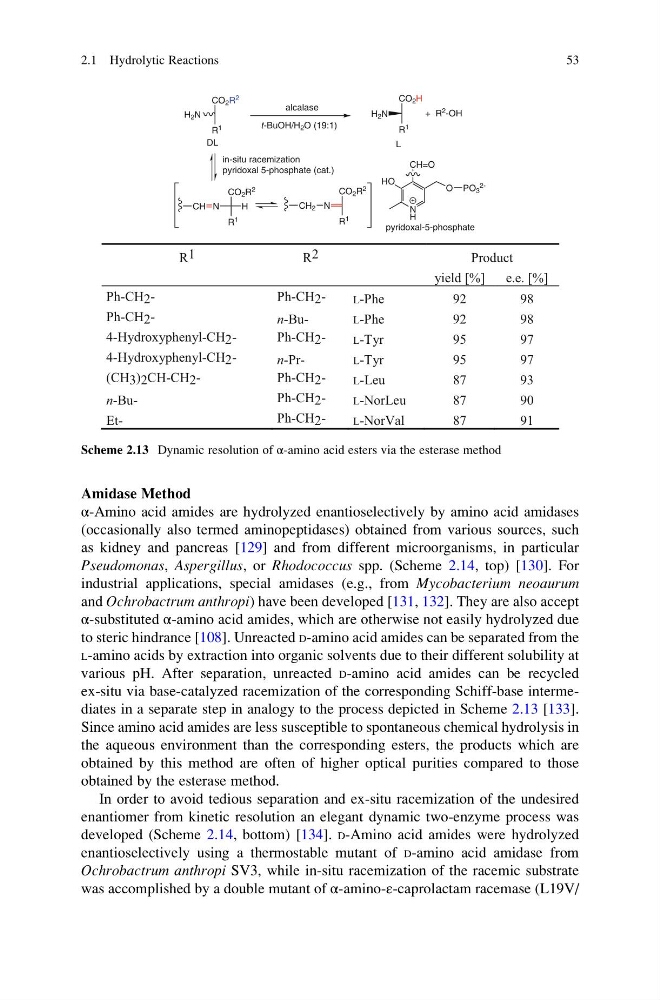
ex-situ via base-catalyzed racemization of the corresponding Schiff-base intermediates in a separate step in analogy to the process depicted in Scheme 2.13 [133].
Since amino acid amides are less susceptible to spontaneous chemical hydrolysis in
the aqueous environment than the corresponding esters, the products which are
obtained by this method are often of higher optical purities compared to those
obtained by the esterase method.
In order to avoid tedious separation and ex-situ racemization of the undesired
enantiomer from kinetic resolution an elegant dynamic two-enzyme process was
developed (Scheme 2.14, bottom) [134]. D-Amino acid amides were hydrolyzed
enantioselectively using a thermostable mutant of D-amino acid amidase from
Ochrobactrum anthropi SV3, while in-situ racemization of the racemic substrate
was accomplished by a double mutant of α-amino-ε-caprolactam racemase (L19V/
H 2 N
R 1
CO 2 H
H 2 N
R
1
CO 2 R
2
CH 2 N
R
1
CO 2 R
2
H
CH N
R
1
CO 2 R
2
PO 3
2O
CH=O
HO
L
DL
+ R 2 -OH
pyridoxal-5-phosphate
in-situ racemization
pyridoxal 5-phosphate (cat.)
alcalase
t-BuOH/H 2 O (19:1)
N
H
R 1
R 2
Product
yield [%]
e.e. [%]
Ph-CH 2 -
P h - C H 2 -
L-Phe
92
98
Ph-CH 2 -
n-BuL-Phe
92
98
4-Hydroxyphenyl-CH 2 -
P h - C H 2 -
L-Tyr
95
97
4-Hydroxyphenyl-CH 2 -
n-PrL-Tyr
95
97
(CH 3 ) 2 CH-CH 2 -
P h - C H 2 -
L-Leu
87
93
n-BuPh-CH 2 -
L-NorLeu
87
90
EtPh-CH 2 -
L-NorVal
87
91
Scheme 2.13 Dynamic resolution of α-amino acid esters via the esterase method
2.1 Hydrolytic Reactions
53
α-Amino acid amides are hydrolyzed enantioselectively by amino acid amidases
(occasionally also termed aminopeptidases) obtained from various sources, such
as kidney and pancreas [129] and from different microorganisms, in particular
Pseudomonas, Aspergillus, or Rhodococcus spp. (Scheme 2.14, top) [130]. For
industrial applications, special amidases (e.g., from Mycobacterium neoaurum
and Ochrobactrum anthropi) have been developed [131, 132]. They are also accept
α-substituted α-amino acid amides, which are otherwise not easily hydrolyzed due
to steric hindrance [108]. Unreacted D-amino acid amides can be separated from the
L-amino acids by extraction into organic solvents due to their different solubility at
various pH. After separation, unreacted D-amino acid amides can be recycled
ex-situ via base-catalyzed racemization of the corresponding Schiff-base intermediates in a separate step in analogy to the process depicted in Scheme 2.13 [133].
Since amino acid amides are less susceptible to spontaneous chemical hydrolysis in
the aqueous environment than the corresponding esters, the products which are
obtained by this method are often of higher optical purities compared to those
obtained by the esterase method.
In order to avoid tedious separation and ex-situ racemization of the undesired
enantiomer from kinetic resolution an elegant dynamic two-enzyme process was
developed (Scheme 2.14, bottom) [134]. D-Amino acid amides were hydrolyzed
enantioselectively using a thermostable mutant of D-amino acid amidase from
Ochrobactrum anthropi SV3, while in-situ racemization of the racemic substrate
was accomplished by a double mutant of α-amino-ε-caprolactam racemase (L19V/
H 2 N
R 1
CO 2 H
H 2 N
R
1
CO 2 R
2
CH 2 N
R
1
CO 2 R
2
H
CH N
R
1
CO 2 R
2
PO 3
2O
CH=O
HO
L
DL
+ R 2 -OH
pyridoxal-5-phosphate
in-situ racemization
pyridoxal 5-phosphate (cat.)
alcalase
t-BuOH/H 2 O (19:1)
N
H
R 1
R 2
Product
yield [%]
e.e. [%]
Ph-CH 2 -
P h - C H 2 -
L-Phe
92
98
Ph-CH 2 -
n-BuL-Phe
92
98
4-Hydroxyphenyl-CH 2 -
P h - C H 2 -
L-Tyr
95
97
4-Hydroxyphenyl-CH 2 -
n-PrL-Tyr
95
97
(CH 3 ) 2 CH-CH 2 -
P h - C H 2 -
L-Leu
87
93
n-BuPh-CH 2 -
L-NorLeu
87
90
EtPh-CH 2 -
L-NorVal
87
91
Scheme 2.13 Dynamic resolution of α-amino acid esters via the esterase method
2.1 Hydrolytic Reactions
53