

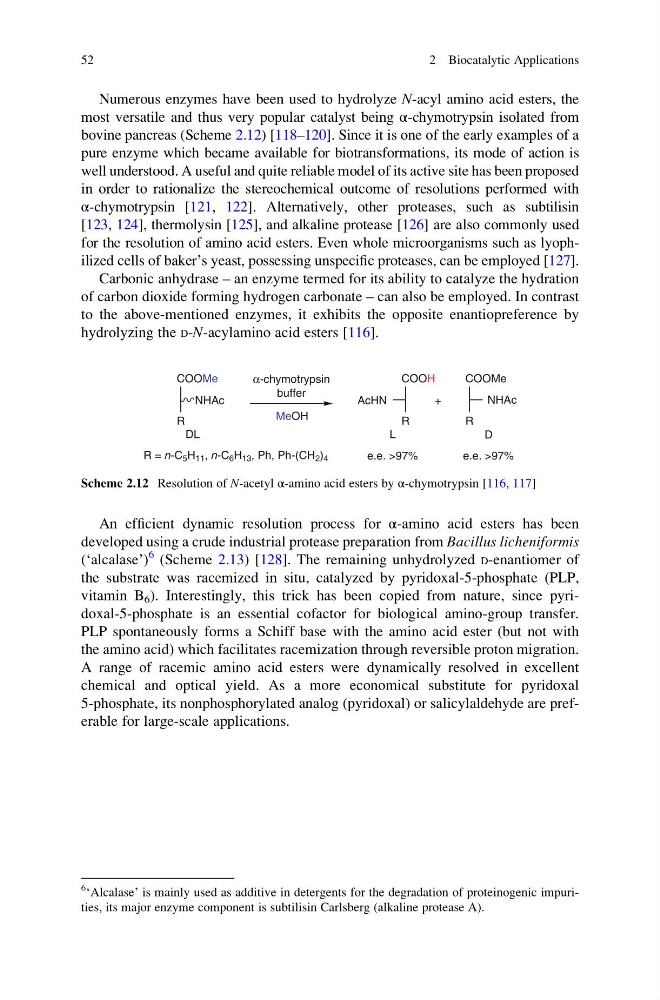
Numerous enzymes have been used to hydrolyze N-acyl amino acid esters, the
most versatile and thus very popular catalyst being α-chymotrypsin isolated from
bovine pancreas (Scheme 2.12) [118–120]. Since it is one of the early examples of a
pure enzyme which became available for biotransformations, its mode of action is
well understood. A useful and quite reliable model of its active site has been proposed
in order to rationalize the stereochemical outcome of resolutions performed with
α-chymotrypsin [121, 122]. Alternatively, other proteases, such as subtilisin
[123, 124], thermolysin [125], and alkaline protease [126] are also commonly used
for the resolution of amino acid esters. Even whole microorganisms such as lyophilized cells of baker’s yeast, possessing unspecific proteases, can be employed [127].
Carbonic anhydrase – an enzyme termed for its ability to catalyze the hydration
of carbon dioxide forming hydrogen carbonate – can also be employed. In contrast
to the above-mentioned enzymes, it exhibits the opposite enantiopreference by
hydrolyzing the D-N-acylamino acid esters [116].
An efficient dynamic resolution process for α-amino acid esters has been
developed using a crude industrial protease preparation from Bacillus licheniformis
(‘alcalase’)
6 (Scheme 2.13) [128]. The remaining unhydrolyzed D-enantiomer of
the substrate was racemized in situ, catalyzed by pyridoxal-5-phosphate (PLP,
vitamin B 6 ). Interestingly, this trick has been copied from nature, since pyridoxal-5-phosphate is an essential cofactor for biological amino-group transfer.
PLP spontaneously forms a Schiff base with the amino acid ester (but not with
the amino acid) which facilitates racemization through reversible proton migration.
A range of racemic amino acid esters were dynamically resolved in excellent
chemical and optical yield. As a more economical substitute for pyridoxal
5-phosphate, its nonphosphorylated analog (pyridoxal) or salicylaldehyde are preferable for large-scale applications.
6 ‘Alcalase’ is mainly used as additive in detergents for the degradation of proteinogenic impurities, its major enzyme component is subtilisin Carlsberg (alkaline protease A).
AcHN
R
COOH
NHAc
R
COOMe
NHAc
R
COOMe
R = n-C 5 H 11 , n-C 6 H 13 , Ph, Ph-(CH 2 ) 4
L
DL
+
α-chymotrypsin
buffer
e.e. >97%
e.e. >97%
D
MeOH
Scheme 2.12 Resolution of N-acetyl α-amino acid esters by α-chymotrypsin [116, 117]
52
2 Biocatalytic Applications
most versatile and thus very popular catalyst being α-chymotrypsin isolated from
bovine pancreas (Scheme 2.12) [118–120]. Since it is one of the early examples of a
pure enzyme which became available for biotransformations, its mode of action is
well understood. A useful and quite reliable model of its active site has been proposed
in order to rationalize the stereochemical outcome of resolutions performed with
α-chymotrypsin [121, 122]. Alternatively, other proteases, such as subtilisin
[123, 124], thermolysin [125], and alkaline protease [126] are also commonly used
for the resolution of amino acid esters. Even whole microorganisms such as lyophilized cells of baker’s yeast, possessing unspecific proteases, can be employed [127].
Carbonic anhydrase – an enzyme termed for its ability to catalyze the hydration
of carbon dioxide forming hydrogen carbonate – can also be employed. In contrast
to the above-mentioned enzymes, it exhibits the opposite enantiopreference by
hydrolyzing the D-N-acylamino acid esters [116].
An efficient dynamic resolution process for α-amino acid esters has been
developed using a crude industrial protease preparation from Bacillus licheniformis
(‘alcalase’)
6 (Scheme 2.13) [128]. The remaining unhydrolyzed D-enantiomer of
the substrate was racemized in situ, catalyzed by pyridoxal-5-phosphate (PLP,
vitamin B 6 ). Interestingly, this trick has been copied from nature, since pyridoxal-5-phosphate is an essential cofactor for biological amino-group transfer.
PLP spontaneously forms a Schiff base with the amino acid ester (but not with
the amino acid) which facilitates racemization through reversible proton migration.
A range of racemic amino acid esters were dynamically resolved in excellent
chemical and optical yield. As a more economical substitute for pyridoxal
5-phosphate, its nonphosphorylated analog (pyridoxal) or salicylaldehyde are preferable for large-scale applications.
6 ‘Alcalase’ is mainly used as additive in detergents for the degradation of proteinogenic impurities, its major enzyme component is subtilisin Carlsberg (alkaline protease A).
AcHN
R
COOH
NHAc
R
COOMe
NHAc
R
COOMe
R = n-C 5 H 11 , n-C 6 H 13 , Ph, Ph-(CH 2 ) 4
L
DL
+
α-chymotrypsin
buffer
e.e. >97%
e.e. >97%
D
MeOH
Scheme 2.12 Resolution of N-acetyl α-amino acid esters by α-chymotrypsin [116, 117]
52
2 Biocatalytic Applications