

substrates are generally not accepted by hydrolases. Thus, enantiopure α-methyl or
α-ethyl amino acids are generally not accessible by these methods, although some
exceptions are known [108, 109].
The recycling of the undesired enantiomer from the kinetic resolution is of
crucial importance particularly on an industrial scale [110]. In the past, amino
acid esters were thermally racemized at about 150–170
C, milder conditions for
the racemization of amino acid amides employed the formation of Schiff bases with
aromatic aldehydes (such as benzaldehyde or salicylaldehyde) (Scheme 2.13).
Nowadays, racemases [111] are used in dynamic resolution processes.
Esterase Method
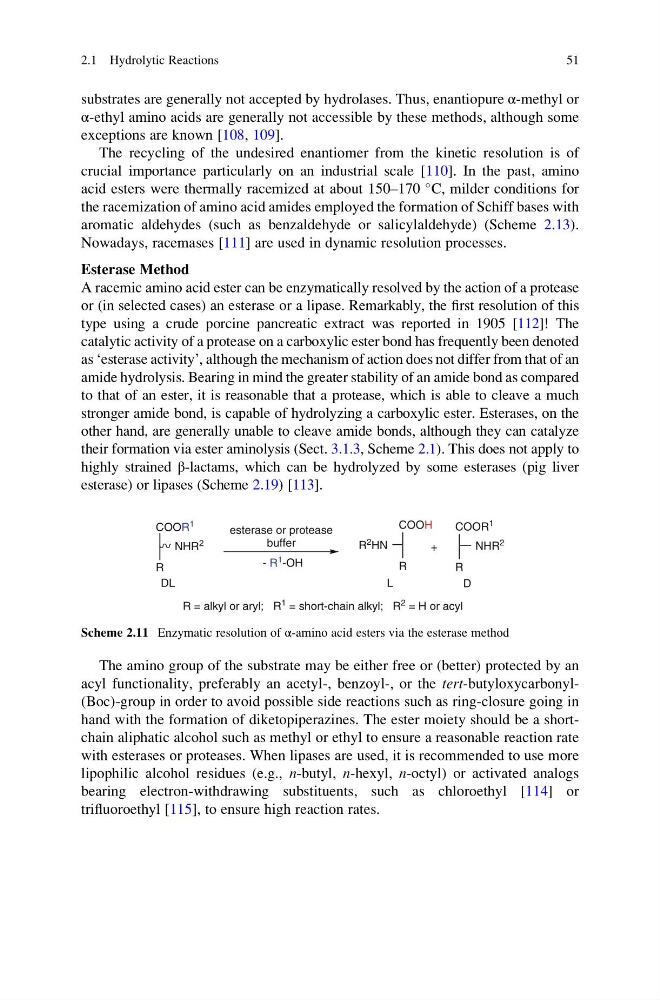
A racemic amino acid ester can be enzymatically resolved by the action of a protease
or (in selected cases) an esterase or a lipase. Remarkably, the first resolution of this
type using a crude porcine pancreatic extract was reported in 1905 [112]! The
catalytic activity of a protease on a carboxylic ester bond has frequently been denoted
as ‘esterase activity’, although the mechanism of action does not differ from that of an
amide hydrolysis. Bearing in mind the greater stability of an amide bond as compared
to that of an ester, it is reasonable that a protease, which is able to cleave a much
stronger amide bond, is capable of hydrolyzing a carboxylic ester. Esterases, on the
other hand, are generally unable to cleave amide bonds, although they can catalyze
their formation via ester aminolysis (Sect. 3.1.3, Scheme 2.1). This does not apply to
highly strained β-lactams, which can be hydrolyzed by some esterases (pig liver
esterase) or lipases (Scheme 2.19) [113].
The amino group of the substrate may be either free or (better) protected by an
acyl functionality, preferably an acetyl-, benzoyl-, or the tert-butyloxycarbonyl(Boc)-group in order to avoid possible side reactions such as ring-closure going in
hand with the formation of diketopiperazines. The ester moiety should be a shortchain aliphatic alcohol such as methyl or ethyl to ensure a reasonable reaction rate
with esterases or proteases. When lipases are used, it is recommended to use more
lipophilic alcohol residues (e.g., n-butyl, n-hexyl, n-octyl) or activated analogs
bearing electron-withdrawing substituents, such as chloroethyl [114] or
trifluoroethyl [115], to ensure high reaction rates.
R
2 HN
R
COOH
NHR 2
R
COOR 1
NHR
2
R
COOR 1
R = alkyl or aryl; R
1 = short-chain alkyl; R
2 = H or acyl
L
DL
+
esterase or protease
buffer
- R 1 -OH
D
Scheme 2.11 Enzymatic resolution of α-amino acid esters via the esterase method
2.1 Hydrolytic Reactions
51
α-ethyl amino acids are generally not accessible by these methods, although some
exceptions are known [108, 109].
The recycling of the undesired enantiomer from the kinetic resolution is of
crucial importance particularly on an industrial scale [110]. In the past, amino
acid esters were thermally racemized at about 150–170
C, milder conditions for
the racemization of amino acid amides employed the formation of Schiff bases with
aromatic aldehydes (such as benzaldehyde or salicylaldehyde) (Scheme 2.13).
Nowadays, racemases [111] are used in dynamic resolution processes.
Esterase Method
A racemic amino acid ester can be enzymatically resolved by the action of a protease
or (in selected cases) an esterase or a lipase. Remarkably, the first resolution of this
type using a crude porcine pancreatic extract was reported in 1905 [112]! The
catalytic activity of a protease on a carboxylic ester bond has frequently been denoted
as ‘esterase activity’, although the mechanism of action does not differ from that of an
amide hydrolysis. Bearing in mind the greater stability of an amide bond as compared
to that of an ester, it is reasonable that a protease, which is able to cleave a much
stronger amide bond, is capable of hydrolyzing a carboxylic ester. Esterases, on the
other hand, are generally unable to cleave amide bonds, although they can catalyze
their formation via ester aminolysis (Sect. 3.1.3, Scheme 2.1). This does not apply to
highly strained β-lactams, which can be hydrolyzed by some esterases (pig liver
esterase) or lipases (Scheme 2.19) [113].
The amino group of the substrate may be either free or (better) protected by an
acyl functionality, preferably an acetyl-, benzoyl-, or the tert-butyloxycarbonyl(Boc)-group in order to avoid possible side reactions such as ring-closure going in
hand with the formation of diketopiperazines. The ester moiety should be a shortchain aliphatic alcohol such as methyl or ethyl to ensure a reasonable reaction rate
with esterases or proteases. When lipases are used, it is recommended to use more
lipophilic alcohol residues (e.g., n-butyl, n-hexyl, n-octyl) or activated analogs
bearing electron-withdrawing substituents, such as chloroethyl [114] or
trifluoroethyl [115], to ensure high reaction rates.
R
2 HN
R
COOH
NHR 2
R
COOR 1
NHR
2
R
COOR 1
R = alkyl or aryl; R
1 = short-chain alkyl; R
2 = H or acyl
L
DL
+
esterase or protease
buffer
- R 1 -OH
D
Scheme 2.11 Enzymatic resolution of α-amino acid esters via the esterase method
2.1 Hydrolytic Reactions
51