

compounds or components of such agents. For instance, D-phenylglycine and its phydroxy derivative are used for the synthesis of antibiotics such as ampicillin and
amoxicillin, respectively, and D-valine is an essential component of the insecticidal
synthetic pyrethroid fluvalinate (Scheme 2.208).
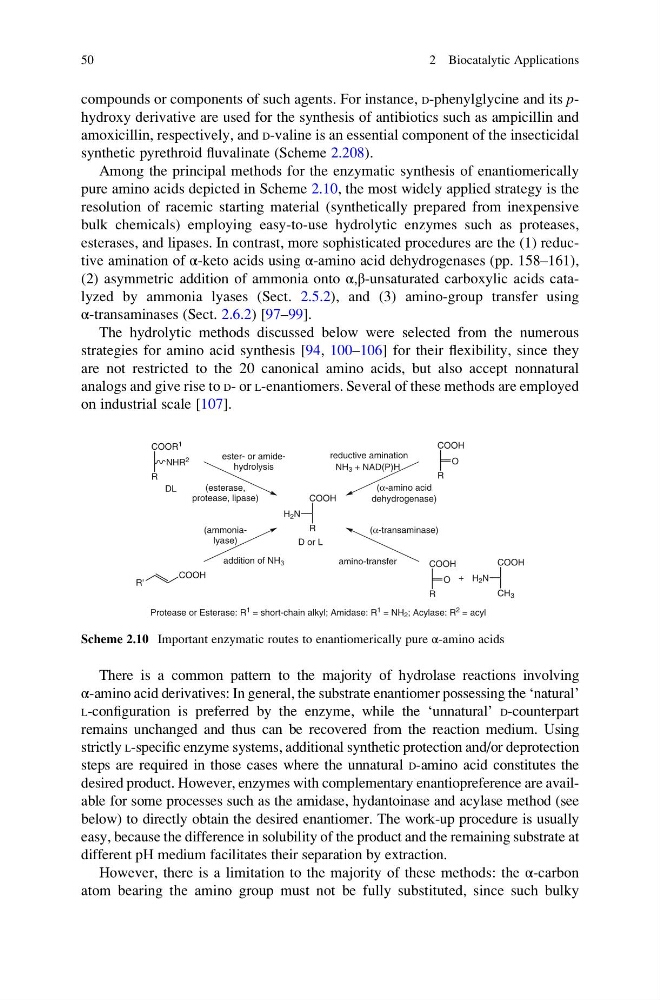
Among the principal methods for the enzymatic synthesis of enantiomerically
pure amino acids depicted in Scheme 2.10, the most widely applied strategy is the
resolution of racemic starting material (synthetically prepared from inexpensive
bulk chemicals) employing easy-to-use hydrolytic enzymes such as proteases,
esterases, and lipases. In contrast, more sophisticated procedures are the (1) reductive amination of α-keto acids using α-amino acid dehydrogenases (pp. 158–161),
(2) asymmetric addition of ammonia onto α,β-unsaturated carboxylic acids catalyzed by ammonia lyases (Sect. 2.5.2), and (3) amino-group transfer using
α-transaminases (Sect. 2.6.2) [97–99].
The hydrolytic methods discussed below were selected from the numerous
strategies for amino acid synthesis [94, 100–106] for their flexibility, since they
are not restricted to the 20 canonical amino acids, but also accept nonnatural
analogs and give rise to D- or L-enantiomers. Several of these methods are employed
on industrial scale [107].
There is a common pattern to the majority of hydrolase reactions involving
α-amino acid derivatives: In general, the substrate enantiomer possessing the ‘natural’
L-configuration is preferred by the enzyme, while the ‘unnatural’ D-counterpart
remains unchanged and thus can be recovered from the reaction medium. Using
strictly L-specific enzyme systems, additional synthetic protection and/or deprotection
steps are required in those cases where the unnatural D-amino acid constitutes the
desired product. However, enzymes with complementary enantiopreference are available for some processes such as the amidase, hydantoinase and acylase method (see
below) to directly obtain the desired enantiomer. The work-up procedure is usually
easy, because the difference in solubility of the product and the remaining substrate at
different pH medium facilitates their separation by extraction.
However, there is a limitation to the majority of these methods: the α-carbon
atom bearing the amino group must not be fully substituted, since such bulky
O
R
COOH
H 2 N
R
COOH
COOH
R'
NHR 2
R
COOR 1
O
R
COOH
CH 3
H 2 N
COOH
reductive amination
NH 3 + NAD(P)H
(ammonialyase)
addition of NH 3
(esterase,
protease, lipase)
Protease or Esterase: R
1 = short-chain alkyl; Amidase: R
1 = NH 2 ; Acylase: R
2 = acyl
D or L
DL
(α-amino acid
dehydrogenase)
+
(α-transaminase)
amino-transfer
ester- or amidehydrolysis
Scheme 2.10 Important enzymatic routes to enantiomerically pure α-amino acids
50
2 Biocatalytic Applications
amoxicillin, respectively, and D-valine is an essential component of the insecticidal
synthetic pyrethroid fluvalinate (Scheme 2.208).
Among the principal methods for the enzymatic synthesis of enantiomerically
pure amino acids depicted in Scheme 2.10, the most widely applied strategy is the
resolution of racemic starting material (synthetically prepared from inexpensive
bulk chemicals) employing easy-to-use hydrolytic enzymes such as proteases,
esterases, and lipases. In contrast, more sophisticated procedures are the (1) reductive amination of α-keto acids using α-amino acid dehydrogenases (pp. 158–161),
(2) asymmetric addition of ammonia onto α,β-unsaturated carboxylic acids catalyzed by ammonia lyases (Sect. 2.5.2), and (3) amino-group transfer using
α-transaminases (Sect. 2.6.2) [97–99].
The hydrolytic methods discussed below were selected from the numerous
strategies for amino acid synthesis [94, 100–106] for their flexibility, since they
are not restricted to the 20 canonical amino acids, but also accept nonnatural
analogs and give rise to D- or L-enantiomers. Several of these methods are employed
on industrial scale [107].
There is a common pattern to the majority of hydrolase reactions involving
α-amino acid derivatives: In general, the substrate enantiomer possessing the ‘natural’
L-configuration is preferred by the enzyme, while the ‘unnatural’ D-counterpart
remains unchanged and thus can be recovered from the reaction medium. Using
strictly L-specific enzyme systems, additional synthetic protection and/or deprotection
steps are required in those cases where the unnatural D-amino acid constitutes the
desired product. However, enzymes with complementary enantiopreference are available for some processes such as the amidase, hydantoinase and acylase method (see
below) to directly obtain the desired enantiomer. The work-up procedure is usually
easy, because the difference in solubility of the product and the remaining substrate at
different pH medium facilitates their separation by extraction.
However, there is a limitation to the majority of these methods: the α-carbon
atom bearing the amino group must not be fully substituted, since such bulky
O
R
COOH
H 2 N
R
COOH
COOH
R'
NHR 2
R
COOR 1
O
R
COOH
CH 3
H 2 N
COOH
reductive amination
NH 3 + NAD(P)H
(ammonialyase)
addition of NH 3
(esterase,
protease, lipase)
Protease or Esterase: R
1 = short-chain alkyl; Amidase: R
1 = NH 2 ; Acylase: R
2 = acyl
D or L
DL
(α-amino acid
dehydrogenase)
+
(α-transaminase)
amino-transfer
ester- or amidehydrolysis
Scheme 2.10 Important enzymatic routes to enantiomerically pure α-amino acids
50
2 Biocatalytic Applications