

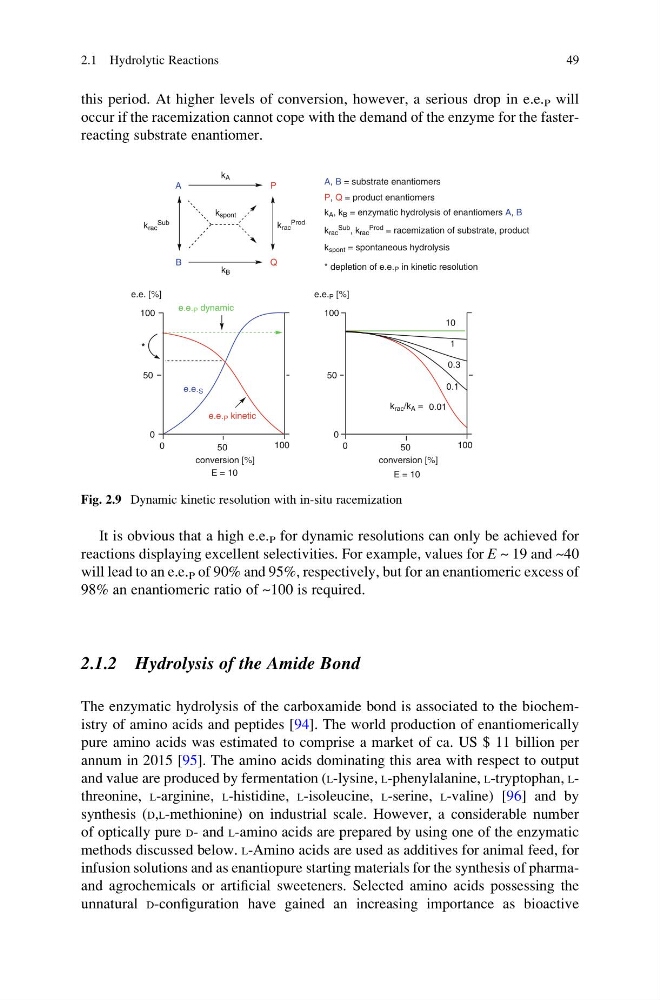
this period. At higher levels of conversion, however, a serious drop in e.e. P will
occur if the racemization cannot cope with the demand of the enzyme for the fasterreacting substrate enantiomer.
It is obvious that a high e.e. P for dynamic resolutions can only be achieved for
reactions displaying excellent selectivities. For example, values for E ~ 19 and ~40
will lead to an e.e. P of 90% and 95%, respectively, but for an enantiomeric excess of
98% an enantiomeric ratio of ~100 is required.
2.1.2 Hydrolysis of the Amide Bond
The enzymatic hydrolysis of the carboxamide bond is associated to the biochemistry of amino acids and peptides [94]. The world production of enantiomerically
pure amino acids was estimated to comprise a market of ca. US $ 11 billion per
annum in 2015 [95]. The amino acids dominating this area with respect to output
and value are produced by fermentation (L-lysine, L-phenylalanine, L-tryptophan, Lthreonine, L-arginine, L-histidine, L-isoleucine, L-serine, L-valine) [96] and by
synthesis (D,L-methionine) on industrial scale. However, a considerable number
of optically pure D- and L-amino acids are prepared by using one of the enzymatic
methods discussed below. L-Amino acids are used as additives for animal feed, for
infusion solutions and as enantiopure starting materials for the synthesis of pharmaand agrochemicals or artificial sweeteners. Selected amino acids possessing the
unnatural D-configuration have gained an increasing importance as bioactive
P, Q = product enantiomers
A, B = substrate enantiomers
k A
k B
k rac
Prod
k rac
Sub
k spont
k A , k B = enzymatic hydrolysis of enantiomers A, B
k rac
Sub , k rac
Prod = racemization of substrate, product
k spont = spontaneous hydrolysis
* depletion of e.e. P in kinetic resolution
A
B
P
Q
10
k rac /k A = 0.01
0.1
0.3
1
50
50
e.e. P [%]
100
0
0
100
E = 10
conversion [%]
conversion [%]
E = 10
e.e. S
100
0
0
100
e.e. [%]
50
50
*
e.e. P kinetic
e.e. P dynamic
Fig. 2.9 Dynamic kinetic resolution with in-situ racemization
2.1 Hydrolytic Reactions
49
occur if the racemization cannot cope with the demand of the enzyme for the fasterreacting substrate enantiomer.
It is obvious that a high e.e. P for dynamic resolutions can only be achieved for
reactions displaying excellent selectivities. For example, values for E ~ 19 and ~40
will lead to an e.e. P of 90% and 95%, respectively, but for an enantiomeric excess of
98% an enantiomeric ratio of ~100 is required.
2.1.2 Hydrolysis of the Amide Bond
The enzymatic hydrolysis of the carboxamide bond is associated to the biochemistry of amino acids and peptides [94]. The world production of enantiomerically
pure amino acids was estimated to comprise a market of ca. US $ 11 billion per
annum in 2015 [95]. The amino acids dominating this area with respect to output
and value are produced by fermentation (L-lysine, L-phenylalanine, L-tryptophan, Lthreonine, L-arginine, L-histidine, L-isoleucine, L-serine, L-valine) [96] and by
synthesis (D,L-methionine) on industrial scale. However, a considerable number
of optically pure D- and L-amino acids are prepared by using one of the enzymatic
methods discussed below. L-Amino acids are used as additives for animal feed, for
infusion solutions and as enantiopure starting materials for the synthesis of pharmaand agrochemicals or artificial sweeteners. Selected amino acids possessing the
unnatural D-configuration have gained an increasing importance as bioactive
P, Q = product enantiomers
A, B = substrate enantiomers
k A
k B
k rac
Prod
k rac
Sub
k spont
k A , k B = enzymatic hydrolysis of enantiomers A, B
k rac
Sub , k rac
Prod = racemization of substrate, product
k spont = spontaneous hydrolysis
* depletion of e.e. P in kinetic resolution
A
B
P
Q
10
k rac /k A = 0.01
0.1
0.3
1
50
50
e.e. P [%]
100
0
0
100
E = 10
conversion [%]
conversion [%]
E = 10
e.e. S
100
0
0
100
e.e. [%]
50
50
*
e.e. P kinetic
e.e. P dynamic
Fig. 2.9 Dynamic kinetic resolution with in-situ racemization
2.1 Hydrolytic Reactions
49