

2.1.3 Ester Hydrolysis
2.1.3.1 Esterases and Proteases
In contrast to the large number of readily available microbial lipases, less than a
dozen of true ‘esterases’ – such as pig and horse liver esterases (PLE [182] and
HLE, respectively) – have been used to perform the bulk of the large number of
highly selective hydrolyses of carboxylic esters. Thus, the use of a different esterase
is not easy in cases where the reaction proceeds with insufficient selectivity with a
popular enzyme such as PLE.
An esterase which has been shown to catalyze the hydrolysis of nonnatural esters
with exceptionally high selectivities is acetylcholine esterase (ACE). It would
certainly be a valuable enzyme to add to the limited number of available esterases
but it has a significant disadvantage since it is isolated from Electrophorus
electricus – the electric eel. Comparing the natural abundance of this species with
the occurrence of horses or pigs, its high price – which is prohibitive for large-scale
applications – is probably justified. Thus, the number of ACE applications is limited
[183–186]. Additionally, also cholesterol esterase is of limited use, since it seems to
prefer bulky substrates which show structural similarities to the natural substrates of
cholesterol esterase, i.e., steroid esters [58, 187].
To overcome this narrow range of readily available esterases, whole microbial
cells are sometimes used instead of isolated enzyme preparations [188]. Although
some highly selective conversions using whole-cell systems have been reported, it
is clear that any optimization by controlling the reaction conditions is very complicated when whole cells are employed, because in most cases the nature of the
actual active enzyme system remains unknown.
More recently, novel microbial esterases [189, 190] such as carboxyl-esterase
NP [191] have been identified from an extensive screening in search for biocatalysts
with high specificities for certain types of substrates. Since they have been made
available in generous amounts by genetic engineering [192], they are now being
O
NH
H 2 N
CO 2 H
O
NH
NH 2
HO 2 C
O
HN
lactamase
Rhodococcus sp.
(-)-cispentacin
+
rac
steps
+
NH
O
H 2 N
D
L
α-amino-ε-caprolactam racemase
L-α-aminoε-caprolactamase
D-α-aminoε-caprolactamase
CO 2 H
(CH 2 ) 4
NH 2
NH 2
CO 2 H
(CH 2 ) 4
NH 2
H 2 N
L-Lys
D-Lys
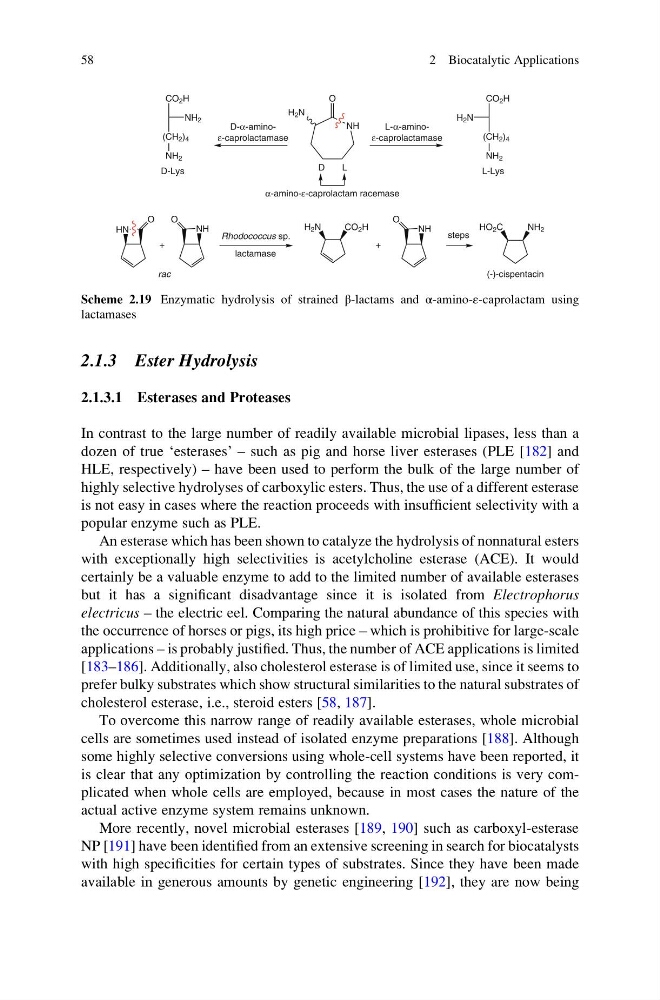
Scheme 2.19 Enzymatic hydrolysis of strained β-lactams and α-amino-ε-caprolactam using
lactamases
58
2 Biocatalytic Applications
2.1.3.1 Esterases and Proteases
In contrast to the large number of readily available microbial lipases, less than a
dozen of true ‘esterases’ – such as pig and horse liver esterases (PLE [182] and
HLE, respectively) – have been used to perform the bulk of the large number of
highly selective hydrolyses of carboxylic esters. Thus, the use of a different esterase
is not easy in cases where the reaction proceeds with insufficient selectivity with a
popular enzyme such as PLE.
An esterase which has been shown to catalyze the hydrolysis of nonnatural esters
with exceptionally high selectivities is acetylcholine esterase (ACE). It would
certainly be a valuable enzyme to add to the limited number of available esterases
but it has a significant disadvantage since it is isolated from Electrophorus
electricus – the electric eel. Comparing the natural abundance of this species with
the occurrence of horses or pigs, its high price – which is prohibitive for large-scale
applications – is probably justified. Thus, the number of ACE applications is limited
[183–186]. Additionally, also cholesterol esterase is of limited use, since it seems to
prefer bulky substrates which show structural similarities to the natural substrates of
cholesterol esterase, i.e., steroid esters [58, 187].
To overcome this narrow range of readily available esterases, whole microbial
cells are sometimes used instead of isolated enzyme preparations [188]. Although
some highly selective conversions using whole-cell systems have been reported, it
is clear that any optimization by controlling the reaction conditions is very complicated when whole cells are employed, because in most cases the nature of the
actual active enzyme system remains unknown.
More recently, novel microbial esterases [189, 190] such as carboxyl-esterase
NP [191] have been identified from an extensive screening in search for biocatalysts
with high specificities for certain types of substrates. Since they have been made
available in generous amounts by genetic engineering [192], they are now being
O
NH
H 2 N
CO 2 H
O
NH
NH 2
HO 2 C
O
HN
lactamase
Rhodococcus sp.
(-)-cispentacin
+
rac
steps
+
NH
O
H 2 N
D
L
α-amino-ε-caprolactam racemase
L-α-aminoε-caprolactamase
D-α-aminoε-caprolactamase
CO 2 H
(CH 2 ) 4
NH 2
NH 2
CO 2 H
(CH 2 ) 4
NH 2
H 2 N
L-Lys
D-Lys
Scheme 2.19 Enzymatic hydrolysis of strained β-lactams and α-amino-ε-caprolactam using
lactamases
58
2 Biocatalytic Applications