

nucleophile: in order to obtain an equilibration constant of K > 10, about 20 M
equivalents of nucleophile versus substrate are sufficient to obtain a virtually
irreversible type of reaction. Other techniques, such as using special cosubstrates
which cause an irreversible type of reaction, are discussed in Sect. 3.1.1.
Sequential Biocatalytic Resolutions For a racemic substrate bearing two chemically and stereochemically identical reactive groups, an enzymatic resolution proceeds through two consecutive steps via an intermediate monoester stage. During the
course of such a reaction the substrate is forced to enter the active site of the enzyme
twice – it is therefore ‘double-selected’. Since each of the selectivities of both of the
sequential steps determine the final optical purity of the product, exceptionally high
selectivities can be achieved by using such a ‘double-sieving’ procedure.
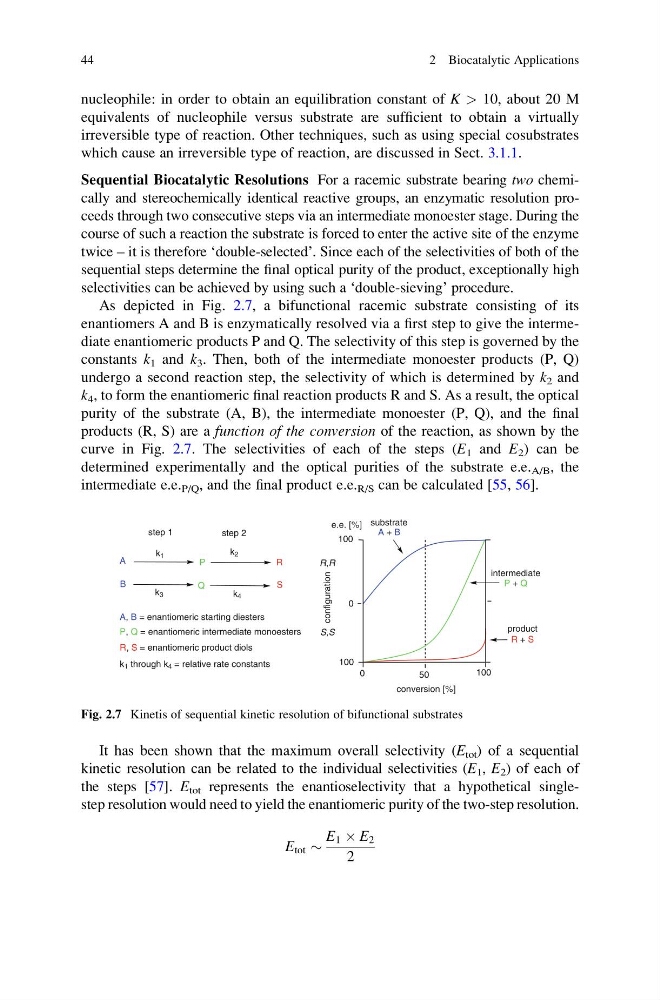
As depicted in Fig. 2.7, a bifunctional racemic substrate consisting of its
enantiomers A and B is enzymatically resolved via a first step to give the intermediate enantiomeric products P and Q. The selectivity of this step is governed by the
constants k 1 and k 3 . Then, both of the intermediate monoester products (P, Q)
undergo a second reaction step, the selectivity of which is determined by k 2 and
k 4 , to form the enantiomeric final reaction products R and S. As a result, the optical
purity of the substrate (A, B), the intermediate monoester (P, Q), and the final
products (R, S) are a function of the conversion of the reaction, as shown by the
curve in Fig. 2.7. The selectivities of each of the steps (E 1 and E 2 ) can be
determined experimentally and the optical purities of the substrate e.e. A/B , the
intermediate e.e. P/Q , and the final product e.e. R/S can be calculated [55, 56].
It has been shown that the maximum overall selectivity (E tot ) of a sequential
kinetic resolution can be related to the individual selectivities (E 1 , E 2 ) of each of
the steps [57]. E tot represents the enantioselectivity that a hypothetical singlestep resolution would need to yield the enantiomeric purity of the two-step resolution.
E tot $
E 1 Â E 2
2
R,R
S,S
100
50
e.e. [%]
conversion [%]
100
0
100
0
A + B
P + Q
R + S
step 2
step 1
k 4
k 3
k 2
k 1
A, B = enantiomeric starting diesters
P, Q = enantiomeric intermediate monoesters
R, S = enantiomeric product diols
k 1 through k 4 = relative rate constants
R
Q
P
S
A
B
substrate
intermediate
product
configuration
Fig. 2.7 Kinetis of sequential kinetic resolution of bifunctional substrates
44
2 Biocatalytic Applications
equivalents of nucleophile versus substrate are sufficient to obtain a virtually
irreversible type of reaction. Other techniques, such as using special cosubstrates
which cause an irreversible type of reaction, are discussed in Sect. 3.1.1.
Sequential Biocatalytic Resolutions For a racemic substrate bearing two chemically and stereochemically identical reactive groups, an enzymatic resolution proceeds through two consecutive steps via an intermediate monoester stage. During the
course of such a reaction the substrate is forced to enter the active site of the enzyme
twice – it is therefore ‘double-selected’. Since each of the selectivities of both of the
sequential steps determine the final optical purity of the product, exceptionally high
selectivities can be achieved by using such a ‘double-sieving’ procedure.
As depicted in Fig. 2.7, a bifunctional racemic substrate consisting of its
enantiomers A and B is enzymatically resolved via a first step to give the intermediate enantiomeric products P and Q. The selectivity of this step is governed by the
constants k 1 and k 3 . Then, both of the intermediate monoester products (P, Q)
undergo a second reaction step, the selectivity of which is determined by k 2 and
k 4 , to form the enantiomeric final reaction products R and S. As a result, the optical
purity of the substrate (A, B), the intermediate monoester (P, Q), and the final
products (R, S) are a function of the conversion of the reaction, as shown by the
curve in Fig. 2.7. The selectivities of each of the steps (E 1 and E 2 ) can be
determined experimentally and the optical purities of the substrate e.e. A/B , the
intermediate e.e. P/Q , and the final product e.e. R/S can be calculated [55, 56].
It has been shown that the maximum overall selectivity (E tot ) of a sequential
kinetic resolution can be related to the individual selectivities (E 1 , E 2 ) of each of
the steps [57]. E tot represents the enantioselectivity that a hypothetical singlestep resolution would need to yield the enantiomeric purity of the two-step resolution.
E tot $
E 1 Â E 2
2
R,R
S,S
100
50
e.e. [%]
conversion [%]
100
0
100
0
A + B
P + Q
R + S
step 2
step 1
k 4
k 3
k 2
k 1
A, B = enantiomeric starting diesters
P, Q = enantiomeric intermediate monoesters
R, S = enantiomeric product diols
k 1 through k 4 = relative rate constants
R
Q
P
S
A
B
substrate
intermediate
product
configuration
Fig. 2.7 Kinetis of sequential kinetic resolution of bifunctional substrates
44
2 Biocatalytic Applications