

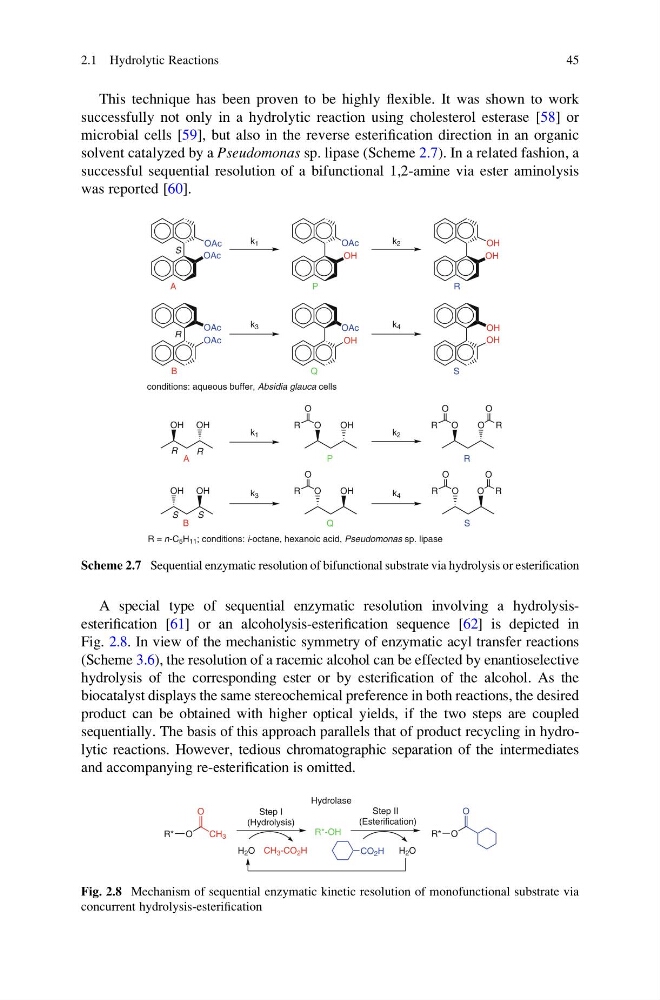
This technique has been proven to be highly flexible. It was shown to work
successfully not only in a hydrolytic reaction using cholesterol esterase [58] or
microbial cells [59], but also in the reverse esterification direction in an organic
solvent catalyzed by a Pseudomonas sp. lipase (Scheme 2.7). In a related fashion, a
successful sequential resolution of a bifunctional 1,2-amine via ester aminolysis
was reported [60].
A special type of sequential enzymatic resolution involving a hydrolysisesterification [61] or an alcoholysis-esterification sequence [62] is depicted in
Fig. 2.8. In view of the mechanistic symmetry of enzymatic acyl transfer reactions
(Scheme 3.6), the resolution of a racemic alcohol can be effected by enantioselective
hydrolysis of the corresponding ester or by esterification of the alcohol. As the
biocatalyst displays the same stereochemical preference in both reactions, the desired
product can be obtained with higher optical yields, if the two steps are coupled
sequentially. The basis of this approach parallels that of product recycling in hydrolytic reactions. However, tedious chromatographic separation of the intermediates
and accompanying re-esterification is omitted.
O R
O
O
O
R
O R
O
O
O
R
OH
O
O
R
OH
O
O
R
OH OH
OH
OH
OH
OH
OH
OH
OH
OAc
OAc
OH
OAc
OAc
OAc
OAc
k 2
k 4
k 1
k 3
R = n-C 5 H 11 ; conditions: i-octane, hexanoic acid, Pseudomonas sp. lipase
conditions: aqueous buffer, Absidia glauca cells
k 4
k 2
k 3
k 1
S
R
S
S
P
R
B
P
B
A
S
R
A
S
R
Q
R
Q
Scheme 2.7 Sequential enzymatic resolution of bifunctional substrate via hydrolysis or esterification
O
CH 3
O
R*
O
O
R*
Hydrolase
R*-OH
Step I
Step II
(Hydrolysis)
(Esterification)
H 2 O
H 2 O CH 3 -CO 2 H
CO 2 H
Fig. 2.8 Mechanism of sequential enzymatic kinetic resolution of monofunctional substrate via
concurrent hydrolysis-esterification
2.1 Hydrolytic Reactions
45
successfully not only in a hydrolytic reaction using cholesterol esterase [58] or
microbial cells [59], but also in the reverse esterification direction in an organic
solvent catalyzed by a Pseudomonas sp. lipase (Scheme 2.7). In a related fashion, a
successful sequential resolution of a bifunctional 1,2-amine via ester aminolysis
was reported [60].
A special type of sequential enzymatic resolution involving a hydrolysisesterification [61] or an alcoholysis-esterification sequence [62] is depicted in
Fig. 2.8. In view of the mechanistic symmetry of enzymatic acyl transfer reactions
(Scheme 3.6), the resolution of a racemic alcohol can be effected by enantioselective
hydrolysis of the corresponding ester or by esterification of the alcohol. As the
biocatalyst displays the same stereochemical preference in both reactions, the desired
product can be obtained with higher optical yields, if the two steps are coupled
sequentially. The basis of this approach parallels that of product recycling in hydrolytic reactions. However, tedious chromatographic separation of the intermediates
and accompanying re-esterification is omitted.
O R
O
O
O
R
O R
O
O
O
R
OH
O
O
R
OH
O
O
R
OH OH
OH
OH
OH
OH
OH
OH
OH
OAc
OAc
OH
OAc
OAc
OAc
OAc
k 2
k 4
k 1
k 3
R = n-C 5 H 11 ; conditions: i-octane, hexanoic acid, Pseudomonas sp. lipase
conditions: aqueous buffer, Absidia glauca cells
k 4
k 2
k 3
k 1
S
R
S
S
P
R
B
P
B
A
S
R
A
S
R
Q
R
Q
Scheme 2.7 Sequential enzymatic resolution of bifunctional substrate via hydrolysis or esterification
O
CH 3
O
R*
O
O
R*
Hydrolase
R*-OH
Step I
Step II
(Hydrolysis)
(Esterification)
H 2 O
H 2 O CH 3 -CO 2 H
CO 2 H
Fig. 2.8 Mechanism of sequential enzymatic kinetic resolution of monofunctional substrate via
concurrent hydrolysis-esterification
2.1 Hydrolytic Reactions
45