

The equations linking the enantioselectivity of the reaction (the Enantiomeric
Ratio E), the conversion (c), the optical purities of substrate (e.e. S ) and product
(e.e. P ), and the equilibrium constant K are as follows:
For the product
For the substrate
E ¼
ln 1 À 1 þ K
ð
Þc 1 þ e:e: P
ð
Þ
½
ln 1 À 1 þ K
ð
Þc 1 À e:e: P
ð
Þ
½
E ¼
ln 1 À 1 þ K
ð
Þ c þ e:e: S 1 À c
f
g
ð
Þ
½
ln 1 À 1 þ K
ð
Þ c À e:e: S 1 À c
f
g
ð
Þ
½
c ¼ conversion, e:e: ¼ enantiomeric excess of substrate S
ð Þ or product P
ð Þ,
E ¼ Enantiomeric Ratio, K ¼ equilibrium constant of the reaction
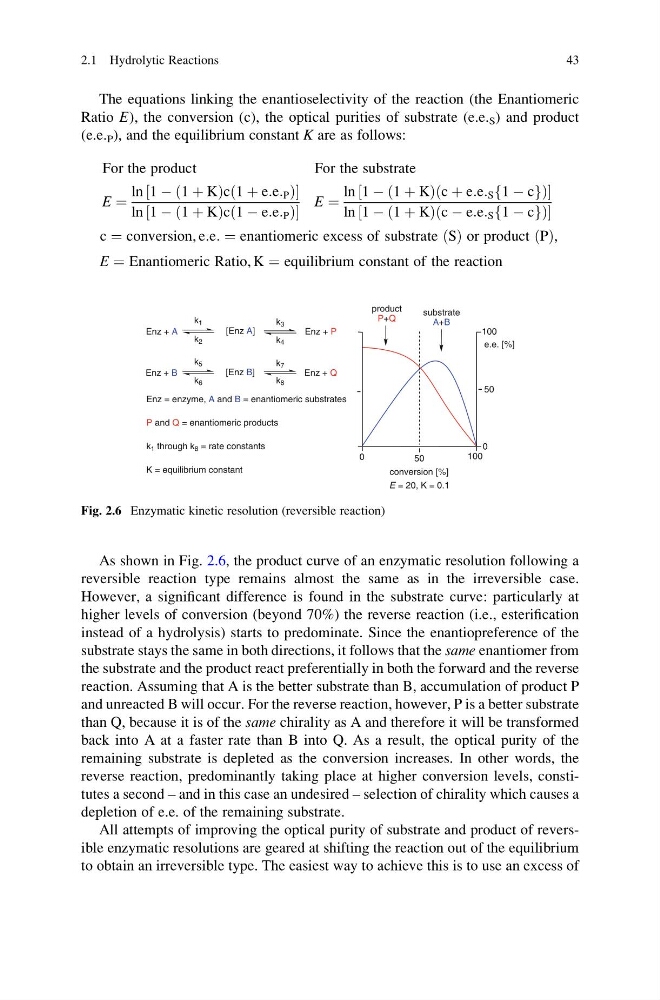
As shown in Fig. 2.6, the product curve of an enzymatic resolution following a
reversible reaction type remains almost the same as in the irreversible case.
However, a significant difference is found in the substrate curve: particularly at
higher levels of conversion (beyond 70%) the reverse reaction (i.e., esterification
instead of a hydrolysis) starts to predominate. Since the enantiopreference of the
substrate stays the same in both directions, it follows that the same enantiomer from
the substrate and the product react preferentially in both the forward and the reverse
reaction. Assuming that A is the better substrate than B, accumulation of product P
and unreacted B will occur. For the reverse reaction, however, P is a better substrate
than Q, because it is of the same chirality as A and therefore it will be transformed
back into A at a faster rate than B into Q. As a result, the optical purity of the
remaining substrate is depleted as the conversion increases. In other words, the
reverse reaction, predominantly taking place at higher conversion levels, constitutes a second – and in this case an undesired – selection of chirality which causes a
depletion of e.e. of the remaining substrate.
All attempts of improving the optical purity of substrate and product of reversible enzymatic resolutions are geared at shifting the reaction out of the equilibrium
to obtain an irreversible type. The easiest way to achieve this is to use an excess of
k 8
k 4
Enz + B
[Enz B]
Enz + Q
k 6
k 7
Enz + A
[Enz A]
Enz + P
k 1
k 2
k 3
Enz = enzyme, A and B = enantiomeric substrates
P and Q = enantiomeric products
k 1 through k 8 = rate constants
K = equilibrium constant
k 5
50
50
e.e. [%]
conversion [%]
100
0
0
100
E = 20, K = 0.1
A+B
P+Q
product
substrate
Fig. 2.6 Enzymatic kinetic resolution (reversible reaction)
2.1 Hydrolytic Reactions
43
Ratio E), the conversion (c), the optical purities of substrate (e.e. S ) and product
(e.e. P ), and the equilibrium constant K are as follows:
For the product
For the substrate
E ¼
ln 1 À 1 þ K
ð
Þc 1 þ e:e: P
ð
Þ
½
ln 1 À 1 þ K
ð
Þc 1 À e:e: P
ð
Þ
½
E ¼
ln 1 À 1 þ K
ð
Þ c þ e:e: S 1 À c
f
g
ð
Þ
½
ln 1 À 1 þ K
ð
Þ c À e:e: S 1 À c
f
g
ð
Þ
½
c ¼ conversion, e:e: ¼ enantiomeric excess of substrate S
ð Þ or product P
ð Þ,
E ¼ Enantiomeric Ratio, K ¼ equilibrium constant of the reaction
As shown in Fig. 2.6, the product curve of an enzymatic resolution following a
reversible reaction type remains almost the same as in the irreversible case.
However, a significant difference is found in the substrate curve: particularly at
higher levels of conversion (beyond 70%) the reverse reaction (i.e., esterification
instead of a hydrolysis) starts to predominate. Since the enantiopreference of the
substrate stays the same in both directions, it follows that the same enantiomer from
the substrate and the product react preferentially in both the forward and the reverse
reaction. Assuming that A is the better substrate than B, accumulation of product P
and unreacted B will occur. For the reverse reaction, however, P is a better substrate
than Q, because it is of the same chirality as A and therefore it will be transformed
back into A at a faster rate than B into Q. As a result, the optical purity of the
remaining substrate is depleted as the conversion increases. In other words, the
reverse reaction, predominantly taking place at higher conversion levels, constitutes a second – and in this case an undesired – selection of chirality which causes a
depletion of e.e. of the remaining substrate.
All attempts of improving the optical purity of substrate and product of reversible enzymatic resolutions are geared at shifting the reaction out of the equilibrium
to obtain an irreversible type. The easiest way to achieve this is to use an excess of
k 8
k 4
Enz + B
[Enz B]
Enz + Q
k 6
k 7
Enz + A
[Enz A]
Enz + P
k 1
k 2
k 3
Enz = enzyme, A and B = enantiomeric substrates
P and Q = enantiomeric products
k 1 through k 8 = rate constants
K = equilibrium constant
k 5
50
50
e.e. [%]
conversion [%]
100
0
0
100
E = 20, K = 0.1
A+B
P+Q
product
substrate
Fig. 2.6 Enzymatic kinetic resolution (reversible reaction)
2.1 Hydrolytic Reactions
43