

the internet [51].
4 As a rule of thumb, enantiomeric ratios below 15 are inacceptable
for practical purposes. They can be regarded as being moderate to good in the range
of 15–30, and above this value they are excellent. However, values of E > 200
cannot be accurately determined due to the inaccuracies emerging from the determination of the enantiomeric excess (e.g., by NMR, HPLC, or GC), because in this
range even an extremely small variation of e.e. S or e.e. P causes a significant change
in the numerical value of E.
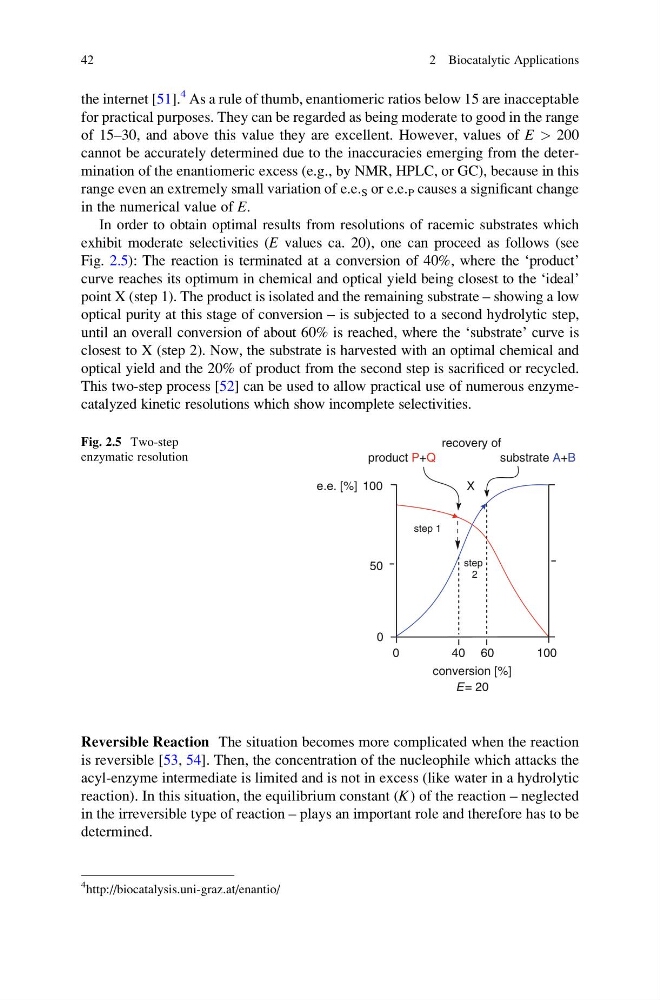
In order to obtain optimal results from resolutions of racemic substrates which
exhibit moderate selectivities (E values ca. 20), one can proceed as follows (see
Fig. 2.5): The reaction is terminated at a conversion of 40%, where the ‘product’
curve reaches its optimum in chemical and optical yield being closest to the ‘ideal’
point X (step 1). The product is isolated and the remaining substrate – showing a low
optical purity at this stage of conversion – is subjected to a second hydrolytic step,
until an overall conversion of about 60% is reached, where the ‘substrate’ curve is
closest to X (step 2). Now, the substrate is harvested with an optimal chemical and
optical yield and the 20% of product from the second step is sacrificed or recycled.
This two-step process [52] can be used to allow practical use of numerous enzymecatalyzed kinetic resolutions which show incomplete selectivities.
Reversible Reaction The situation becomes more complicated when the reaction
is reversible [53, 54]. Then, the concentration of the nucleophile which attacks the
acyl-enzyme intermediate is limited and is not in excess (like water in a hydrolytic
reaction). In this situation, the equilibrium constant (K ) of the reaction – neglected
in the irreversible type of reaction – plays an important role and therefore has to be
determined.
recovery of
60
40
50
e.e. [%]
conversion [%]
100
0
0
1 0 0
E = 20
X
step
2
step 1
product P+Q
substrate A+B
Fig. 2.5 Two-step
enzymatic resolution
4 http://biocatalysis.uni-graz.at/enantio/
42
2 Biocatalytic Applications
4 As a rule of thumb, enantiomeric ratios below 15 are inacceptable
for practical purposes. They can be regarded as being moderate to good in the range
of 15–30, and above this value they are excellent. However, values of E > 200
cannot be accurately determined due to the inaccuracies emerging from the determination of the enantiomeric excess (e.g., by NMR, HPLC, or GC), because in this
range even an extremely small variation of e.e. S or e.e. P causes a significant change
in the numerical value of E.
In order to obtain optimal results from resolutions of racemic substrates which
exhibit moderate selectivities (E values ca. 20), one can proceed as follows (see
Fig. 2.5): The reaction is terminated at a conversion of 40%, where the ‘product’
curve reaches its optimum in chemical and optical yield being closest to the ‘ideal’
point X (step 1). The product is isolated and the remaining substrate – showing a low
optical purity at this stage of conversion – is subjected to a second hydrolytic step,
until an overall conversion of about 60% is reached, where the ‘substrate’ curve is
closest to X (step 2). Now, the substrate is harvested with an optimal chemical and
optical yield and the 20% of product from the second step is sacrificed or recycled.
This two-step process [52] can be used to allow practical use of numerous enzymecatalyzed kinetic resolutions which show incomplete selectivities.
Reversible Reaction The situation becomes more complicated when the reaction
is reversible [53, 54]. Then, the concentration of the nucleophile which attacks the
acyl-enzyme intermediate is limited and is not in excess (like water in a hydrolytic
reaction). In this situation, the equilibrium constant (K ) of the reaction – neglected
in the irreversible type of reaction – plays an important role and therefore has to be
determined.
recovery of
60
40
50
e.e. [%]
conversion [%]
100
0
0
1 0 0
E = 20
X
step
2
step 1
product P+Q
substrate A+B
Fig. 2.5 Two-step
enzymatic resolution
4 http://biocatalysis.uni-graz.at/enantio/
42
2 Biocatalytic Applications