

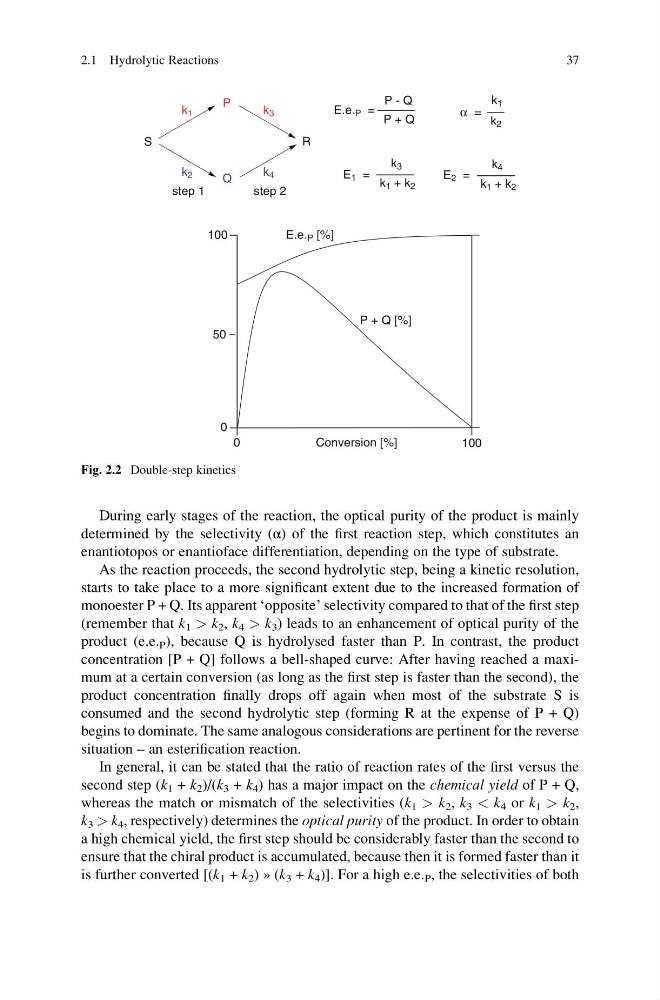
During early stages of the reaction, the optical purity of the product is mainly
determined by the selectivity (α) of the first reaction step, which constitutes an
enantiotopos or enantioface differentiation, depending on the type of substrate.
As the reaction proceeds, the second hydrolytic step, being a kinetic resolution,
starts to take place to a more significant extent due to the increased formation of
monoester P + Q. Its apparent ‘opposite’ selectivity compared to that of the first step
(remember that k 1 > k 2 , k 4 > k 3 ) leads to an enhancement of optical purity of the
product (e.e. P ), because Q is hydrolysed faster than P. In contrast, the product
concentration [P + Q] follows a bell-shaped curve: After having reached a maximum at a certain conversion (as long as the first step is faster than the second), the
product concentration finally drops off again when most of the substrate S is
consumed and the second hydrolytic step (forming R at the expense of P + Q)
begins to dominate. The same analogous considerations are pertinent for the reverse
situation – an esterification reaction.
In general, it can be stated that the ratio of reaction rates of the first versus the
second step (k 1 + k 2 )/(k 3 + k 4 ) has a major impact on the chemical yield of P + Q,
whereas the match or mismatch of the selectivities (k 1 > k 2 , k 3 < k 4 or k 1 > k 2 ,
k 3 > k 4 , respectively) determines the optical purity of the product. In order to obtain
a high chemical yield, the first step should be considerably faster than the second to
ensure that the chiral product is accumulated, because then it is formed faster than it
is further converted [(k 1 + k 2 ) » (k 3 + k 4 )]. For a high e.e. P , the selectivities of both
k 1
k 2
k 3
k 4
E.e. P [%]
100
0
Conversion [%]
P + Q [%]
0
100
50
step 2
step 1
k 1 + k 2
k 4
E 2 =
k 1 + k 2
k 3
E 1 =
E.e. P =
P - Q
P + Q
α =
k 1
k 2
P
S
Q
R
Fig. 2.2 Double-step kinetics
2.1 Hydrolytic Reactions
37
determined by the selectivity (α) of the first reaction step, which constitutes an
enantiotopos or enantioface differentiation, depending on the type of substrate.
As the reaction proceeds, the second hydrolytic step, being a kinetic resolution,
starts to take place to a more significant extent due to the increased formation of
monoester P + Q. Its apparent ‘opposite’ selectivity compared to that of the first step
(remember that k 1 > k 2 , k 4 > k 3 ) leads to an enhancement of optical purity of the
product (e.e. P ), because Q is hydrolysed faster than P. In contrast, the product
concentration [P + Q] follows a bell-shaped curve: After having reached a maximum at a certain conversion (as long as the first step is faster than the second), the
product concentration finally drops off again when most of the substrate S is
consumed and the second hydrolytic step (forming R at the expense of P + Q)
begins to dominate. The same analogous considerations are pertinent for the reverse
situation – an esterification reaction.
In general, it can be stated that the ratio of reaction rates of the first versus the
second step (k 1 + k 2 )/(k 3 + k 4 ) has a major impact on the chemical yield of P + Q,
whereas the match or mismatch of the selectivities (k 1 > k 2 , k 3 < k 4 or k 1 > k 2 ,
k 3 > k 4 , respectively) determines the optical purity of the product. In order to obtain
a high chemical yield, the first step should be considerably faster than the second to
ensure that the chiral product is accumulated, because then it is formed faster than it
is further converted [(k 1 + k 2 ) » (k 3 + k 4 )]. For a high e.e. P , the selectivities of both
k 1
k 2
k 3
k 4
E.e. P [%]
100
0
Conversion [%]
P + Q [%]
0
100
50
step 2
step 1
k 1 + k 2
k 4
E 2 =
k 1 + k 2
k 3
E 1 =
E.e. P =
P - Q
P + Q
α =
k 1
k 2
P
S
Q
R
Fig. 2.2 Double-step kinetics
2.1 Hydrolytic Reactions
37