

steps should match each other (k 1 > k 2 , k 4 > k 3 ), i.e., if P is formed predominantly
in the first step from S, it should react at a slower rate than Q in the second step.
Figure 2.2 shows a typical example of such a double-step process, where the first
step is about ten times faster than the second, with selectivities matching (k 1 ¼ 100,
k 2 ¼ 10, k 3 ¼ 1, k 4 ¼ 10).
In addition to trial-and-error experiments (i.e., by stopping such double-step
reactions at various intervals and checking the yield and optical purity of the
product), the e.e.-conversion dependence may also be calculated [33]. The validity
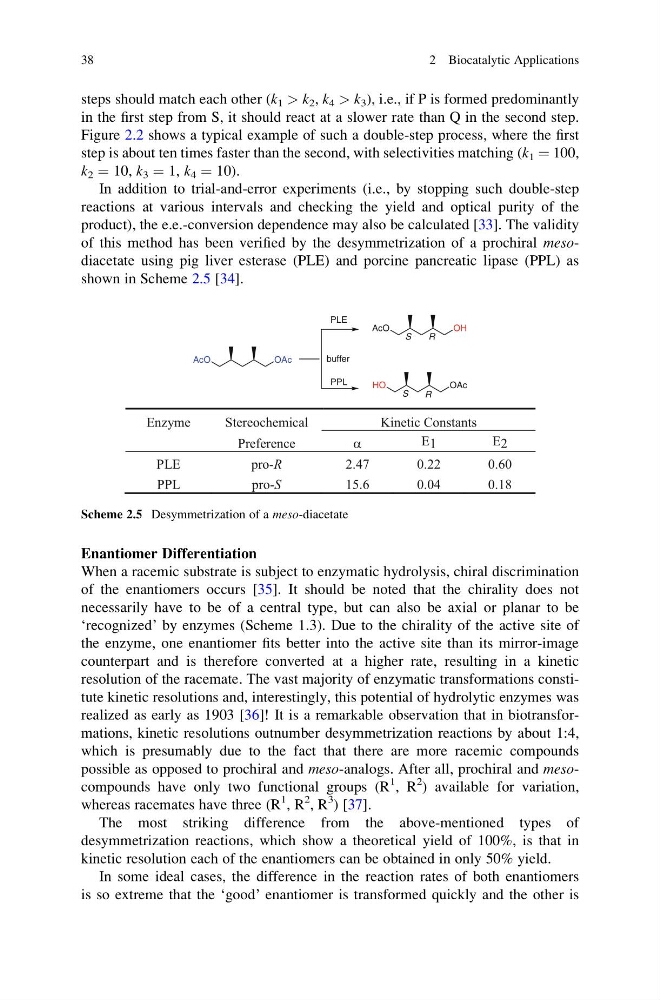
of this method has been verified by the desymmetrization of a prochiral mesodiacetate using pig liver esterase (PLE) and porcine pancreatic lipase (PPL) as
shown in Scheme 2.5 [34].
Enantiomer Differentiation
When a racemic substrate is subject to enzymatic hydrolysis, chiral discrimination
of the enantiomers occurs [35]. It should be noted that the chirality does not
necessarily have to be of a central type, but can also be axial or planar to be
‘recognized’ by enzymes (Scheme 1.3). Due to the chirality of the active site of
the enzyme, one enantiomer fits better into the active site than its mirror-image
counterpart and is therefore converted at a higher rate, resulting in a kinetic
resolution of the racemate. The vast majority of enzymatic transformations constitute kinetic resolutions and, interestingly, this potential of hydrolytic enzymes was
realized as early as 1903 [36]! It is a remarkable observation that in biotransformations, kinetic resolutions outnumber desymmetrization reactions by about 1:4,
which is presumably due to the fact that there are more racemic compounds
possible as opposed to prochiral and meso-analogs. After all, prochiral and mesocompounds have only two functional groups (R
1 , R
2
) available for variation,
whereas racemates have three (R
1 , R
2 , R
3 ) [37].
The most striking difference from the above-mentioned types of
desymmetrization reactions, which show a theoretical yield of 100%, is that in
kinetic resolution each of the enantiomers can be obtained in only 50% yield.
In some ideal cases, the difference in the reaction rates of both enantiomers
is so extreme that the ‘good’ enantiomer is transformed quickly and the other is
OAc
AcO
OH
AcO
OAc
HO
buffer
PLE
PPL
R
S
R
S
Enzyme
Stereochemical
Kinetic Constants
Preference
α
E 1
E 2
PLE
pro-R
2.47
0.22
0.60
PPL
pro-S
15.6
0.04
0.18
Scheme 2.5 Desymmetrization of a meso-diacetate
38
2 Biocatalytic Applications
in the first step from S, it should react at a slower rate than Q in the second step.
Figure 2.2 shows a typical example of such a double-step process, where the first
step is about ten times faster than the second, with selectivities matching (k 1 ¼ 100,
k 2 ¼ 10, k 3 ¼ 1, k 4 ¼ 10).
In addition to trial-and-error experiments (i.e., by stopping such double-step
reactions at various intervals and checking the yield and optical purity of the
product), the e.e.-conversion dependence may also be calculated [33]. The validity
of this method has been verified by the desymmetrization of a prochiral mesodiacetate using pig liver esterase (PLE) and porcine pancreatic lipase (PPL) as
shown in Scheme 2.5 [34].
Enantiomer Differentiation
When a racemic substrate is subject to enzymatic hydrolysis, chiral discrimination
of the enantiomers occurs [35]. It should be noted that the chirality does not
necessarily have to be of a central type, but can also be axial or planar to be
‘recognized’ by enzymes (Scheme 1.3). Due to the chirality of the active site of
the enzyme, one enantiomer fits better into the active site than its mirror-image
counterpart and is therefore converted at a higher rate, resulting in a kinetic
resolution of the racemate. The vast majority of enzymatic transformations constitute kinetic resolutions and, interestingly, this potential of hydrolytic enzymes was
realized as early as 1903 [36]! It is a remarkable observation that in biotransformations, kinetic resolutions outnumber desymmetrization reactions by about 1:4,
which is presumably due to the fact that there are more racemic compounds
possible as opposed to prochiral and meso-analogs. After all, prochiral and mesocompounds have only two functional groups (R
1 , R
2
) available for variation,
whereas racemates have three (R
1 , R
2 , R
3 ) [37].
The most striking difference from the above-mentioned types of
desymmetrization reactions, which show a theoretical yield of 100%, is that in
kinetic resolution each of the enantiomers can be obtained in only 50% yield.
In some ideal cases, the difference in the reaction rates of both enantiomers
is so extreme that the ‘good’ enantiomer is transformed quickly and the other is
OAc
AcO
OH
AcO
OAc
HO
buffer
PLE
PPL
R
S
R
S
Enzyme
Stereochemical
Kinetic Constants
Preference
α
E 1
E 2
PLE
pro-R
2.47
0.22
0.60
PPL
pro-S
15.6
0.04
0.18
Scheme 2.5 Desymmetrization of a meso-diacetate
38
2 Biocatalytic Applications