

irreversible. The kinetics of all of the single-step reactions described above is very
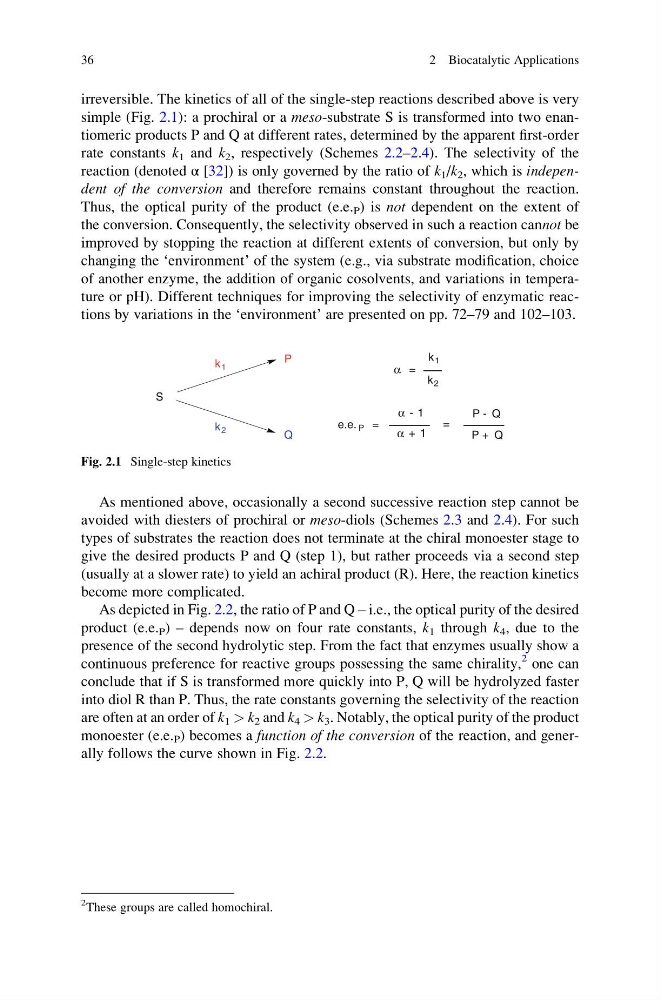
simple (Fig. 2.1): a prochiral or a meso-substrate S is transformed into two enantiomeric products P and Q at different rates, determined by the apparent first-order
rate constants k 1 and k 2 , respectively (Schemes 2.2–2.4). The selectivity of the
reaction (denoted α [32]) is only governed by the ratio of k 1 /k 2 , which is independent of the conversion and therefore remains constant throughout the reaction.
Thus, the optical purity of the product (e.e. P ) is not dependent on the extent of
the conversion. Consequently, the selectivity observed in such a reaction cannot be
improved by stopping the reaction at different extents of conversion, but only by
changing the ‘environment’ of the system (e.g., via substrate modification, choice
of another enzyme, the addition of organic cosolvents, and variations in temperature or pH). Different techniques for improving the selectivity of enzymatic reactions by variations in the ‘environment’ are presented on pp. 72–79 and 102–103.
As mentioned above, occasionally a second successive reaction step cannot be
avoided with diesters of prochiral or meso-diols (Schemes 2.3 and 2.4). For such
types of substrates the reaction does not terminate at the chiral monoester stage to
give the desired products P and Q (step 1), but rather proceeds via a second step
(usually at a slower rate) to yield an achiral product (R). Here, the reaction kinetics
become more complicated.
As depicted in Fig. 2.2, the ratio of P and Q – i.e., the optical purity of the desired
product (e.e. P ) – depends now on four rate constants, k 1 through k 4 , due to the
presence of the second hydrolytic step. From the fact that enzymes usually show a
continuous preference for reactive groups possessing the same chirality,
2 one can
conclude that if S is transformed more quickly into P, Q will be hydrolyzed faster
into diol R than P. Thus, the rate constants governing the selectivity of the reaction
are often at an order of k 1 > k 2 and k 4 > k 3 . Notably, the optical purity of the product
monoester (e.e. P ) becomes a function of the conversion of the reaction, and generally follows the curve shown in Fig. 2.2.
k 2
k 1
α =
k 2
k 1
e.e. P =
=
α - 1
α + 1
P - Q
P + Q
Q
P
S
Fig. 2.1 Single-step kinetics
2 These groups are called homochiral.
36
2 Biocatalytic Applications
simple (Fig. 2.1): a prochiral or a meso-substrate S is transformed into two enantiomeric products P and Q at different rates, determined by the apparent first-order
rate constants k 1 and k 2 , respectively (Schemes 2.2–2.4). The selectivity of the
reaction (denoted α [32]) is only governed by the ratio of k 1 /k 2 , which is independent of the conversion and therefore remains constant throughout the reaction.
Thus, the optical purity of the product (e.e. P ) is not dependent on the extent of
the conversion. Consequently, the selectivity observed in such a reaction cannot be
improved by stopping the reaction at different extents of conversion, but only by
changing the ‘environment’ of the system (e.g., via substrate modification, choice
of another enzyme, the addition of organic cosolvents, and variations in temperature or pH). Different techniques for improving the selectivity of enzymatic reactions by variations in the ‘environment’ are presented on pp. 72–79 and 102–103.
As mentioned above, occasionally a second successive reaction step cannot be
avoided with diesters of prochiral or meso-diols (Schemes 2.3 and 2.4). For such
types of substrates the reaction does not terminate at the chiral monoester stage to
give the desired products P and Q (step 1), but rather proceeds via a second step
(usually at a slower rate) to yield an achiral product (R). Here, the reaction kinetics
become more complicated.
As depicted in Fig. 2.2, the ratio of P and Q – i.e., the optical purity of the desired
product (e.e. P ) – depends now on four rate constants, k 1 through k 4 , due to the
presence of the second hydrolytic step. From the fact that enzymes usually show a
continuous preference for reactive groups possessing the same chirality,
2 one can
conclude that if S is transformed more quickly into P, Q will be hydrolyzed faster
into diol R than P. Thus, the rate constants governing the selectivity of the reaction
are often at an order of k 1 > k 2 and k 4 > k 3 . Notably, the optical purity of the product
monoester (e.e. P ) becomes a function of the conversion of the reaction, and generally follows the curve shown in Fig. 2.2.
k 2
k 1
α =
k 2
k 1
e.e. P =
=
α - 1
α + 1
P - Q
P + Q
Q
P
S
Fig. 2.1 Single-step kinetics
2 These groups are called homochiral.
36
2 Biocatalytic Applications