

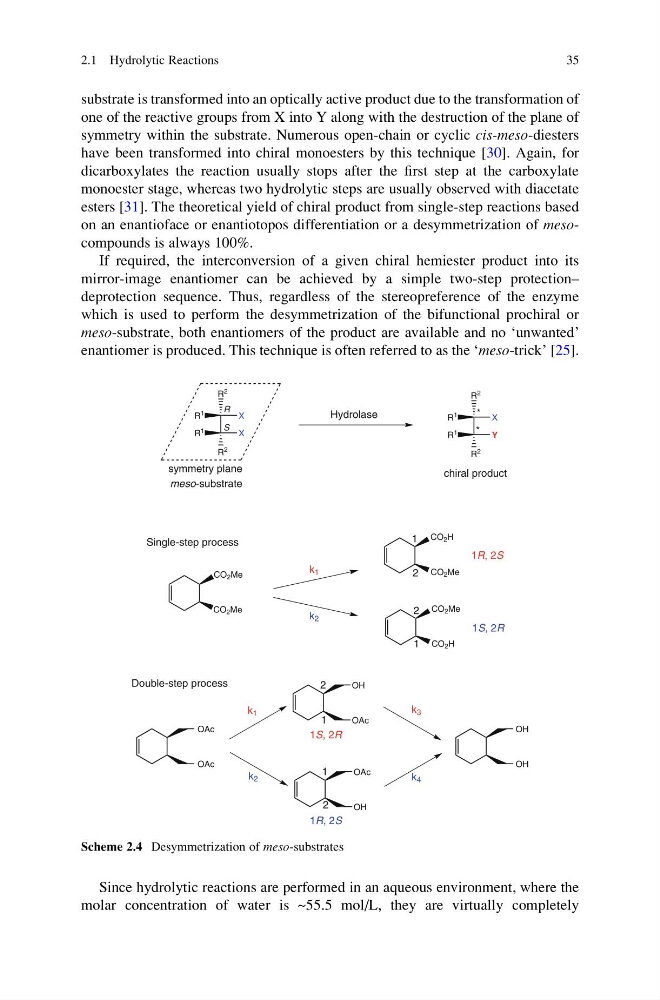
substrate is transformed into an optically active product due to the transformation of
one of the reactive groups from X into Y along with the destruction of the plane of
symmetry within the substrate. Numerous open-chain or cyclic cis-meso-diesters
have been transformed into chiral monoesters by this technique [30]. Again, for
dicarboxylates the reaction usually stops after the first step at the carboxylate
monoester stage, whereas two hydrolytic steps are usually observed with diacetate
esters [31]. The theoretical yield of chiral product from single-step reactions based
on an enantioface or enantiotopos differentiation or a desymmetrization of mesocompounds is always 100%.
If required, the interconversion of a given chiral hemiester product into its
mirror-image enantiomer can be achieved by a simple two-step protection–
deprotection sequence. Thus, regardless of the stereopreference of the enzyme
which is used to perform the desymmetrization of the bifunctional prochiral or
meso-substrate, both enantiomers of the product are available and no ‘unwanted’
enantiomer is produced. This technique is often referred to as the ‘meso-trick’ [25].
Since hydrolytic reactions are performed in an aqueous environment, where the
molar concentration of water is ~55.5 mol/L, they are virtually completely
R
2
R
1
R 1
R
2
X
X
R
2
R
1
R
1
R
2
Y
X
CO 2 Me
CO 2 Me
CO 2 Me
CO 2 H
CO 2 H
CO 2 Me
OAc
OAc
OAc
OH
OH
OAc
OH
OH
meso-substrate
chiral product
k 2
k 1
Hydrolase
1
2
1
2
1R, 2S
1S, 2R
Single-step process
Double-step process
1R, 2S
1S, 2R
1
1
2
2
*
*
symmetry plane
k 4
k 3
k 2
k 1
R
S
Scheme 2.4 Desymmetrization of meso-substrates
2.1 Hydrolytic Reactions
35
one of the reactive groups from X into Y along with the destruction of the plane of
symmetry within the substrate. Numerous open-chain or cyclic cis-meso-diesters
have been transformed into chiral monoesters by this technique [30]. Again, for
dicarboxylates the reaction usually stops after the first step at the carboxylate
monoester stage, whereas two hydrolytic steps are usually observed with diacetate
esters [31]. The theoretical yield of chiral product from single-step reactions based
on an enantioface or enantiotopos differentiation or a desymmetrization of mesocompounds is always 100%.
If required, the interconversion of a given chiral hemiester product into its
mirror-image enantiomer can be achieved by a simple two-step protection–
deprotection sequence. Thus, regardless of the stereopreference of the enzyme
which is used to perform the desymmetrization of the bifunctional prochiral or
meso-substrate, both enantiomers of the product are available and no ‘unwanted’
enantiomer is produced. This technique is often referred to as the ‘meso-trick’ [25].
Since hydrolytic reactions are performed in an aqueous environment, where the
molar concentration of water is ~55.5 mol/L, they are virtually completely
R
2
R
1
R 1
R
2
X
X
R
2
R
1
R
1
R
2
Y
X
CO 2 Me
CO 2 Me
CO 2 Me
CO 2 H
CO 2 H
CO 2 Me
OAc
OAc
OAc
OH
OH
OAc
OH
OH
meso-substrate
chiral product
k 2
k 1
Hydrolase
1
2
1
2
1R, 2S
1S, 2R
Single-step process
Double-step process
1R, 2S
1S, 2R
1
1
2
2
*
*
symmetry plane
k 4
k 3
k 2
k 1
R
S
Scheme 2.4 Desymmetrization of meso-substrates
2.1 Hydrolytic Reactions
35